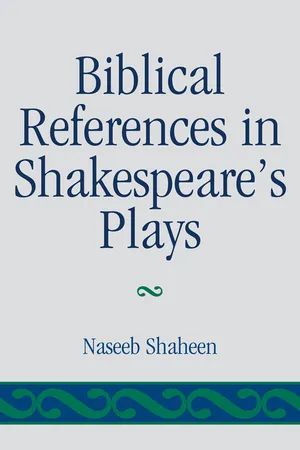
The hundreds of biblical references in Shakespeare's plays give ample evidence that he was well acquainted with Scripture. Not only is the range of his biblical references impressive, but also the aptness with which he makes them. Hamlet and Othello each have more than fifty biblical references. No study of Shakespeare's plays is complete that ignores Shakespeare's use of scripture.
The Bibles that Shakespeare knew, however, were not those that are in use today. By the time the King James Bible appeared in 1611, Shakespeare's career was all but over, and the Anglican liturgy that is evident in his plays is likewise one that few persons are acquainted with. This volume provides a comprehensive survey of the English Bibles of Shakespeare's day, notes their similarities and differences, and indicates which version the playwright knew best. The thorny question of what constitutes a valid biblical reference is also discussed.
This study of Shakespeare's biblical references is not based on secondary sources. The author owned one of the world's largest collections of early English bibles, including over one hundred copies of the Geneva bible and numerous editions of other Bibles, prayer books, and books of homilies of Shakespeare's day.
To be of real worth, a study of Shakespeare's biblical references should also enable the reader to determine which references Shakespeare borrowed from his plot sources and which he added from his own memory as part of his design for the play. The author studies every source that Shakespeare is known to have read or consulted before writing each play and has examined the biblical references in those sources. Shaheen then points out which biblical references in his literary sources Shakespeare accepted, and how he adapted them in his plays. This information is especially valuable when assessing the theological meanings that are sometimes imposed on his plays, meanings that often go beyond what Shakespeare intended or what his audience must have understood.
Biblical References in Shakespeare's Plays is considerably broader in scope than any other study of its kind and provides the scholarly checks and balances in dealing with the subject that previous studies lacked.
- English
- ePUB (mobile friendly)
- Available on iOS & Android
eBook - ePub
Biblical References in Shakespeare's Plays
About this book
Information
Topic
Theology & ReligionSubtopic
BiblesTable of contents
- Introduction
- 1 The English Bible in Shakespeare's Day
- 2 Shakespeare and the Anglican Liturgy
- 3 Criteria for a Valid Reference
- Part I The Comedies
- The Two Gentlemen of Verona
- The Taming of the Shrew
- The Comedy of Errors
- Love's Labor's Lost
- A Midsummer Night's Dream
- The Merchant of Venice
- The Merry Wives of Windsor
- Much Ado About Nothing
- As You Like It
- Twelfth Night
- Measure for Measure
- All's Well That Ends Well
- Part II The History Plays
- 1 Henry VI
- 2 Henry VI
- 3 Henry VI
- Richard III
- Richard II
- King John
- 1 Henry IV
- 2 Henry IV
- Henry V
- Henry VIII
- Part III The Tragedies
- Titus Andronicus
- Romeo and Juliet
- Julius Caesar
- Hamlet
- Troilus and Cressida
- Othello
- King Lear
- Macbeth
- Antony and Cleopatra
- Coriolanus
- Timon of Athens
- Part IV The Romances
- Pericles
- Cymbeline
- The Winter's Tale
- The Tempest
- The Two Noble Kinsmen
- Sir Thomas More
- Appendix A Index to Shakespeare's Biblical References
- Appendix B References to the Book of Common Prayer
- Appendix C References to the Homilies
- Bibliography
Trusted by 375,005 students
Access to over 1.5 million titles for a fair monthly price.
Study more efficiently using our study tools.
Frequently asked questions
Yes, you can cancel anytime from the Subscription tab in your account settings on the Perlego website. Your subscription will stay active until the end of your current billing period. Learn how to cancel your subscription
No, books cannot be downloaded as external files, such as PDFs, for use outside of Perlego. However, you can download books within the Perlego app for offline reading on mobile or tablet. Learn how to download books offline
Perlego offers two plans: Essential and Complete
- Essential is ideal for learners and professionals who enjoy exploring a wide range of subjects. Access the Essential Library with 800,000+ trusted titles and best-sellers across business, personal growth, and the humanities. Includes unlimited reading time and Standard Read Aloud voice.
- Complete: Perfect for advanced learners and researchers needing full, unrestricted access. Unlock 1.5M+ books across hundreds of subjects, including academic and specialized titles. The Complete Plan also includes advanced features like Premium Read Aloud and Research Assistant.
We are an online textbook subscription service, where you can get access to an entire online library for less than the price of a single book per month. With over 1.5 million books across 990+ topics, we’ve got you covered! Learn about our mission
Look out for the read-aloud symbol on your next book to see if you can listen to it. The read-aloud tool reads text aloud for you, highlighting the text as it is being read. You can pause it, speed it up and slow it down. Learn more about Read Aloud
Yes! You can use the Perlego app on both iOS and Android devices to read anytime, anywhere — even offline. Perfect for commutes or when you’re on the go.
Please note we cannot support devices running on iOS 13 and Android 7 or earlier. Learn more about using the app
Please note we cannot support devices running on iOS 13 and Android 7 or earlier. Learn more about using the app
Yes, you can access Biblical References in Shakespeare's Plays by Naseeb Shaheen in PDF and/or ePUB format, as well as other popular books in Theology & Religion & Bibles. We have over 1.5 million books available in our catalogue for you to explore.