eBook - ePub
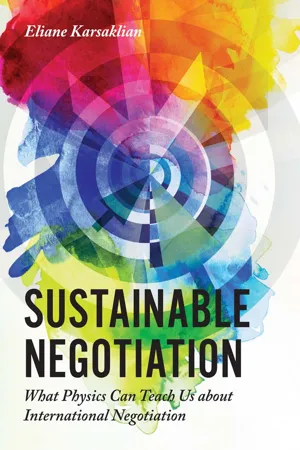
Sustainable Negotiation
What Physics Can Teach Us About International Negotiation
- 120 pages
- English
- ePUB (mobile friendly)
- Available on iOS & Android
eBook - ePub
About this book
This new and innovative book introduces a new approach to negotiation, where 'Sustainable Negotiation' replaces the old notion of winning. Instead of 'doing a deal' and walking away, negotiation becomes a continuous process of solving problems and creating relationships with no term limits, which better reflects the real world today. Just as we strive to create a sustainable approach to the natural world, we need to do the same with people if we want to keep working together and building a more harmonious business world. The book borrows from the field of physics to make the case that negotiators need to know what is not visible so they can explain what is visible. This alignment gives negotiators the tools to think differently about what they see, helping them to look beyond traditional negotiation techniques and to develop a forward-thinking and sustainable approach to business. Written by a leading international negotiation expert, Sustainable Negotiation introduces a completely new perspective on international negotiation, providing practical, field-tested examples, experiments and guidance to enable readers to implement sustainable negotiation in the real world.
Information

Negotiation Is about Energy
Scientific discovery and scientific knowledge have been achieved only by those who have gone in pursuit of them without any practical purpose whatsoever in view.
— Max Planck (1959)
Don’t let this chapter title frighten you! While I have a background in physics, I’m not a physicist — and am betting you aren’t, either. This is a book for business professionals: from CEOs, to lawyers, to pilots, to engineers, to doctors, to salespeople, to anyone who wants to advance in his or her career. You’ll find no arcane or obscure theorems or formulas here.
What you will find is a good example of the evolution of ideas — and how this applies to international negotiation.
Actually, this entire book is a lot about energy. Energy makes objects move forward. It enables people to accomplish things. It sustains efforts in sports, in thinking, in having fun. Negotiating requires effort and energy. Negotiating internationally requires additional effort and energy.
A Brief History of Classical Physics and Quantum Mechanics
Physics — and the idea that energy causes transformation — had its origin in ancient Greece. However, most of us are familiar with the discovery Sir Isaac Newton made in 1686: when the apple fell on his head. This sparked his notion that an object will stay at rest — or continue moving toward the ground at the same speed (velocity) — unless it encounters an outside force. Then he created a number of formulas about how those outside forces affect the velocity of our object. Following up on Galileo’s theory of Earth’s gravity, Newton stated that the same force was being applied to any object, which turned into the law of universal gravitation.
This launched classical physics. Newton’s ideas — and the ones that built upon them — were called “deterministic.” Physicists believed that (1) if you knew the exact positions and the velocities of all particles at a given time, (2) along with how they functioned, then (3) you could determine the future (and past) positions and velocities of all particles at any other time (called their trajectory).
It was all neat and tidy until experiments in the late 1800s and early 1900s started yielding results no one could explain. These forced physicists to look for alternative theories to understand these new outcomes. Ideas and rules about how to move and share energy became the basis of quantum physics.
Newton equated light with water waves: both were made of tiny particles that would bend around obstacles. But Albert Einstein showed there were situations where light behaves as a stream of particles that carry energy. Max Planck’s work with electromagnetic radiation brought the next leap.
Planck discovered that this radiation had the properties of particles and waves. Like a wave, radiation bent around obstacles and openings — which couldn’t be explained by classical physics. Planck introduced the idea of “quantum” or “quanta,” from the Latin “how much,” as units of energy. He saw this as a finite packet of energy that depends on the frequency and velocity of the radiation, which became the root of quantum theory.
Einstein took this forward another step. He explained how magnetism and electricity came from the same electromagnetic force, but they were seen differently in different situations. Based on this principle, he demonstrated that light is not always a wave: it can sometimes act as a particle.
Quantum mechanics sprang from this. Physics needed to abandon the notion of precisely defined trajectories of particles moving through time and space applying to everything. Newton’s ideas worked fine with the behavior of larger bodies — such as yours, or a car, or planets. Instead, when we started talking about subatomic particles (such as electrons), we needed to speak about the “probabilities” that something would happen.
In other words, classical physics operates on a macroscopic level, while quantum mechanics operates on a microscopic level. We needed to use specific tools and equipment to see what the naked eye can’t: microscopes.
This evolution speaks to the duality in physics: matter can be more than one thing at the same time: both waves and particles.
Why There’s a Connection between Physics and Negotiation
After spending most of my career in international negotiation, I’ve noticed there’s a parallel here. Businesspeople have been taught to view negotiation as a competition. This is akin to the classical physics approach of determinism. If you look at the groups involved in a negotiation, and the resources at their disposal, you can determine which will be the winners and which the losers. (We’ll get into the fallacy of win/win shortly.)
Newton stated that an object will stay at rest or continue moving toward the ground at the same speed unless it encounters an outside force. The same thing happens when you are negotiating. You can keep going with your strategy, ideas, and propositions until they hit someone’s objections. Then your offers either change their trajectories to adjust to the objections, or stop as if they had hit a wall. Just as with energy, your propositions are not created or destroyed during a negotiation: they are transformed.
But I believe negotiation has moved beyond this model, with its roots in the western world. Increasing numbers of businesspeople are coming from the Africa, Asian, the Middle Eastern, and South American cultures. Their viewpoints are different. They operate more often with the quantum physics approach of probabilities. This means they can hold what appears to be opposing viewpoints at the same time.
That is why they look unpredictable to most Westerners. Their thinking patterns and their behaviors are not linear and can surprise others by bending around obstacles until they reach their goals. There is no clear-cut position in these cultures as opposed to the American culture, for instance. It is a waste of time to try to determine their trajectory. We can only talk about probabilities of future behaviors.
If American and Western European businesspeople want to remain relevant in the global marketplace, they need to move beyond the classical model of negotiation.
“Classical Negotiation”
Contemporary ideas about negotiation can be traced back to 1981. This is when members of the Harvard Negotiation Project — Roger Fisher and William Ury — wrote Getting to Yes: Negotiating without Giving In. This book is one of the longest running business paperback bestsellers.
Fisher and Ury introduced the idea of “principled negotiation.” This involved having negotiators determine which of their needs were fixed (non-negotiable) and which were variable (open to change). By knowing this, they could agree on solutions that were acceptable to all sides.
They applied a deterministic approach to negotiation. If you knew the exact position of your partners and how their minds worked, you could predict their future behavior and would have no surprises when negotiating with them. The outcome of your negotiation would only depend on the consistency of your own strategy and the way you manage the information you have about your partners.
Principled negotiation is based on these five propositions:
- Separate the people from the problem
- Focus on interests, not positions
- Invent options for mutual gain
- Insist on using objective criteria
- Know your best alternative to negotiated agreement.
Their book also incorporated some negotiating strategy ideas from game theory that are still accepted today: win/win and win/lose.
Win/win strategy has become the norm because it’s politically correct. A negotiator’s goal is to arrive at beneficial outcomes for all parties. Negotiators search for collaboration and are more likely to make concessions and avoid conflicts. It also means that you want to create good relationships with the other side, even if you don’t get as much as you could out of that specific business. The strategy has a long-term orientation.
Win/win tries to be an integrative approach. Objectives, constraints, and the needs of all parties are factored into the process. It also means that one party’s problems become all parties’ problems, to which a common solution should be found. Working together to find solutions to all of these issues means the global gains are bigger and shared by everybody. Negotiators believe that the process and outcomes must be fair for both sides — for the length of the agreement.
Win/lose strategy is used when negotiators don’t believe all parties can win. Their aim becomes protecting their own interests. The rationale is that other people’s problems are not their problems. In this approach, people aren’t interested in being transparent and sharing gains. However, the result doesn’t always look aggressive and can be very subtle. In addition, negotiators may announce win/win intentions but get into a win/lose strategy as the talks progress.
There is a third approach no one speaks about, because it is considered politically incorrect. But it goes on too frequently to be ignored.
Lose/lose strategy can happen when negotiators don’t have the goal of working with others and can’t — or won’t — openly say so. They still might go to the negotiating table to play the game and gather information, but they refuse all possibilities of agreement. No alternatives will ever be good enough. Lose/lose strategy leads to no outcome, since the parties are unable to do business together.
Another possibility is that the negotiation starts with a win/win or a win/lose strategy and turns into a lose/lose one. Several factors can lead to confrontation, so each party says to the other, “If you don’t give me what I want, I won’t give anything to you.” The one who adjusts the most is seen as needing the other more — and losing.
I consider these ideas classical negotiation. My concern is that these — like classical physics — can no longer explain the negotiating universe.
Newton’s ideas worked fine with the behavior of larger bodies, but other theories and equipment were needed to deal with subatomic particles. We can parallel classical physics with what we can see, and quantum physics with what exists but we can’t see.
Here is the parallel with people. We can see what they do through their behavior, but we can’t see the underlying reasons for their behavior. We need tools that enable us to identify what is influencing their actions. That means understanding attitudes, opinions, motivations, fears, culture. When you work mainly with people from other cultures, you can only think about probabilities.
The Culture that Spawned Classical Negotiation
When Fisher and Ury wrote Getting to Yes, here is how the business world looked. Western cultures — European and U.S. — controlled and drove global markets. From a classical cultural perspective, this is how those cultures appeared and what they valued.
Environmental control cultures are more likely to rely on schedules and to avoid surprises and improvisations. Anything that wasn’t planned disturbs them.
Monochronic cultures are punctual. Time is fixed for them, and being late looks unprofessional. In addition, monochronic negotiators have a linear conception of time: the past, present, and future do not mix.
Achievement-oriented cultures view what a person has accomplished as a professional as counting much more than who the person is (including her or his network). These cultures value experience more than diplomas and rely on facts and figures. They also respect confident people who have extensive experience in negotiating.
Low context cultures are more task oriented. They get straight to the point, don’t need to get to know other people personally to negotiate with them, and base their trust on contracts. People from these cultures practice direct communication and can be either formal (like the Swiss) or informal (like Americans).
Individualistic cultures have negotiators who are more independent. They negotiate by themselves or in teams with a limited number of members.
Universalistic cultures are egalitarian and apply the same rules to everybody. Their rules are clearly stated, understood, and observed. Universalistic negotiators will follow the company’s directives no matter whom they are negotiating with.
Masculine cultures value competition, materialism, and professional achievement. Competitive negotiators have a short-term orientation, so are punctual, quickly get to the point, are efficient, and want to walk away with a signed contract.
Orderly cultures are interested in schedules with set times and tasks. Negotiators need to know about their meetings — the topics to discuss and the people participating in each meeting — in advance. They wish to plan as a way to avoid uncertainty. They feel uncomfortable if plans change and perceive this as a lack of professionalism and organization.
Linear thinking cultures follow a sequential logic. For instance, when making presentations, people introduce the topic, give the big picture, and then get into some details about the main points. They wrap up by presenting the key takeaways, tell people where they may find all the remaining details, and then take questions. Interrupting this presentation flow is seen as rude.
In larger “space bubble” cultures, p...
Table of contents
- Cover
- Title Page
- 1 Negotiation Is about Energy
- 2 Negotiation Is about Paradoxes
- 3 Negotiation Is about Optical Illusions
- 4 Negotiation Is about Probabilities
- 5 Negotiation Is about Integration
- 6 Negotiation Is about Sustainability
- 7 Sustainable Negotiation Is Possible
- Afterword
- References
- About the Author
- Index
Trusted by 375,005 students
Access to over 1.5 million titles for a fair monthly price.
Study more efficiently using our study tools.
Frequently asked questions
Yes, you can cancel anytime from the Subscription tab in your account settings on the Perlego website. Your subscription will stay active until the end of your current billing period. Learn how to cancel your subscription
No, books cannot be downloaded as external files, such as PDFs, for use outside of Perlego. However, you can download books within the Perlego app for offline reading on mobile or tablet. Learn how to download books offline
Perlego offers two plans: Essential and Complete
- Essential is ideal for learners and professionals who enjoy exploring a wide range of subjects. Access the Essential Library with 800,000+ trusted titles and best-sellers across business, personal growth, and the humanities. Includes unlimited reading time and Standard Read Aloud voice.
- Complete: Perfect for advanced learners and researchers needing full, unrestricted access. Unlock 1.5M+ books across hundreds of subjects, including academic and specialized titles. The Complete Plan also includes advanced features like Premium Read Aloud and Research Assistant.
We are an online textbook subscription service, where you can get access to an entire online library for less than the price of a single book per month. With over 1.5 million books across 990+ topics, we’ve got you covered! Learn about our mission
Look out for the read-aloud symbol on your next book to see if you can listen to it. The read-aloud tool reads text aloud for you, highlighting the text as it is being read. You can pause it, speed it up and slow it down. Learn more about Read Aloud
Yes! You can use the Perlego app on both iOS and Android devices to read anytime, anywhere — even offline. Perfect for commutes or when you’re on the go.
Please note we cannot support devices running on iOS 13 and Android 7 or earlier. Learn more about using the app
Please note we cannot support devices running on iOS 13 and Android 7 or earlier. Learn more about using the app
Yes, you can access Sustainable Negotiation by Eliane Karsaklian in PDF and/or ePUB format, as well as other popular books in Business & Business internazionale. We have over 1.5 million books available in our catalogue for you to explore.