eBook - ePub
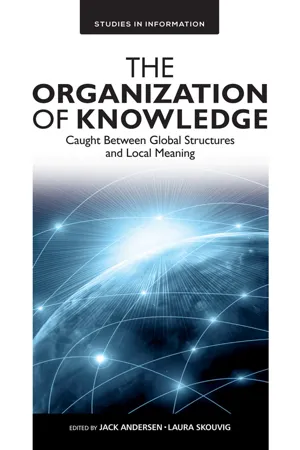
The Organization of Knowledge
Caught Between Global Structures and Local Meaning
- 128 pages
- English
- ePUB (mobile friendly)
- Available on iOS & Android
eBook - ePub
The Organization of Knowledge
Caught Between Global Structures and Local Meaning
About this book
This book critically examines the organization of knowledge as it is involved in matters of digital communication, the social, cultural and political consequences of classifying, and how particular historical contexts shape ideas of information and what information to classify and record. Due to permeation of digital infrastructures, software, and digital media in everyday life, many aspects of contemporary culture and society are infused with the activity and practice of classification. That means that old questions about classification have their potency in modern discourses about surveillance, identify formation, big data and so on. At the same time, this situation also implies a need to reconsider these old questions and how to frame them in digital culture. This book contains contributions that consider classic library classification practices and how their choices have social, cultural and political effect, how the organization of knowledge is not only a professional practice but is also a way of communicating and understanding digital culture, and how what a particular historical context perceives as information has implications for the recording of that information.
Information
Topic
FilologíaChapter 1
Genre, Organized Knowledge, and Communicative Action in Digital Culture
Abstract
The purpose of the chapter is to argue for a twofold understanding of knowledge organization: the organization of knowledge as a form of communicative action in digital culture and the organization of knowledge as an analytical means to address features of digital culture.
The approach taken is an interpretative text-based form of argumentation.
The chapter suggests that by putting forward such a twofold understanding of knowledge organization, new directions are given as to how to situate and understand the activity and practice of the organization of knowledge in digital culture.
By offering the twofold understanding of the organization of knowledge, a tool of reflection is provided when users and the public at large try to make sense of, for example, data, archives, search engines, or algorithms.
The originality of the chapter is its demonstration of how to conceive of knowledge organization as a form of communicative action and as an analytical means for understanding issues in digital culture.
Keywords: The organization of knowledge; genre; digital culture; digital media; communicative action
Chapter Outline
- 1.1. Introduction
- 1.2. The Everyday Organization of Knowledge and Communication in Digital Culture
- 1.3. Genre: Understanding Local Communicative Interactions and Social Structure
- 1.4. Search Engines and Communicative Actions
- 1.5. Algorithms: Between Communication and Culture
- 1.6. Databases: The Ordering of Culture and Society
- 1.7. The Organization of Knowledge as Analytical Concept in Digital Culture
- 1.8 The Organization of Knowledge as a Genre in Digital Culture
- 1.9 Conclusion
1.1. Introduction
Any given form of culture can always be described in a variety of ways: a literate culture, an enlightenment culture, a culture of participation, a culture of experience, or as “a whole way of life” (Williams, 1989). Our current form of digital media culture, I suggest, can be described as a culture of ordering, structuring, and archiving as we witness an abundance of activities and practices that have to do with organizing, listing, archiving, ordering, or searching for items; that is, what is in information studies called the organization of knowledge. What used to be the professional practice of archivists and librarians, is now a way of navigating media culture and of producing culture, whether by humans or algorithms. The activities and practices of ordering, listing, archiving, categorizing, and searching are carried out by people in their everyday interactions in digital networks, suggesting that the organization of knowledge is a tool used to make sense of our daily routinized communicative interactions. Moreover, given the omnipresence of social, mobile, and networked media in our everyday life, it is too a tool employed to make sense of our lifeworld as it stretches from local, through regional, and to global digital contexts.
Moving on from these observations, we can begin to question how the organization of knowledge shapes everyday life because of its “inscription” in digital media. In digital culture, ordering and archiving is a way of interacting with digital media. It is “a whole way of life.” It is a form of communicative action: One cannot experience digital media without also practicing knowledge organization: people construct queries, examine results, and access retrieved items as a matter of course when interacting with digital content. Accordingly, the creation of data to facilitate search and retrieval (tagging, labeling, or linking) is likewise a communicative action.
In this chapter, I will try to take a step back and think about how we can describe and understand ordering and archiving and its place and meaning in digital culture. In doing so, I will suggest a twofold understanding of the organization of knowledge. First, I will elaborate an understanding of it as a form of communicative action in digital culture. Genre is a means of understanding typified forms of social and communicative actions in particular forms of human activity spheres. Specifically, I want to underpin how we can begin to understand the organization of knowledge as a form of typified social and communicative action in digital media.
Second, I am going to consider how the organization of knowledge can be a means to understand features of digital culture. In digital culture, we encounter the activity and practice of ordering and archiving, particularly through search engines, algorithms, and databases, and I am going to look at what they do communicatively in digital culture. Such an understanding has the potential to enhance conversations about new media and the new communicative infrastructures in society, where the activity and practice of the organization of knowledge has increasing social and cultural significance.
The chapter unfolds in the following way. I begin with some brief remarks on the everyday organization of knowledge. For this purpose, I draw on the work of Beer (2013) and his ideas about the archive in digital culture. Next, I consider how genre can be used to explore the understanding of the organization of knowledge suggested in this chapter. By looking into some work done on search engines, databases, and algorithms as a means of communication, I begin to establish the premise from where to argue for the organization of knowledge as a communicative genre in digital culture and as an analytical concept for understanding features of digital culture.
1.2. The Everyday Organization of Knowledge and Communication in Digital Culture
Libraries, archives, and similar kinds of collecting institutions and systems have for a long time been used to share and facilitate access to their particular collections. The whole idea of having collaborating local, regional, national, and global bibliographical systems rests on the assumption that providing access to structured collections of recorded knowledge is a social responsibility and of benefit to particular user communities: the public and societies at large. These efforts continue with digital networks and digital media and play a significant part in society’s communicative and information infrastructure.
However, what I would like to pay attention to in this chapter is the communication and organization of knowledge in digital networks that takes place outside these institutions and the practices and activities of their professionals. I will look at the everyday organization of knowledge in the everyday life of people when involved in different communicative interactions, whether that is on Facebook, YouTube, Twitter, Flickr, Wikipedia, or on search engines. In digital culture there is a public expectation to be able to search and to store — and to be searched for and stored — in structured collections of items, because digital media, as opposed to classic mass media, offers, among other things, this exact possibility due to their inherent database configurations (Manovich, 2001), and because of digital media’s integration in almost all other forms of media we encounter in our everyday digital culture. Thus, with digital media it seems like digital culture is centered on the idea of organizing, archiving, and ordering in everyday life.
This is also the central theme of David Beer’s book, Popular Culture and New Media (Beer, 2013). In particular, Beer pays attention to the role of classification in everyday life given the permeation of new media. He labels this as “the classificatory imagination” and argues that “… we need to begin to factor in the decentralization of cultural classification and archiving processes to understand the ordering of culture. In other words we need to develop a stronger sense of the classificatory imagination in culture” (Beer, 2013, p. 44; italics in original), with “classificatory imagination” covering the idea that people come to think and act by means of classification in everyday encounters with digital media. This argument about the necessity of factoring in the decentralization and domestication of classification and archiving in everyday is important for the argument to be developed in this chapter. Recognizing that classification and archiving are a means of ordering culture offers an opportunity to reflect upon what this means to the practice and activity of the organization of knowledge in everyday life.
Continuing this line of reasoning, Beer proposes the concept of archives as a means to understand digital culture: “The concept of archives can be used to explore the ordering of data in digital culture and to ask who controls them, what is stored, how it is accessed, how it is managed and so on” (Beer, 2013, p. 41). It is not a concept developed strictly from archival theory. It is used in a rather symbolic way to underscore the archival processes triggered by the proliferation of data in digital culture. Communication in digital networks is facilitated by data produced by people’s communicative actions in their infrastructures of participation (Beer, 2013, p. 53). Data is collected by services and platforms and stored in archives, producing traces of our communicative affairs. Digital networks and the communicative actions they enable go hand-in-hand with forms of knowledge organization, or archiving as Beer (2013) argues, as much of the work of categorization, tagging, and ordering is carried out by people in their everyday interactions in digital networks. They do this because they communicate and relate to each other and make sense of society at large by these means. Thus, the concept of archives as an analytical tool offers a way to understand communication in digital culture and digital networks.
Here, I want to take Beer’s argument a step further. People and institutions do not communicate and produce communicative actions coincidentally. In order to make sense of, for instance, tagging or archiving as modes of communication and ordering, humans construct structured ways of communication in order to make their communications recognizable and intelligible to their appropriate local audiences and activity contexts. Typified forms of communication and genres are developed.
1.3. Genre: Understanding Local Communicative Interactions and Social Structure
In rhetorically oriented understandings of genre, genre is a typified form of communication employed by people in various spheres of human activity and social practices (Bakhtin, 1986; Bazerman, 1988; Berkenkotter & Huckin, 1995; Devitt, 2004; Luckmann, 2009; Miller, 1984; Yates, 1989). Genre as an analytical concept is a powerful means of understanding diverse forms of communication as it sheds light on not only the very concrete form(s) of text(s) used in human activity spheres, but also on the social structures producing genres and their role in coordinating social organization (Luckmann, 2009). As such, genre is always caught between its broader scope of production and its concrete local context of appropriation and interpretation. The uptake of the genre (Freadman, 1994) in a concrete setting is crucial for its success in coordinating social action. Given that the action of a genre can be caused by activity contexts outside of the particular genre, genre always mediates between a local and global level. For instance, the genre of the scholarly journal article is mediating between its local contexts of production and its extension into multiple disciplinary and globally dispersed contexts. However, the very appropriation of a genre is of course locally dependent. Genre is thus always caught in the tensions and contradictions between local and global communication contexts and, at the same time, is the communicative means available to people for producing recognizable communicative actions between or within local and global contexts.
Genre is a means for making sense of communication at a distance and for making communication recognizable to others. Genre entails specific forms of communicative relationships and positionings among individuals. Typification, coming from Schutz’s phenomenology (Schutz, 1967), can help establish and maintain a communicative order at a distance that helps writer and reader share a recognizable space of meaning and make available a common ground for meaningful construction and for meaningful discourse.
Because distance means a distance between something, communication is always mediated. It is not and cannot be pure dialogue between separated minds (Peters, 1999). Genre is always about the other or the addressee, as Bakhtin notes (Bakhtin, 1986). Genre implies the other as genre is a social game and not a solipsistic trap. The other is necessary. Otherwise, distance is not distance. Thus, genre is not a technical fix for communication. It is a communicative solution to socio-communicative problems (Luckmann, 2009). It is a social and cultural tool loaded with the ideologies, motives, ideas, and knowledge of particular groups of people in particular contexts. Genre is not the outcome of some master plan. Genre is pragmatically molded by tensions and contradictions between participants in human activities.
Framing my further observations within this view of genre, I am now going to examine how search engines, algorithms, and databases communicatively perform in digital culture. Having done that, I will move on to elaborate my argument about the organization of knowledge as a concept for making sense of features of digital culture and as a genre in digital culture.
1.4. Search Engines and Communicative Actions
In current media culture, searching and search engines are significant forms of media interaction. On a par with television, radio, and the press, search engines are a new powerful form of mass media which penetrate our everyday lives and public spheres in almost every dimension. “As our use of digital media converges, mixing and combining computer applications with more traditional media, we also find search engines becoming part of our entire media ecosystem” (Halavais, 2009, p. 10). The homepages of public authorities and private companies present themselves as ordered places to be searched in order for us to produce meaningful action with them. Cell phones, apps, and e-books include a search function, and the big search engines such as Google or Bing constantly make us aware of the importance of being searchable, represented, and visible (or invisible) in their collection of digital resources. In other words, search engines have introduced the verb “to search” constituting a new communicative action different from but complementing the verbs attached to traditional mass media such as “to listen, to read, or to watch.” Contemporarily, these four verbs and actions represent prominent ways of interacting with various media and cultural forms.
Search engines have induced “a culture of search” (Hillis, Petit, & Jarret, 2013). They help produce the public expectation that almost everything relevant is being recorded and is available and searchable; that everything is coded and archived for retrieval. “Search is a way of life” and “a public utility,” as noted by Hillis et al. (201...
Table of contents
- Cover
- Title
- 1 Genre, Organized Knowledge, and Communicative Action in Digital Culture
- 2 Information Cultures: Shapes and Shapings of Information
- 3 The (De-)Universalization of the United States: Inscribing Māori History in the Library of Congress Classification
- 4 Reader-Interest Classifications: Local Classifications or Global Industry Interest?
- 5 Knowledge Representation of Photographic Documents: A Case Study at the Federal University of Pernambuco (Brazil)
- 6 Slanted Knowledge Organization as a New Ethical Perspective
- About the Editors
- Index
Trusted by 375,005 students
Access to over 1.5 million titles for a fair monthly price.
Study more efficiently using our study tools.
Frequently asked questions
Yes, you can cancel anytime from the Subscription tab in your account settings on the Perlego website. Your subscription will stay active until the end of your current billing period. Learn how to cancel your subscription
No, books cannot be downloaded as external files, such as PDFs, for use outside of Perlego. However, you can download books within the Perlego app for offline reading on mobile or tablet. Learn how to download books offline
Perlego offers two plans: Essential and Complete
- Essential is ideal for learners and professionals who enjoy exploring a wide range of subjects. Access the Essential Library with 800,000+ trusted titles and best-sellers across business, personal growth, and the humanities. Includes unlimited reading time and Standard Read Aloud voice.
- Complete: Perfect for advanced learners and researchers needing full, unrestricted access. Unlock 1.5M+ books across hundreds of subjects, including academic and specialized titles. The Complete Plan also includes advanced features like Premium Read Aloud and Research Assistant.
We are an online textbook subscription service, where you can get access to an entire online library for less than the price of a single book per month. With over 1.5 million books across 990+ topics, we’ve got you covered! Learn about our mission
Look out for the read-aloud symbol on your next book to see if you can listen to it. The read-aloud tool reads text aloud for you, highlighting the text as it is being read. You can pause it, speed it up and slow it down. Learn more about Read Aloud
Yes! You can use the Perlego app on both iOS and Android devices to read anytime, anywhere — even offline. Perfect for commutes or when you’re on the go.
Please note we cannot support devices running on iOS 13 and Android 7 or earlier. Learn more about using the app
Please note we cannot support devices running on iOS 13 and Android 7 or earlier. Learn more about using the app
Yes, you can access The Organization of Knowledge by Jack Andersen, Laura Skouvig, Jack Andersen,Laura Skouvig in PDF and/or ePUB format, as well as other popular books in Filología & Biblioteconomía y ciencia de la información. We have over 1.5 million books available in our catalogue for you to explore.