Academic critical urbanists, as well as housing activists, have however queried this dominant
policy narrative regarding contemporary urban renewal, preferring instead to regard it as
a key part of neoliberal urban restructuring and state-led gentrification which generate new
socio-spatial inequalities and insecurities through displacement and exclusion processes. This
book examines this debate through original, in-depth case study research on the processes and
impacts of urban renewal on social housing in European, U.S. and Australian cities. The book
also looks beyond the Western urban heartlands of social housing to consider how renewal is
occurring, and with what effects, in countries with historically limited social housing sectors such
as Japan, Chile, Turkey and South Africa.
eBook - ePub
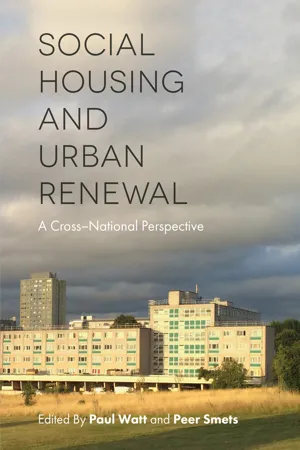
Social Housing and Urban Renewal
A Cross-National Perspective
- 512 pages
- English
- ePUB (mobile friendly)
- Available on iOS & Android
eBook - ePub
Social Housing and Urban Renewal
A Cross-National Perspective
About this book
This book offers a cross-national perspective on contemporary urban renewal in relation to
social rental housing. Social housing estates – as developed either by governments (public
housing) or not-for-profit agencies – became a prominent feature of the 20th century urban
landscape in Northern European cities, but also in North America and Australia. Many
estates were built as part of earlier urban renewal, 'slum clearance' programs especially in
the post-World War 2 heyday of the Keynesian welfare state. During the last three decades,
however, Western governments have launched high-profile 'new urban renewal' programs
whose aim has been to change the image and status of social housing estates away from
being zones of concentrated poverty, crime and other social problems. This latest phase
of urban renewal – often called 'regeneration' – has involved widespread demolition of
social housing estates and their replacement with mixed-tenure housing developments in
which poverty deconcentration, reduced territorial stigmatization, and social mixing of poor
tenants and wealthy homeowners are explicit policy goals.
Information
Publisher
Emerald Publishing LimitedYear
2017Print ISBN
9781838679330
9781787141254
eBook ISBN
9781787149106
Topic
ArchitectureSubtopic
Urban Planning & Landscaping1
SOCIAL HOUSING AND URBAN RENEWAL: AN INTRODUCTION
FROM UTOPIA TO DYSTOPIA: THE DEVELOPMENT AND DECLINE OF SOCIAL HOUSING ESTATES
Social housing estates — as developed either by local states (viz. public/municipal housing) or voluntary sector housing associations — became a prominent feature of the twentieth century urban landscape in many Northern European cities, and also to a lesser extent in North American and Australian cities.1 Many of these estates were built as part of earlier urban renewal, “slum clearance” programs especially in the post–World War II heyday of the Keynesian welfare state. Old, overcrowded, slum areas of private rental housing were demolished to make way for new modernist housing blocks and estates which provided physically improved and affordable rental housing for workers and their families. In both Northern Europe and North America, the estates were created at a time of considerable optimism both in terms of town planning and modernist architecture, and also in the capacity of welfare states to build and manage mass housing projects (Campkin, 2013; Urban, 2012).
The heartlands of social housing in capitalist societies have been the large, industrial — now in many cases ex-industrial — cities of Northern Europe in the Netherlands, Austria, Denmark, France, the United Kingdom, and West Germany where there was extensive social housing provision, often, although not exclusively, in the form of monotenure estates. In some cities, these estates were largely located in inner-city areas, as for example in London and Amsterdam, whereas in other cases the estates were predominantly built in the suburban periphery, for example on the outskirts of the major Scottish cities of Glasgow and Edinburgh, in the grand ensembles around Paris, Copenhagen, and West German cities such as Cologne and Dusseldorf (Power, 1997; Turkington & Watson, 2015; Urban, 2012; Whitehead & Scanlon, 2007).
In many Northern European societies, social housing took on a “mass” rather than a “residual” form (Harloe, 1995) in the sense that it did not house just the poorest and most vulnerable but instead catered for large tranches of the population, notably the industrial working class.2 It was, in the words of the Swedish Social Democratic Party, “the people’s home” (folkhemmet; Harloe, 1995, p. 1), an example of welfare capitalism in action. This was also the case in postwar Britain where millions of people “considered council houses better than private accommodation, both in quality and in the security they offered” (Todd, 2014, pp. 179–180). This extensive provision did not, however, equate to the universalism that dominated other sectors of the postwar Keynesian welfare state such as health, education, and social security. Instead, housing has long been recognized as the “wobbly pillar under the welfare state” (Torgersen, 1987), even if that pillar has proved to be a good deal wobblier in some societies (and their cities) than others, notably England (Hodkinson, Watt, & Mooney, 2013; Watt & Minton, 2016; Chapters 3, 5, and 13 of this volume). In contrast to Northern Europe, social housing was far less prominent in US, Canadian, and Australian cities and tended to operate via an explicitly “residual” model of provision which primarily catered for the poor and notably for racialized minority groups (Darcy, 2010; Harloe, 1995; Hirsch, 1983; Wacquant, 2008).3
The widespread postwar optimism regarding social housing did not, however, last long. Despite the often utopian visions which lay behind social housing estates, in a relatively short time they came to be seen as problematic both in design and social terms by politicians, the mass media, and academics. This was especially the case in relation to the large, modernist concrete “tower and slab” estates (Campkin, 2013; Coleman, 1990; Urban, 2012), for example, the “brutalist” about-to-be-demolished Robin Hood Gardens estate in East London (Mould, 2017). They were, and often still are, regarded as “sink estates” — stigmatized crucibles of urban poverty, misery, and lawlessness (Campkin, 2013) — even if residents’ lived reality was often at some remove from such stereotypical, stigmatizing images (Garbin & Millington, 2012; Watt, 2008), as discussed further in this chapter and several chapters of this volume.
Nowhere was this apparent systemic failure more pronounced than in the case of the public housing “projects” in the large US cities. Large postwar projects such as the Pruitt–Igoe tower blocks in St. Louis, and Cabrini-Green and Robert Taylor Homes in Chicago (now all demolished), rapidly became bywords for spatially concentrated poverty and crime. The sources of this decline were manifold but included, in various combinations, a significant underestimation of management and maintenance costs, systemic public underfunding, neglect and disinvestment, mounting unemployment coupled with demographic concentrations of poor families including many young people (see inter alia Bradford Hunt, 2009; Heathcott, 2012; Rainwater, 1970; Urban, 2012; Vale, 2013; Wacquant, 2008).
Furthermore, the spatial concentration of poverty had a profound racialized aspect to it since the new modernist housing projects by and large replicated the racialized injustices of the old “black ghetto.” The deliberate racialized siting of the new public housing projects in or near the old inner-city black ghettoes, away from white neighborhoods, resulted in their becoming the “second ghetto,” as Hirsch (1983) famously described in the case of Chicago. The projects’ typically stark, towering appearance on the urban landscape only highlighted the symbolism of policy failures: “in many cities, public housing has simply become a more visible kind of slum, and by its very existence as a public programme highlights the failure of the federal response to poverty” (Rainwater, 1970, p. 524; original emphasis).
If the US inner-city projects were emerging as problematic by the mid-1960s, their subsequent decline was further exacerbated by a lethal cocktail of deindustrialization and the flight of newly affluent blacks to the suburbs, as powerfully argued by the Chicago-based sociologist William Julius Wilson (1987, 1993). The “truly disadvantaged” — those poor African Americans left behind in the inner city including in the projects — not only lacked jobs but, unlike the ghettoes of early- to mid-twentieth century US cities such as Harlem, they also had a dearth of “respectable” role models. The result, Wilson argued, was the spatial concentration of poverty and social dysfunctionality in the inner city and the production of spatial “neighborhood effects” which result in negative life chances for the poor and their children over and above any individual disadvantages they might face.
If concentrated urban poverty and social dysfunctionality were most severe in the US projects, they were also identified in Northern European inner-city and peripheral social housing estates (Beider, 2007; Musterd, Murie, & Kesteloot, 2006; Power, 1997; Turkington & Watson, 2015; van Kempen, Dekker, Hall, & Tosics, 2005). English council estates and the Parisian banlieues, for example, experienced large-scale urban disturbances — “riots” — during the 1990s and 2000s (Dikecs, 2007; Power & Tunstall, 1997). Furthermore, in academic terms, the “neighborhood effects” which Wilson identified arguably made their way from Chicago to the poorer areas of European and Australian cities including social housing estates. Those people growing up in such estates were said to be doubly disadvantaged — not only by their parents’ poverty, but also by the poverty and disadvantages of the place itself which magnified young people’s social exclusion (Friedrichs, Galster, & Musterd 2003; Jenks & Mayer, 1990; Manley, van Ham, Bailey, Simpson, & Maclennan, 2013). Estate residents were said to lack effective role models and connections to the world of work, since they were spatially isolated and lived with similar poor people to themselves.
Before turning to the preferred policy solution to the decline of social housing estates via their all-too-literal “fall” — demolition — it’s worth pausing at this point to add vital nuance to the above overarching narrative. For one thing, what seems to have happened is that certain iconic, infamous US projects — such as Pruitt–Igoe and Robert Taylor Homes — took on a symbolic significance that is way beyond their socio-spatial representativeness. Despite the specific problems faced by Pruitt–Igoe and the way its decline was produced by macro-social and economic forces, this did not prevent it from assuming a symbolic, even mythical status in the eyes of politicians and those who were only too happy to see public housing interventions as inherently problematic (Freidrichs, 2011; Heathcott, 2012). In other words, these particular projects came to symbolize what Goetz (2013, p. 40) calls an “exaggerated discourse of disaster,” in which any policy successes from the projects in general were drowned out by a plethora of “bad news” stories. As we discuss later, residents of the projects, especially African-American women, were also at the forefront of concerted grass-roots mobilization attempts to combat the all-too frequent bureaucratic inertia and neglect they faced and in so doing demonstrated considerable attachment to their homes and neighborhoods (Feldman & Stall, 2004).
In relation to this, there is also disproportionate media and academic attention given to the Chicago Housing Authority project “failures,” while the far more extensive, well-funded, and generally positive projects run by the New York City Housing Authority receive relatively little attention (Hyra, 2008; Urban, 2012). As for the frequent design determinism which the policy analysts all too often employ to justify demolishing public housing units, Urban (2012, p. 32) points out how “many [NYC] areas that in the 1960s acquired a bad reputation – such as Harlem or the South Bronx – were neither high-rises nor public housing, but rather poor neighborhoods of three-story brownstone houses from the late nineteenth century.”
If US public housing is neither defined nor encapsulated by the Robert Taylor Homes or even the Chicago projects as a whole, it is even more questionable to try and make sweeping cross-national generalizations across from the US project experience to that of Northern European social housing estates (see inter alia Aalbers, van Gent, & Pinkster, 2011; Fenton, Lupton, Arrundale, & Tunstall, 2012; Stal & Zuberi, 2010; Wacquant, 2008). Not only were the latter far more extensive than the former, but in many European cities they were not equivalent to the racialized, hyper-marginalized enclaves of the US inner cities. As Wacquant (2008) and others have argued, the experiences of the black, inner-urban hyper-ghetto — in relation to racism, crime, poverty, and welfare state withdrawal — have no European equivalent, despite certain modernist architectural similarities (Urban, 2012). For one thing, the US projects have had long-term strict income ceilings which mean they tend to cater for the poor and vulnerable far more than in Europe.
In comparison to the US projects, Northern European estates for much of their history did not cater for the very poor but instead for the manual working class and even sections of the middle classes (Harloe, 1995; Watt, 2005). More recently, however, many European countries have imposed formal income levels ceilings regarding who has access to social housing, while some continue to have no formal income restrictions (e.g., Austria, Denmark) (Scanlon et al., 2015). However, as Scanlon et al. (2015) identify, social tenants tend to have lower incomes than average in Europe. In addition, while the data are incomplete, they also found that ethnic minorities and immigrants tend to be overrepresented in social housing (31% in the Netherlands and 25% in Denmark), and even higher in large cities, for example Munich (Scanlon et al., 2015, p. 5), Paris and London (Urban, 2012), although not Berlin (Urban, 2012). Despite the concentration of low-income and ethnic minority groups in social housing in Europe, this is still far from the situation pertaining to the US inner-city projects, and especially to the most infamous projects such as Robert Taylor Hom...
Table of contents
- Cover
- Title Page
- 1 Social Housing and Urban Renewal: An Introduction
- 2 Holding on to Hope: Assessing Redevelopment of Boston’s Orchard Park Public Housing Project
- 3 ‘The Blue Bit, that Was My Bedroom’: Rubble, Displacement and Regeneration in Inner-City London
- 4 Gentrification as Policy Goal or Unintended Outcome? Contested Meanings of Urban Renewal and Social Housing Reform in an Australian City
- 5 Are Social Mix and Participation Compatible? Conflicts and Claims in Urban Renewal in France and England
- 6 Promoting Social Mix through Tenure Mix: Social Housing and Mega-Event Regeneration in Turin
- 7 Tenure Mix against the Background of Social Polarization. Social Mixing of Moroccan-Dutch and Native-Born Dutch in Amsterdam East
- 8 Phased Out, Demolished and Privatized: Social Housing in an East German ‘Shrinking City’
- 9 Social Housing and Urban Renewal in Tokyo: From Post-War Reconstruction to the 2020 Olympic Games
- 10 Territorial Stigmatization in Socially-Mixed Neighborhoods in Chicago and Santiago: A Comparison of Global-North and Global-South Urban Renewal Problems
- 11 Caught Between the Market and Transformation: Urban Regeneration and the Provision of Low-Income Housing in Inner-City Johannesburg
- 12 Social Housing, Urban Renewal and Shifting Meanings of ‘Welfare State’ in Turkey: A Study of the Karapınar Renewal Project, EskiŞehir
- 13 The Inbetweeners: Living with Abandonment, Gentrification and Endless Urban ‘Renewal’ in Salford, UK
- 14 Social Housing and Urban Renewal: Conclusion
- About the Authors
- Index
Trusted by 375,005 students
Access to over 1.5 million titles for a fair monthly price.
Study more efficiently using our study tools.
Frequently asked questions
Yes, you can cancel anytime from the Subscription tab in your account settings on the Perlego website. Your subscription will stay active until the end of your current billing period. Learn how to cancel your subscription
No, books cannot be downloaded as external files, such as PDFs, for use outside of Perlego. However, you can download books within the Perlego app for offline reading on mobile or tablet. Learn how to download books offline
Perlego offers two plans: Essential and Complete
- Essential is ideal for learners and professionals who enjoy exploring a wide range of subjects. Access the Essential Library with 800,000+ trusted titles and best-sellers across business, personal growth, and the humanities. Includes unlimited reading time and Standard Read Aloud voice.
- Complete: Perfect for advanced learners and researchers needing full, unrestricted access. Unlock 1.5M+ books across hundreds of subjects, including academic and specialized titles. The Complete Plan also includes advanced features like Premium Read Aloud and Research Assistant.
We are an online textbook subscription service, where you can get access to an entire online library for less than the price of a single book per month. With over 1.5 million books across 990+ topics, we’ve got you covered! Learn about our mission
Look out for the read-aloud symbol on your next book to see if you can listen to it. The read-aloud tool reads text aloud for you, highlighting the text as it is being read. You can pause it, speed it up and slow it down. Learn more about Read Aloud
Yes! You can use the Perlego app on both iOS and Android devices to read anytime, anywhere — even offline. Perfect for commutes or when you’re on the go.
Please note we cannot support devices running on iOS 13 and Android 7 or earlier. Learn more about using the app
Please note we cannot support devices running on iOS 13 and Android 7 or earlier. Learn more about using the app
Yes, you can access Social Housing and Urban Renewal by Paul Watt, Peer Smets, Paul Watt,Peer Smets in PDF and/or ePUB format, as well as other popular books in Architecture & Urban Planning & Landscaping. We have over 1.5 million books available in our catalogue for you to explore.