eBook - ePub
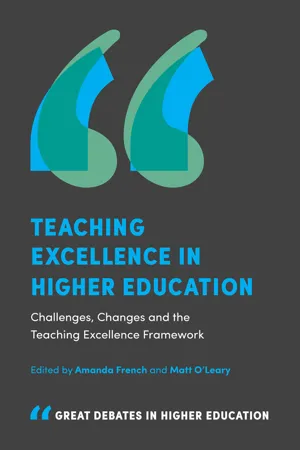
Teaching Excellence in Higher Education
Challenges, Changes and the Teaching Excellence Framework
- 120 pages
- English
- ePUB (mobile friendly)
- Available on iOS & Android
eBook - ePub
Teaching Excellence in Higher Education
Challenges, Changes and the Teaching Excellence Framework
About this book
The introduction of the Teaching Excellence Framework heralds an era of unprecedented scrutiny and focus on the quality of teaching in universities in England. This book offers inter-disciplinary, evidence-informed discussion around notions of excellence in higher education teaching. It will act as a key stimulus for institutional and sector-wide debates and a reference point for initiatives around the TEF agenda. Drawing on the authentic, grounded experiences of practising HE professionals and complemented by a range of recent case studies, this book offers insight into the pursuit of capturing excellence in the complex and wide-ranging context of HE teaching. It will consider what the repercussions of TEF might mean to those involved in learning and teaching in the sector and how this might impact institutional policy and practice.
Information
Topic
DidatticaSubtopic
Istruzione superiore1
INTRODUCTION
It was arguably in the late 1990s and early 2000s that the notion of ‘teaching excellence’ became a common phrase to identify and celebrate ‘high-quality’ teaching in higher education institutions (HEIs). This focus on teaching excellence has led to a prolonged period where teaching has slowly grown in importance in HEIs. Key drivers for this slow development have resulted in the creation of formal frameworks for recognising ‘teaching excellence’, the increasing need to focus on teaching as the main income generator for some HEIs, the rise of student satisfaction data, particularly through the creation of the National Student Survey, and the organisational imperative to capture positive performance indicators around programme and module evaluations. In turn, these factors have become increasingly important due to the rise of the ‘marketised’ higher education (HE) system. In the transition from a civic to a market sector, establishing market position and unique selling points has become increasingly important business for HEIs in the UK.
As a result of these developments, universities have become more concerned with publicly demonstrating the teaching expertise of their academic staff with a view to increasing student recruitment for their programmes of study. Now, as part of the Higher Education and Research Bill (HERB) passed with unseemly haste in April 2017,1 HEIs have witnessed the introduction of the Teaching Excellence Framework (TEF), heralding an era of unprecedented scrutiny and focus on the quality of teaching in England.
The concept of ‘teaching excellence’ has, however, all too often been shaped by political criteria which has played a pivotal role in structuring debate around it. These debates have also reflected how academic work has changed significantly in recent decades, as universities worldwide respond to globalisation, the massification of HE and the increasing demands placed upon them by their national governments. The so-called ‘new public management’ and neo-liberalism have become powerful political drivers of a quality culture in HE across the world as governments have sought to exercise greater control over universities’ activities, not least, by introducing initiatives to evaluate the quality of their ‘investments’ in the HE sector.
Given the complexity around the concept of teaching excellence and the concomitant difficulties in capturing it, this book seeks to offer an inter-disciplinary, evidence-informed discussion around notions of excellence in HE teaching. Each chapter adds to the existing literature on teaching excellence, much of which is characterised by an acknowledgment that teaching is a multifaceted and complex process. Moreover, throughout the book we aim to show how the term ‘teaching excellence’ is itself not generalisable and is continuously subject to shifts in context and through time.
Drawing on the authentic, grounded experiences of practising HE professionals, we hope this book will offer an insight into some of the specific factors relating to the pursuit of capturing excellence in the complex and wide-ranging context of HE teaching as well as considering the repercussions of TEF for those involved in learning and teaching and how this might impact institutional policy and practice. We also hope that it will act as a key stimulus for institutional and sector-wide debates and a reference point for initiatives, both personal and institutional, around the TEF and the wider agenda of teaching excellence.
NOTE
1. At the time of going to press, the Higher Education and Research Bill was passed through parliament. MPs and peers in the House of Lords agreed on a number of amendments to ensure that the bill became law before the dissolution of parliament on May 3, 2017. While peers in the House of Lords were highly critical of the TEF, particularly the bronze–silver–gold medal rating system and its link to the setting of differentiated tuition fees, the government ultimately rejected the Lords amendment preventing the TEF being used to set universities’ fees. A compromise of sorts was reached insomuch as ministers agreed to delay the introduction of measures linking TEF to differentiated tuition fees until 2020 by which time an independent review of the exercise’s metrics would be completed.
2
CONTEXTUALISING EXCELLENCE IN HIGHER EDUCATION TEACHING: UNDERSTANDING THE POLICY LANDSCAPE
INTRODUCTION
Teaching Excellence as Policy Initiative
[…] teaching quality […] should be among the most important factors in students’ choices. Good teaching – broadly defined to include learning environments, student support, course design, career preparation and ‘soft skills’, as well as what happens in the lecture theatre or lab – pays dividends in terms of outcomes for students[…]. (BIS, 2016b)
The focus on teaching excellence in the Higher Education and Research Bill (HERB) is not entirely unexpected, political interest in the quality of teaching standards, as a way of helping parents and students to make informed ‘choices’ about which school to choose for their children, has after all, been a mainstay of governmental interventions in compulsory education for several decades. In this sense, the Teaching Excellence Framework (TEF) is new only insofar as it seeks to embed a government-led quality approach to teaching in legislation in higher education (HE).
The current preoccupation with ‘teaching excellence’ as a political tool for change in HE has been evident not only in the government’s own publications such as Securing a Sustainable Future for Higher Education: An Independent Review of Higher Education Funding and Student Finance (Browne, 2010), the White Papers, The Future of Higher Education (DfES, 2003), Students at the Heart of the System (2011) and Higher Education: Teaching Excellence, Social Mobility and Student Choice and Success as Knowledge Economy (2016); the HE Act (2003); and the Green Paper Fulfilling Our Potential: Teaching Excellence, Social Mobility and Student Choice (2015), but also in a number of high-profile academic reviews commissioned in recent years by UK government-funded agencies such as the Higher Education Association whose many publications on the subject include Excellence in Teaching and Learning: A Review of the Literature (Little, Locke, Parker, & Richardson, 2007) and Considering Teaching Excellence in Higher Education: 2007–2013: A Literature Review Since the CHERI Report 2007 (Gunn & Fisk, 2013). In addition, there have been several European and wider transnational reports, including The Professionalisation of Academics as Teachers in Higher Education. Standing Committee for Social Sciences: European Science Foundation (Pleschová et al., 2012) and the OECD’s Quality Teaching in Higher Education: Policies and Practices: An Institutional Management Guide for Higher Education Institutions (Hénard & Roseveare, 2012), Report to the European Commission: Improving the Quality of Teaching and Learning in Europe’s Higher Education Institutions (2013); as well as many independent academic studies (Brusoni et al., 2014; Gibbs, 2010; Skelton, 2007). Ironically, in the light of HERB and the centrality of TEF to its reforms, all these different sources point to how difficult it actually is to make a clear case for what could or does constitute teaching excellence, let alone how it might actually be used to drive up standards, reduce inequality and reduce social mobility which are just some of the issues that HERB claims TEF will address.
Most recently, perhaps in order to prepare the ground for TEF, the Department for Business, Innovation and Skills (BIS) commissioned yet another literature review entitled, Teaching Quality in Higher Education: Literature Review and Qualitative Research (Greatbatch & Holland, 2016), which also carried out some primary research with students using focus groups to ask them about their opinions and experience of teaching excellence. The resulting comprehensive, if somewhat inconclusive, report echoed many of the findings from previous reports and studies. Most significantly, for this book, the BIS report concluded that teaching excellence is difficult to define, primarily because of the problems in establishing what teaching quality is, not least because perceptions of it differ across different academic disciplines (Parpala, Lindblom-Ylänne, & Rytkönen, 2011). All of which make it difficult to compare like with like, within and across universities (which, of course, is exactly what the TEF is trying to do). Moreover, although research shows that students can and do comment negatively or positively on their experiences of teaching, the extent to which they can evaluate its relative excellence is debatable. This is not least because they normally experience teaching only once as an undergraduate, in one institution (possibly two if they do an exchange), so arguably they have little to compare that singular experience with. While there is evidence that different approaches to teaching and learning and the distinctive experiences of learning that they engender could be significant, relatively little external quality auditing had been done on the impact of how diverse teaching approaches and the learning experiences they create might inform or affect students’ perceptions of teaching excellence per se (Bradley, Kirby, & Madriaga, 2015). Finally, international researches into teaching quality audits have reported that they often generate additional bureaucratic burdens on staff and inhibit innovations in teaching (Goldstein, 2004). The BIS report concluded therefore that there was:
[…] limited research on the extent to which such [teaching quality] audits have improved quality assurance in universities. (p. 4)
The BIS study focus groups revealed that students relied heavily on a university’s general or departmental reputation as an indicator of its teaching quality before deciding where to apply to. Their sources for this kind of information were most often commercial publications such as The Sunday Times Good University Guide (O’Leary, 2013), The Guardian newspaper’s Online University Guide and the Times Educational Supplement’s special HE editions and league tables, as well as independent websites like Which university? and social media, especially The Student Room, Facebook and Twitter. They also cited location, UCAS KIS information on employment, institutions’ own web-pages and marketing materials as well as their personal experiences of Open Day and other events. Interestingly, given the aims of the BIS report, the authors concluded that:
[…] teaching quality did not feature as a key issue that the students explicitly referenced as a reason for choosing where they wanted to study. (2016)
In short, this most up-to-date literature review, commissioned by the government, revealed that there are real differences between different students in different kinds of institutions, about what quality teaching is perceived to be. Often, as the BIS report concludes, we know no more than what the students want:
[…] staff who are enthusiastic and knowledgeable about their subject, empathetic, approachable, helpful and patient, and [who] encourage students to develop their full potential. (p. 5)
While undeniably important, these difficulties to measure qualities in lecturers highlight the problem of trying to effectively evaluate the quality of teaching excellence across HEIs and the different subject areas within them. As Collini (2016) recently wrote with regard to TEF:
[…] how ‘satisfied’ students are with their teaching accounts for one part of that experience. Even then it is hard to know whether such reports give a direct indication of the quality of teaching, as opposed to issues such as workload, ease of getting high marks and so on.
In addition, there appears to be very little in current research into teaching quality (and the TEF debate as a whole) about the potentially negative consequences of lecturers challenging students by exposing them to new ideas and encouraging intellectual risk-taking, which are all arguably distinctive features of HE learning (Barnett, 2007; Kelty & Bunten, 2017). Studies have shown that far from satisfying students, the use of innovative, challenging and/or unfamiliar teaching strategies often leaves them feeling uncomfortable and even unhappy with their learning experiences that may, in turn, affect their willingness to evaluate such learning experiences positively in the NSS (Harvey, 2005; Yorke, 2009).
The recent Higher Education Academy (HEA)/Higher Education Policy Institute Student Academic Experience Survey (Neves & Hillman, 2016) found that over one-third of undergraduates in England believe their HE course represented very poor or poor value for money. The consumer organisation Which? in its report A Degree of Value: Value for Money from the Student Perspective, November, 2014, similarly found that 3 in 10 students thought that their experience of HE represented poor value. However, perhaps tellingly, neither of these studies identified teaching quality specifically as a key component of respondents’ dissatisfaction. In comparison, the European Commission’s research (St. Aubyn, Pina, Garcia, & Pais, 2008) put British universities ahead of their competitors in Europe for research and teaching outcomes. While HEFCE’s (2016) own review of the NSS concluded that student satisfaction scores have ‘increased steadily’.
Trying to define and then measure teaching ‘excellence’ (or even to determine if there is actually a lack of it as the current government maintains) is, it seems, very difficult. As the European Association for Quality Assurance in Higher Education’s (ENQA) report on the Concept of Excellence in Higher Education (Brusoni et al., 2014) made clear, where they had been implemented across the globe, quality assurance systems for HE were not particularly geared to identifying or promoting excellence, but are more about setting thresholds for quality and encouraging improvement (p. 13). However, despite these difficulties, the current government confidently, at least publically, maintain that they can address what they call the ‘acute’ lack of information about teaching quality in HE through TEF and the other drivers identified in HERB. The reality however may be more complex.
In parliament the debate about HERB was characterised, from the start, by vagueness from its authors and supporters and scepticism by its detractors, especially around the use of matrices in TEF. Debate over HERB consequently resulted in a protracted period of political ‘ping-pong’ as various amendments and challenges bounced back between the government and the Lords, which was comprehensively chronicled and debated, week by week, by the website Wonkhe (Wonkhe.com). The Lords contained a well-organised cross-party group who were keen to see HERB substantially amended, especially on its use of matrices and the proposal to link TEF rankings to tuition fees (Hansard, 2017, passim). However, the snap election on 9 June meant that HERB passed rather unexpectedly into law on 27 April 2017 precipitating some hasty compromises. One concession agreed to by the government to get the HERB ...
Table of contents
- Cover
- Title Page
- 1 Introduction
- 2 Contextualising Excellence in Higher Education Teaching: Understanding the Policy Landscape
- 3 From Teaching Excellence to Emergent Pedagogies: A Complex Process Alternative to Understanding the Role of Teaching in Higher Education
- 4 Monitoring and Measuring Teaching Excellence in Higher Education: from Contrived Competition to Collective Collaboration
- 5 Developing and Supporting Teaching Excellence in Higher Education
- 6 Conclusion
- Index
Trusted by 375,005 students
Access to over 1.5 million titles for a fair monthly price.
Study more efficiently using our study tools.
Frequently asked questions
Yes, you can cancel anytime from the Subscription tab in your account settings on the Perlego website. Your subscription will stay active until the end of your current billing period. Learn how to cancel your subscription
No, books cannot be downloaded as external files, such as PDFs, for use outside of Perlego. However, you can download books within the Perlego app for offline reading on mobile or tablet. Learn how to download books offline
Perlego offers two plans: Essential and Complete
- Essential is ideal for learners and professionals who enjoy exploring a wide range of subjects. Access the Essential Library with 800,000+ trusted titles and best-sellers across business, personal growth, and the humanities. Includes unlimited reading time and Standard Read Aloud voice.
- Complete: Perfect for advanced learners and researchers needing full, unrestricted access. Unlock 1.5M+ books across hundreds of subjects, including academic and specialized titles. The Complete Plan also includes advanced features like Premium Read Aloud and Research Assistant.
We are an online textbook subscription service, where you can get access to an entire online library for less than the price of a single book per month. With over 1.5 million books across 990+ topics, we’ve got you covered! Learn about our mission
Look out for the read-aloud symbol on your next book to see if you can listen to it. The read-aloud tool reads text aloud for you, highlighting the text as it is being read. You can pause it, speed it up and slow it down. Learn more about Read Aloud
Yes! You can use the Perlego app on both iOS and Android devices to read anytime, anywhere — even offline. Perfect for commutes or when you’re on the go.
Please note we cannot support devices running on iOS 13 and Android 7 or earlier. Learn more about using the app
Please note we cannot support devices running on iOS 13 and Android 7 or earlier. Learn more about using the app
Yes, you can access Teaching Excellence in Higher Education by Amanda French, Matt O'Leary, Amanda French,Matt O'Leary in PDF and/or ePUB format, as well as other popular books in Didattica & Istruzione superiore. We have over 1.5 million books available in our catalogue for you to explore.