![]()
1
INTRODUCTION
INNOVATION — AN OLD CHALLENGE
Innovation is about survival — of course. If we don’t change what we offer the world and the ways in which we create and deliver it then we may not be around for long. In a competitive environment product/service and process innovation are part of the strategic imperative.
But it’s not just about being prepared to change — we have limited resources so we need to make sure the ways in which we change are the right ones and that we balance the risks and the potential rewards. And we need to think strategically about this, building for the long-term as well as dealing with short-term challenges.
We also need to be able to leverage something — we might be in the right place at the right time once but if we want to stay in the game we have to invest. Innovation is ideas — knowledge — converted into value and so we need to think about how to build and manage our knowledge base — competence.
Knowledge isn’t enough — we also need to learn how to create value from it. Innovation isn’t a magical event like the cartoons depicting a light-bulb magically flashing on above someone’s head. It’s about turning those ideas — knowledge — into value, and that involves a long and uncertain journey. We might manage to get to our destination once by sheer good fortune, but being able to make the journey repeatedly needs much more in the way of a map, provisions, experience.
Successful innovation requires careful management, organizing key behaviours into embedded routines which define the way we approach the challenges of searching for opportunities, selecting the right ones and implementing innovation against a background of uncertainty.
And finally — as if innovation wasn’t already a tough enough order — we also need to be able to step back from time to time and reflect on how well we are managing it. In a changing world are our recipes, our organizational structures and processes still the right ones? Do we to keep on, cut back or develop new routines? Does our approach to managing innovation still fit the world in which we are trying to operate? Besides the capability to turn knowledge into value we need a second order capability to reflect and learn, constantly tuning our approach — what we could term dynamic capability.
So if we are serious about innovation then we need to be strategic in the ways we think about, organize and manage the process. Survival is not an accident.
THE DNA OF INNOVATION
In 1962 the Nobel Prize for Medicine was awarded to Frances Crick, James Watson and Maurice Wilkins for their work unravelling the structure of the DNA molecule. Together, with others in the team like Rosalind Franklin, they were able to open the door to our better understanding of genetics — how characteristics are passed on from generation to generation. A century earlier Gregor Mendel was already experimenting with these ideas in his monastery garden in Austria but the key piece of the puzzle which eluded him was the structure and operational information which the DNA model provided.
Strands of DNA make up genes and these provide the carriers for what makes an individual in terms of their make-up and behaviour — blue eyes, long legs, stronger heart, etc. Genes encode the programs for the future and being able to carry forward key characteristics enables us to survive in hostile and complex environments.
Understanding the building blocks through which genetics operates moved us to a new world where we can now engage in genetic engineering — removing troublesome genes or switching them off, splicing in new ones with additional capabilities, improving the health of existing ones.
Organizations have DNA — and we often use this metaphor. But DNA in an organization involves a set of ‘programs’ embedded in its structure and processes — the way we do things around here. Much organizational theory talks about ‘routines’ — and these are effectively the expressions of genetic coding around how we tackle the day-to-day tasks of the organization. So in the world of innovation there are routines for how we search, how we choose projects, how we manage them and so on.1
The big difference between an organizational model and the wider world of evolutionary genetics is that we don’t have to wait for random mutations to modify the genes. Within organizations we can carry out ‘genetic engineering’ to revise and reshape the genes in more active ways. That’s the role of leadership, trying to create organizations which are well adapted for their current and future environments.
If an organization is to survive and continue to innovate it needs to find some way of passing on its genes — continuity. And it also needs to have the capacity to review, revise and modify its genetic make-up for innovation — changing some and splicing in others, adding to the overall capability.
THE ‘ONE-HUNDRED CLUB’
Needless to say not many organizations manage to do this over an extended period. Anyone might get lucky once — but whilst we hear a lot about start-ups as the exciting ‘sharp end’ of innovation, the reality is that most of them do not stay the distance. Growing a business from these early seeds isn’t simply a matter of time — there’s no guarantee of survival. It’s a process fraught with challenge and based on crisis — riding the waves of change and being able to stay on top (even if its’ a rough ride) rather than being drawn under.
Behind every global business there was once an entrepreneur or two — Henry Ford, William Procter and James Gamble, Bill Hewlett and Dave Packard, George Eastman — make up your own list. Making the journey from those early days to where they are today wasn’t easy and involved negotiating a series of strategic challenges along the way. Leadership can take many forms, from tight hands-on control (think Steve Jobs or Jeff Bezos) through to models in which the founders continue to influence through gentle guidance, inspiring and challenging the organization as it moves forward. James Dyson was very much a hands-on founder but now plays a key role in shaping the longer-term strategic development, leaving the day-to-day running of the company to others. Richard Branson plays a similar role within Virgin as does Amancio Ortega within Inditex (Zara’s parent company).
Growth inevitably requires a different approach, putting structures and processes in place where there was once fluidity and informal exchange. Striking the balance between creativity and control, between exploration and exploitation, between do better and do different — these are the day-to-day challenges of organizations moving from entrepreneurial start-up mode to long-term large-scale activity.
So it’s not surprizing that relatively few organizations find themselves celebrating their 100th birthday. The challenges of innovation not only involve negotiating a turbulent world of changing technologies, markets and competition, they also involve the need for reviewing and changing the innovation model itself. Importantly this is not about simply adopting the latest management prescriptions, and following the fads and fashions of thinking about how to grow innovative businesses.
THREE KEY ELEMENTS
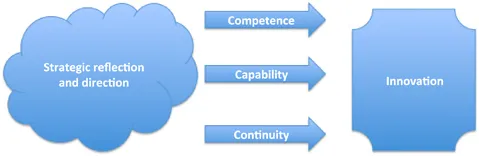
Smart survivors adapt and develop their own solutions, configuring from useful new external ideas and weaving these into the fabric of their own organization. They aim for continuity and flexibility and in particular they pay attention to three key strategic areas in which they build their organizational strengths (Figure 1.1):
- Competence — innovation relies on new knowledge. So we need to work on building the knowledge base, not just accumulating but gardening, nurturing new shoots, trying new crops, ensuring fertile soil — and from time to time pruning and cutting back. Innovation strategy depends on managing processes of competence building (through R&D, market research, strategic alliance and network building) and on other processes through which the knowledge base is configured and deployed to create value.
- Capability — innovation isn’t simply about accumulating knowledge, it is about creating value from it. Being able to do this and to repeat the trick means learning and embedding key lessons about how to make innovation happen. How to search, how to select, how to implement, how to capture value. The concept of ‘routines’ is helpful here — repeated and reinforced patterns of behaviour which eventually become embedded in the way we do things — our policies, procedures, processes.
- Continuity — over time these approaches become the company’s culture — ‘the way we do things around here’ representing its underlying values and beliefs. But if it is going to survive and prosper then it also needs ways of ensuring carryover of the essence of the company, understanding and transmitting its DNA to future generations.
Figure 1.1. Core Elements in Long-term Innovation.
WHO DOES THE INNOVATING?
It’s easy to talk about ‘the organization’ as if it were a machine just running these programs — routines — for innovation. But of course it is not — organizations are made up of people and they enact the routines. Its leaders, who create and shape the context and give strategic direction, and its entrepreneurs, who enable change to happen.
These days entrepreneurs are part of a mythology in which innovation is seen as being about heroes and start-ups. Great men and women who through their passion and insight take bright ideas and wrestle them into something that creates value. It’s a familiar pattern — but it’s also an erroneous one. Most innovation doesn’t take place in this dramatic battling fashion; instead it is a long haul, building and renewing, occasionally pushing the frontiers. Start-ups are only the beginning of what can be a long journey over constantly changing terrain.
The men and women we associate with this start-up phase may exert an influence and provide a direction and energy. But they didn’t grow their businesses alone — they did so through engaging and enabling many others to help them in their entrepreneurial journey.
Entrepreneurs matter — the individuals and teams who enable innovation through their energy and passion. Innovation, as Peter Drucker pointed out, ‘is what entrepreneurs do’.2 But they mostly do it in more modest ways, working within all sorts of organizations to keep the innovation motor running. They are the agents of change, the champions who move things forward, carrying the innovation torch.
Maybe we need a new word for this character — someone who works within an organization but who is also an agent of change. Various attempts have been made — the idea of the ‘intrapreneur’, for example someone who is prepared to swim against the mainstream organizational tide.3 Or ‘promotor’ — a label used by German researcher Eberhard Witte who suggested that we need different kinds of promotors, some with the technical knowledge to help mobilize their quest for change (‘fach-promotor’) and some with the power and influence to help drive it forward (‘macht-promotor’).4 Others, like Roy Rothwell, use the term ‘champion’ — giving the sense of someone prepared to stand their ground, fight their corner and push their vision.5 And Tom Allen’s work on innovation in the NASA space programme gave us another useful label — the gatekeeper, the person at the centre of social networks and webs of influence.6
Whatever the label it’s clear that there are many such ‘everyday entrepreneurs’ in our organizations and collectively they are responsible for moving the innovation agenda forward. They are different from start-up entrepreneurs in terms of the context within which they work, but also in terms of the underlying model they espouse which is less about disruption (the ‘creative destruction’ outlined by Joseph Schumpeter’s famous theory) and more about ‘creative evolution’.7
LEARNING FROM HISTORY
How does innovation happen? We know a lot about isolated cases, stories of breakthroughs like Post-It notes, the Model T Ford, Dyson’s bag-less vacuum cleaner, the i-phone, etc. …. But how does innovation happen within organizations, what goes on below the surface events, what are the underlying routines and how do they change over time?
How do champions operate and how do they keep things moving in a context which is also about stability and resilience? How can leaders of organizations create the conditions within which champions flourish, supporting them, challenging them, stretching them — but above all not losing them because of the ...