eBook - ePub
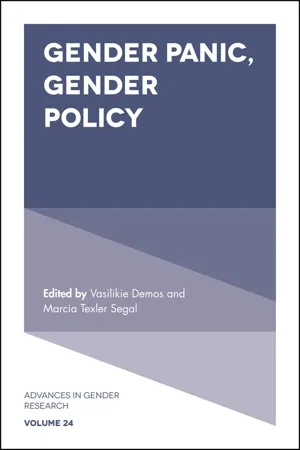
Gender Panic, Gender Policy
- 235 pages
- English
- ePUB (mobile friendly)
- Available on iOS & Android
eBook - ePub
Gender Panic, Gender Policy
About this book
Using diverse theories and methods including analysis of online data, feminist critical discourse, fieldwork, grounded theory, and queer theory, this edited volume explores gender panic and policy in the United States as well as Argentina, Australia, Belarus, Japan, Russia, Sweden, and subnational populations. Contributors consider a range of issues from the meaning of learning to play the traditional female role in order to develop a contemporary heteronormative romantic relationship to the difficulties of fairly accommodating non-binary people in traditionally gendered settings or the problem of implementing a gender-neutral rape law in a prison system that is structurally gendered. Gendered policies pertaining, particularly, to women and their fertility as a result of panics over low birthrates are explored as are issues relating to the validation of and problems with binary gender categories in elite sports. The impact of UN gender equality initiatives including LGBT equality on nation-states is also examined.
Information
TRADITION, WOMEN, AND THE PLACE OF REPRODUCTION
WOMEN IN THE MILITARY IN ARGENTINA: NATIONALISM, GENDER, AND ETHNICITY
ABSTRACT
Purpose: This chapter analyzes the gender/sexuality/race system through which the Argentine Army was constructed as the representative of the nation and guardian of its essential values. I will focus on the challenges faced because of the implementation of gender policies by the Ministry of Defense from a rights-based perspective in the institutional matrix of the military, structured through gender and race hierarchies.
Design/methodology/approach: This chapter is based on findings obtained through my experience as a member of the Gender Policy Council for Defense (GPC), from its creation in 2007 to the present, and my fieldwork on the Argentine Armed Forces.
Findings: The resistance to the implementation of gender policies in large part stems from the defiance of the “national ideal” – incarnated by the Argentine Army – constructed upon gender and race inequalities.
Research limitations/implications: Gender inequalities have generally been excluded and ignored in political analysis and in the study of nations and nationalism. For this reason, it is difficult to recover the missing links of history and give women’s lives and gender relations the importance they deserve in analyses of power. The chapter contributes to this task.
Practical and social implications: The resistance to the implementation of the policies sponsored by the GPC of the Ministry of Defense should be evaluated from a gender and ethnoracial perspective.
Originality/value: Research on women in the Argentine Armed Forces is still limited.
Keywords: Women; military; nationalism; ethnicity; gender policies; Argentina
The investigation that has been reported in this chapter analyzes the principal dimensions of the gender/sexuality/race system by which the Argentine Army has attempted to establish itself as elite and has been constituted as the representative of the nation and its essential values. I believe that making this system, which has received limited attention, visible could help to understand the social panic and resistance to gender policies in the military sphere. Since 2007, the implementation of systematic and sustained gender policies in the Argentine Armed Forces has intensified the perceived threat to the institution’s gender/sexuality/race system initiated by the incorporation of women in 1997 into the Colegio Militar de la Nación (CMN), the officer academy of the Argentine Army.
In accordance with the kind of “social dramas” described by Victor Turner (1974), the introduction of institutional norms based on a gendered egalitarian ethos produced a rupture in the system of social relations, which not only modified gender hierarchies but also ethnoracial hierarchies. The period in which this “crisis” suddenly occurred provides a clearer glimpse of the sex/gender/race system established in normative schemes, which have been consolidated through the realization of the profound regularities of conditioning, training, and social experience (Turner, 1974). I will analyze the Argentine Army as an institution considered as the representative of the nation and its “moral reserve” until the 1980s. The diverse dimensions of gender relations are crucial to comprehending the place of gender and ethnoracial inclusion/exclusion in the constitution of the Army as a state elite – associated with the upper classes – and as a national symbol in the formation of a post-colonial state.
This chapter draws inspiration from Rita Segato (2006, 2007) and Partha Chatterjee (1999) who work from a post-colonial perspective and who have shed light on my fieldwork. These authors draw attention to the danger of transposing concepts developed in the Western centers of power to interpret peripheral realities, without first critically assessing these concepts. Segato’s and Chatterjee’s works are especially relevant in the fields of race and gender relations in contexts of colonial domination.
For Segato, the processes of “racialization” have two levels that are important to recognize: first, the racial mark on Latin American national societies which (from the generalizing and typifying perspective of dominant countries) are perceived as non-White societies and, second, a matrix of racially marked otherness that has been built within each Latin American nation throughout its history. This matrix serves as a platform for the development of exclusion mechanisms by the elites who control the state and its resources (Segato, 2006). Segato considers that beyond the legal fiction of universal citizenship, a specific “national formation of otherness” (2006, p. 7) has played a decisive role in shaping the diversity and internal fractures of each nation. On the basis of this notion, defined as hegemonic national representations that produce realities, Segato analyzes how Brazil, Argentina, and the United States have each resolved ethnoracial heterogeneity in the construction of the nation. While Brazil has supported the ideal of mestizaje (a racial blend or mix) and the United States has fostered a mosaic of identifiable races coexisting as separate human groups on the same land, Argentina has advanced the notion of “ethnic terror” and “fear of diversity,” a homogenizing policing carried out by a Eurocentric elite situated in Buenos Aires, which controls the state institutions. “Being national” thus became a new rigorously constructed identity created by state intelligence and crafted by the three institutions responsible for this undifferentiated and ethnically neutral formation: education, public health, and mandatory military service (Segato, 2006, p. 8).
Chatterjee’s analysis of the “woman question” in India challenges some traditional Western categories aimed at explaining gender inequalities. The value of Chatterjee’s text lies in how it coordinates gender differences and hierarchies with a response to colonial politics and the construction of a nationalist ideology. In his argument, which forms part of a debate with Ghulam Murshid (1983), Chatterjee challenges the meanings attributed by the West to concepts such as public/private and modernity/conservatism, as well as the attribution of negative value to the feminine and to “private” spaces. Furthermore, he shows that what is given and accepted as “feminine” is constructed in direct connection with class membership.
The “woman question” was resolved by making a class distinction among Indian women following colonial logic (Chatterjee, 1999). The “new woman” of nationalist ideology was given a culturally superior position through a contrast between the Westernized women of the prosperous families of the new rich, created through their colonial connections, and the women from the lower classes. The latter were described as vulgar, deprived of a higher moral sense, sexually promiscuous, and subject to brutal physical oppression by men.
Considering the work of both authors, I emphasize two main ideas. On one hand, the histories of colonization, the diverse forms in which difference and inequality are constructed, and the traces of racialization and domination in state projects should be incorporated into national analysis. On the other hand, we should keep in mind how sex/gender systems are permeated by ethnoracial and class subordinations projected from each nation’s horizon of significance. Analyzing gender intersectionally along with ethnoracial and class inequalities within a context of construction of a national ideal enables us not only to make differences among women visible and understandable but also to demonstrate how gender inequality is intimately related to issues of power.
Another important contributor to the ideas in this chapter is Nira Yuval-Davis, who points out the scant attention given to women and gender issues in the analysis of nationalisms. According to Yuval-Davis,
Although not all nationalist ideologies are equally racist, processes of exclusion and inclusion are in operation wherever a delineation of boundaries takes place – as is the case with every ethnic and national collectivity – and many, if not most, include some elements of racist exclusions in their symbolic orders (1993, p. 624).
Taking into account that the formation of the Argentine Army involved the incarnation of the values of the nation and its representation, I believe that the study of the military is particularly relevant to the understanding of the construction of the nation’s specific “racial and gender-marked otherness.” I will focus on two main aspects: (1) the institutional norms that have limited and placed women and non-White men in “subordinate” positions and (2) the inclusion of women in the army as officers since 1997. On the basis of my experience, I will reinterpret the data of Máximo Badaró’s (2009) ethnography on the formation of cadets in the Army’s officer academy (the CMN) with respect to gender relations after the incorporation of women into the institution.
DATA COLLECTION METHODS
This chapter is based on the findings obtained through my experience as a current member of the Gender Policy Council for Defense (GPC) since its creation within the Argentine Ministry of Defense. The GPC has realized a series of regulatory reforms addressing a variety of the issues analyzed herein.
Data were also collected during ethnographic visits to military units of the army, navy, and air force in 2008. I conducted these visits as part of a research group sponsored by the Ministry of Defense, the Observatorio Sociocultural de la Defensa (the Sociocultural Observatory of the Defense), whose objective was to study the military profession in Argentina. Along with two anthropologist colleagues, I stayed between 2 and 5 days at various military units. During the visits, we observed the service-men and -women’s daily practices and conducted interviews and surveys.1 On two occasions, I observed military field exercises. The first exercise was a simulation conducted at night during which the army had to respond to an attack. The second was the first field test performed by cadets of the Argentine Air Force Academy.
My experience as a lecturer in the Gender and Institutional Management Diploma Program of the Argentine Air Force, along with the training I conducted for military women who served as members of the GPC during its inaugural year, and my participation in other institutional interventions for gender education, have all been very useful for understanding the dynamics of gender relations in the Armed Forces.
THE GPC OF THE MINISTRY OF DEFENSE
The GPC was created in early 2007 under the mandate of the first female Argentine Minister of Defense. The GPC serves as an adviser to the Ministry of Defense of the Republic of Argentina. For the formation of the GPC, the Ministry of Defense called upon servicewomen – officers and noncommissioned officers (NCOs) – from the three Armed Forces, representatives from non-governmental organizations (NGOs) related to the defense of women’s rights, and representatives from other state organisms such as the National Secretary of Human Rights and the National Council of Women. The GPC drove reforms of regulations in the Armed Forces, which involved the female dress code; pregnancy, lactation, and maternity leave; the family model encouraged by the military to date; sexual discrimination and harassment; domestic violence; and female participation on commissions abroad, among others.
The gender policies produced by the GPC were designed on the basis of an egalitarian ethos and in conjunction with two areas of knowledge: on one hand, the gender and feminist perspectives constructed by the national and international academic sphere and NGOs defending women’s rights, and, on the other hand, the national, regional, and international regulations regarding human and women’s rights (Masson, 2015). The Convention on the Elimination of all Forms of Discrimination Against Women (CEDAW) is particularly cited in the considerations of the Ministry’s resolutions. For example, it is mentioned as an argument to promote the adoption of temporary special measures by States Parties with the aim of accelerating de facto equality between men and women so that States Parties agree to pursue, by all means and without delay, a policy of eliminating discrimination against women for the adoption of special measures to protect maternity, which shall not be considered discriminatory, and to eliminate discrimination against women in the field of employment.
WOMEN’S HISTORY IN ARGENTINA
To better understand the reforms carried out by the GPC, a brief and schematic reference to the feminist movement in Argentina is necessary. I believe there are four historical moments throughout the twentieth century. The first wave of feminism in Argentina can be traced back to the early twentieth century. The first feminists were linked to the organization of political groups such as the socialist party and anarchist organizations. The members of these first organizations were characterized by their high levels of education and were very influential in the struggle for women’s political rights. The second moment of vital importance for women’s rights took place in 1947, during the administration of Juan Peron: the achievement of women’s suffrage, which occurred within the context of multiple reforms to the legal status of women in various Western countries. The third is the resurgence of the feminist movement in the late 1960s and early 1970s (Calvera, 1990; Masson, 2007). It is worth noting that, during this same period, women participated in left-wing political parties and in some cases in armed conflict. Alth...
Table of contents
- Cover
- Gender Panic, Gender Policy
- Gender Panic, Gender Policy: An Introduction
- Part I: Tradition, Women, and the Place of Reproduction
- Part II: Questioning the Gender Binary
- Part III: Policing Gender: Rules, Regulations, and Laws
- Index
Trusted by 375,005 students
Access to over 1.5 million titles for a fair monthly price.
Study more efficiently using our study tools.
Frequently asked questions
Yes, you can cancel anytime from the Subscription tab in your account settings on the Perlego website. Your subscription will stay active until the end of your current billing period. Learn how to cancel your subscription
No, books cannot be downloaded as external files, such as PDFs, for use outside of Perlego. However, you can download books within the Perlego app for offline reading on mobile or tablet. Learn how to download books offline
Perlego offers two plans: Essential and Complete
- Essential is ideal for learners and professionals who enjoy exploring a wide range of subjects. Access the Essential Library with 800,000+ trusted titles and best-sellers across business, personal growth, and the humanities. Includes unlimited reading time and Standard Read Aloud voice.
- Complete: Perfect for advanced learners and researchers needing full, unrestricted access. Unlock 1.5M+ books across hundreds of subjects, including academic and specialized titles. The Complete Plan also includes advanced features like Premium Read Aloud and Research Assistant.
We are an online textbook subscription service, where you can get access to an entire online library for less than the price of a single book per month. With over 1.5 million books across 990+ topics, we’ve got you covered! Learn about our mission
Look out for the read-aloud symbol on your next book to see if you can listen to it. The read-aloud tool reads text aloud for you, highlighting the text as it is being read. You can pause it, speed it up and slow it down. Learn more about Read Aloud
Yes! You can use the Perlego app on both iOS and Android devices to read anytime, anywhere — even offline. Perfect for commutes or when you’re on the go.
Please note we cannot support devices running on iOS 13 and Android 7 or earlier. Learn more about using the app
Please note we cannot support devices running on iOS 13 and Android 7 or earlier. Learn more about using the app
Yes, you can access Gender Panic, Gender Policy by Vasilikie (Vicky) Demos, Marcia Texler Segal, Vasilikie (Vicky) Demos,Marcia Texler Segal, Vasilikie P. Demos, Marcia Texler Segal in PDF and/or ePUB format, as well as other popular books in Social Sciences & Gender Studies. We have over 1.5 million books available in our catalogue for you to explore.