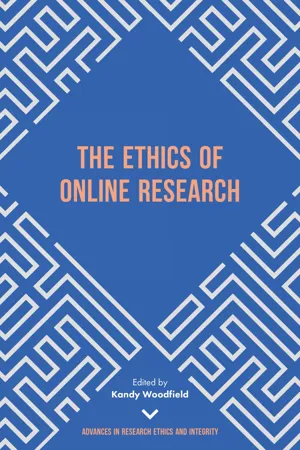
This volume focuses on the ethics of internet and social networking research exploring the challenges faced by researchers making use of social media and big data in their research. The internet, the world wide web and social media – indeed all forms of online communications – are attractive fields of research across a range of disciplines. They offer opportunities for methodological initiatives and innovations in research and easily accessed, massive amounts of primary and secondary data sources. This collection examines the new challenges posed by data generated online, explores how researchers are addressing those ethical challenges, and provides rich case studies of ethical decision making in the digital age.
- 195 pages
- English
- ePUB (mobile friendly)
- Available on iOS & Android
eBook - ePub
The Ethics of Online Research
About this book
Information
Publisher
Emerald Publishing LimitedYear
2017Print ISBN
9781800431751
9781787144866
eBook ISBN
9781787434462
CHAPTER 1
THE ETHICAL DISRUPTIONS OF SOCIAL MEDIA DATA: TALES FROM THE FIELD
ABSTRACT
This chapter explores the perfect storm brewing at the interface of an increasingly organized ethics review process, grounded in principles of anonymity and informed consent, and the formation of a new digital data landscape in which vast quantities of unregulated and often personal information are readily available as research data. This new form of data not only offers huge potential for insight into everyday activities, values, and networks but it also poses some profound challenges, not least as it disrupts the established principles and structures of the ethics review process. The chapter outlines four key disruptions posed by social media data and considers the value of situational ethics as a response. Drawing on the experiences and contributions of Ph.D. students in interdisciplinary Web Science, the chapter concludes that there is a need for more sharing of the ethical challenges faced in the field by those at the ‘cutting edge’ of social media research and the development of shared resources. This might inform and speed-up the adaptation of ethics review processes to the challenges posed by new forms of digital data, to ensure that academic research with these data can keep pace with the methods and analyses being developed elsewhere, especially in commercial and journalistic contexts.
Keywords: Social media data; ethical disruptions; data ownership; social life of data; scale and granularity; interdisciplinarity; web science
INTRODUCTION
Over the past 30 years, the ethics landscape for social research has undergone some fundamental changes. Even as recently as the late 1980s – when I started my Ph.D. – there were no formal ethics procedures for social scientists, at least where I was working. This is certainly not to say that, as researchers, we did not consider the ethics of our research but rather that we relied on our own judgment and on the norms of practice in our field, among our peers and on the advice of our supervisors to guide our practice. Mostly very sensible decisions were made but so too some extraordinary things were done, and some ill-considered risks were taken, at least by today’s standards. Overall, in my experience, research practice appeared to be broadly ethical – but by individual disposition, cultural environment and (sometimes) by luck, rather than by design.
Over the intervening years, there has been a progressive organization and bureaucratization of the UK university research ethics: the establishment of standardized rules and procedures, using specified forms and checklists, within institutionalized workflows and hierarchies of decision-making. The roots for this lie at least as far back as the 1960s, with calls for the introduction of an ethics review process in biomedical research (Kerrison & Pollock, 2005) and with attention to the issue filtering slowly into individual universities, including into the social sciences (Tinker & Coomber, 2005). By 2003, the Economic and Social Research Council began the process of establishing a Research Ethics Framework,1 which was introduced in 2006 and rapidly became established as the benchmark across social science research and – in particular – prescribed a governance framework for institutions wishing to receive ESRC funding (strengthened by updates in 2010). Alongside this, the UK Universities Research Ethics Forum was established in 2005 as a sectorwide group for sharing experience and practice and the UK Research Integrity Office was launched in 2006. The UK ethics governance structure continues to develop, with the publication in 2012 of the Concordat to Share Research Integrity by a consortium of University and Government research agencies, followed by the Economic and Social Research Council’s own more specific and updated Framework for Research Ethics in 2015.
Within this infrastructure, appropriate standards of practice are defined, within a professional framework that provides layers of protection for the researchers and institutions involved. In the interests of our participants, contemporary ethic processes seek to ensure rights, protection from harm, and an active voice in the research process. These processes also protect the researcher from potentially risky situations, and the harms that might result, and from legal liability so long as research is conducted as proposed. In turn, this protects the status, corporate reputation, and financial interests of the universities and research institutions. In Weberian terms these standardized rules offer a progressive means toward efficiency and fairness (Weber, 1964; Clegg, 1990). In more Foucauldian terms, we might also see these changes as part of a shift in the wider organizational discourse, as a new assemblage of values and practices are institutionalized as the ‘right and proper’ values, standards, and practices, where the possible ways of ethical social science research have been narrowed to the ‘best’ way of ensuring ethical research and, it can seem, presented as the ‘only’ way of achieving this. We might think here of informed consent, anonymization and individual protection from harm – the gold standards of the social science ethics regime, echoing the original concerns from biomedicine (Neuhaus & Webmoor, 2012; Kernagham, 2014; Zwitter, 2014).
Meanwhile, as these processes were underway, so too was a remarkable set of changes in the nature of the data that social researchers have available to them. As public applications for the Internet began to take-off in the 1980s, e-mails, bulletin boards, and UseNet groups became a rich new source of ‘found’ data for researchers (Dery, 1994; Rafaeli & Rose, 1993; Rheingold, 1993; Sproull & Kiesler, 1986). But this was nothing compared to what came next. In 1989, Tim Berners-Lee wrote a memorandum proposing a new global information-sharing system that would come to be known as the World Wide Web. Berners-Lee’s original motivation was to find a means through which researchers working in remote teams could share data more easily, using standardized protocols on top of the Internet (Berners-Lee, 2000). This was a rather successful idea, of course, with the number of web pages rising from 0 in 1990 to almost a billion today.2 A significant source of information for researchers across the academy, as well as for governmental and independent research institutes. However, by the mid-2000s, it became clear that this too was just the beginning. What had started as a means of sharing data was becoming a means of generating data – ‘big data’ – of a variety, scale, and velocity unimaginable in 1989. We might think, for example, of the all the browser searches and link-clicks that can be captured as the digital traces of our preoccupations and preferences as we surf the Web and which are fuelling a new data economy (Mayer-Schönberger & Cukier, 2013). Unfortunately, few of these data are accessible to researchers (outside of the corporate giants that own them). However, the evolution of the Web from ‘read only’ to a ‘read-write’ Web that was both driven by and fuelled the take-off of social media has generated another remarkable new source of data for social research, some of which is readily available to researchers, online, and at no cost (e.g., from Twitter, Instagram, and You Tube). These data provide digital traces of the everyday, at an individual and often a remarkably intimate level of detail. As Latour (2007, p. 2) has remarked ‘[…] it is as if the inner workings of private worlds have been pried open.’
So we have a perfect storm. On the one side, we have the cumulative bureaucratization of research ethics review processes, shaped by a particular set of discourses that define appropriate research practice. On the other a radical transformation in our data landscape through processes that fall outside of the remit of our formalized ethics processes and which disrupt the bureaucracy of ethical practice in its current form and the discursive formation that supports this. These are disruptions have become increasingly apparent for those of us working with social media data across the academic field and – more locally – for us in the Web Science Institute, at the University of Southampton, UK, where we undertake a wide range of research with social media across the disciplines, in particular thorough the Centre for Doctoral Training in Web Science. The following discussion is grounded in this practical experience, organized into three sections. Section 1 outlines in principle five of the key ethical disruptions posed by the use of social media data in social research. Section 2 considers some of the consequences of these as they appear in the practice of research, including the turn to situational ethics. Building on this, Section 3 suggests how the practice of situational ethics might be supported. These observations draw on my own experience, on discussion with colleagues over the years, and, in particular, on the contributions of Ph.D. researchers working at the cutting edge of research with social media data under the interdisciplinary umbrella of Web Science.
DISRUPTIONS
In what follows, I outline five ethical disruptions that have arisen in the context described above. These are grounded in our experience. It is, no doubt, an idiosyncratic list and is intended as a starting point, rather than a finished description. In order to develop our understanding of the ethical issues involved in using social media data, researchers will need to share experiences and explore the points of overlap and difference. Important points of difference to consider will include sensitivity to both the different types of data that we use, and the questions that we ask of these data.
These Data are Already Created
Our current ethics regime, and its associated bureaucracy, assumes (very largely) that we are seeking approval to generate new data. The existing assumption is that we design the methodology, we negotiate the terms of access, and we deploy the methods that turn our research into ‘generated’ data. We control the means of production, so we can ensure that this is ethically done. We know who the participants will be, will avoid unnecessary exclusions/appropriate inclusions or protect vulnerable groups, won’t ask about certain things, will seek informed consent, ensuring that our participants understand their right to withdraw, and we won’t conduct covert research (or almost never unless safe, secure, and absolutely necessary). In contrast, social media data are already produced and can be deeply personal. We don’t always know for sure who has produced them or their age or status in terms of the categories of vulnerability we are used to (under 18, unable to give consent, and so on) or, from a more formal, legal perspective, the jurisdictions in which they are produced. And whatever the data were produced for, however much the intention may have been to make a public expression of creativity or to ‘be seen’ (at least at the time) users’ knowledge and understanding of whether their social media posts are ‘data’ are uneven and their views on the re-use of this material are complex (Beninger et al., 2014; Evans, Ginnis, & Bartlett, 2015).
These Data are Beyond Our Control
In completing research ethics review applications, we promise to care for our data, keeping them in a locked filing cabinet and on servers behind a university firewall and password-protected computers. This is underpinned by the assumption that what happens to the data is in our power and that we can use that power to behave ethically. So, we are assumed to be able to guarantee confidentiality and anonymity to our participants, ensuring that no personal details are made public, because no one else has access to the data to interrogate it. An exception to this is the (increasing) expectation or even requirement from funders that data be made available through archives for secondary analysis but even then, it is possible to make the argument that the sensitive nature of particular data sets makes them unsuitable for deposit. If we do deposit our data, we can redact sections to exercise control over anonymization, and the full individual level data sets – qualitative data sets especially – are rarely (as yet) published in their entirety online. In short, the current ethics regime assumes that we can and should make effective assurances to participants about what happens to their data. In contrast, social media data are already published, available to anyone, and computational methods can compare incomplete data to similar data sets published elsewhere, and/or cross reference with other related data sets, at scale and speed, making irreversible anonymization nigh on impossible, especially if we consider the possibilities of as yet uninvented methods for reverse engineering.
These Data are Not Finite
The c...
Table of contents
- Title
- Introduction to Volume 2: The Ethics of Online Research
- Chapter 1. The Ethical Disruptions of Social Media Data: Tales from the Field
- Chapter 2. Users’ Views of Ethics in Social Media Research: Informed Consent, Anonymity, and Harm
- Chapter 3. The Changing Roles of Researchers and Participants in Digital and Social Media Research: Ethics Challenges and Forward Directions
- Chapter 4. Using Twitter as a Data Source: An Overview of Ethical, Legal, and Methodological Challenges
- Chapter 5. Getting to Yes: Informed Consent in Qualitative Social Media Research
- Chapter 6. The Trouble with Tinder: The Ethical Complexities of Researching Location-Aware Social Discovery Apps
- Chapter 7. Ethical Challenges of Publishing and Sharing Social Media Research Data
- Chapter 8. The Ethics of Using Social Media Data in Research: A New Framework
- Chapter 9. Where Next for #Socialethics?
- Chapter 10. Conclusion: Guiding the Ethics of Online Social Media Research – Adaptation or Renovation?
- Index
Trusted by 375,005 students
Access to over 1.5 million titles for a fair monthly price.
Study more efficiently using our study tools.
Frequently asked questions
Yes, you can cancel anytime from the Subscription tab in your account settings on the Perlego website. Your subscription will stay active until the end of your current billing period. Learn how to cancel your subscription
No, books cannot be downloaded as external files, such as PDFs, for use outside of Perlego. However, you can download books within the Perlego app for offline reading on mobile or tablet. Learn how to download books offline
Perlego offers two plans: Essential and Complete
- Essential is ideal for learners and professionals who enjoy exploring a wide range of subjects. Access the Essential Library with 800,000+ trusted titles and best-sellers across business, personal growth, and the humanities. Includes unlimited reading time and Standard Read Aloud voice.
- Complete: Perfect for advanced learners and researchers needing full, unrestricted access. Unlock 1.5M+ books across hundreds of subjects, including academic and specialized titles. The Complete Plan also includes advanced features like Premium Read Aloud and Research Assistant.
We are an online textbook subscription service, where you can get access to an entire online library for less than the price of a single book per month. With over 1.5 million books across 990+ topics, we’ve got you covered! Learn about our mission
Look out for the read-aloud symbol on your next book to see if you can listen to it. The read-aloud tool reads text aloud for you, highlighting the text as it is being read. You can pause it, speed it up and slow it down. Learn more about Read Aloud
Yes! You can use the Perlego app on both iOS and Android devices to read anytime, anywhere — even offline. Perfect for commutes or when you’re on the go.
Please note we cannot support devices running on iOS 13 and Android 7 or earlier. Learn more about using the app
Please note we cannot support devices running on iOS 13 and Android 7 or earlier. Learn more about using the app
Yes, you can access The Ethics of Online Research by Kandy Woodfield in PDF and/or ePUB format, as well as other popular books in Social Sciences & Social Science Research & Methodology. We have over 1.5 million books available in our catalogue for you to explore.