The first in-depth account of the lives and careers of educated slaves and freedmen in ancient Rome
Slaves and freedmen played an important yet understudied role in the literary culture of the Roman Republic. Though their work went largely uncredited, they fulfilled vital roles as editors, researchers, and collaborators in the service of Rome’s literary and political elite. Intellectual Property tells the stories of these gifted and highly educated young men, from Licinius the flute-player, who shaped the rhetorical style of the orator Gaius Gracchus, to the grammarian and teacher Tyrannio of Amisus, who was brought to Rome as a war captive.
Highlighting the unique social prestige of literary production and intellectual performance in a society pervaded by slave labor, Harriet Flower shows how the exorbitant prices paid for the highly educated encouraged a complex system of training young boys for the marketplace or acquiring educated captives as booty, and how they were treated as valuable assets to be deployed as prizes, gifts, or investments that could bestow financial and cultural capital. She demonstrates how enslaved and manumitted intellectuals, far from being menial workers, shared close relationships with leading Romans of the day. They came from a variety of backgrounds and were relied on as coauthors and collaborators in a range of genres, with some gaining fame as authors themselves.
With lively case studies and insightful new interpretations of the ancient sources, Intellectual Property paints a more nuanced picture of enslaved labor in ancient Rome, revealing how the contributions of enslaved intellectuals were closely linked to the ambitious development of Latin literary culture and the dissemination of knowledge.
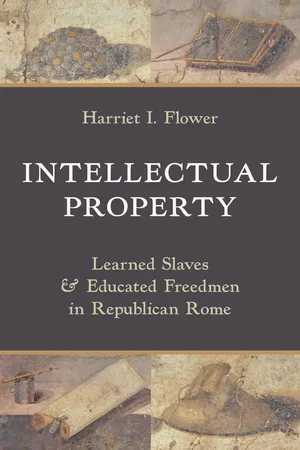
eBook - ePub
Intellectual Property
Learned Slaves and Educated Freedmen in Republican Rome
- English
- ePUB (mobile friendly)
- Available on iOS & Android
eBook - ePub
About this book
Information
Publisher
Princeton University PressYear
2025Print ISBN
9780691270333
9780691266169
eBook ISBN
9780691270210
Table of contents
- Cover Page
- Title Page
- Copyright Page
- Dedication
- Epigraph
- Contents
- Preface
- Introduction: Intellectual Pursuits and the (Formerly) Enslaved
- One: Licinius the Flute Player and Gaius Gracchus the Orator
- Two: In the Households of Cato the Censor and Atticus the Businessman
- Three: The Homegrown and the Immigrant: Quintus Lutatius Daphnis the Freedman and Archias of Antioch the Greek Poet
- Four: Multitaskers: Aurelius Opillus and Lucius Cornelius Epicadus
- Five: Foundlings: A Genial “Miser” and a Librarian who Collected Old Jokes
- Six: Intellectual Prisoners Captured in War: Two Tyrants, a Literary Scholar, and a Fierce Critic
- Seven: Conclusion: Glimpses of Educated Men who had been Enslaved
- Notes
- Bibliography
- Index
Trusted by 375,005 students
Access to over 1.5 million titles for a fair monthly price.
Study more efficiently using our study tools.
Frequently asked questions
Yes, you can cancel anytime from the Subscription tab in your account settings on the Perlego website. Your subscription will stay active until the end of your current billing period. Learn how to cancel your subscription
No, books cannot be downloaded as external files, such as PDFs, for use outside of Perlego. However, you can download books within the Perlego app for offline reading on mobile or tablet. Learn how to download books offline
Perlego offers two plans: Essential and Complete
- Essential is ideal for learners and professionals who enjoy exploring a wide range of subjects. Access the Essential Library with 800,000+ trusted titles and best-sellers across business, personal growth, and the humanities. Includes unlimited reading time and Standard Read Aloud voice.
- Complete: Perfect for advanced learners and researchers needing full, unrestricted access. Unlock 1.5M+ books across hundreds of subjects, including academic and specialized titles. The Complete Plan also includes advanced features like Premium Read Aloud and Research Assistant.
We are an online textbook subscription service, where you can get access to an entire online library for less than the price of a single book per month. With over 1.5 million books across 990+ topics, we’ve got you covered! Learn about our mission
Look out for the read-aloud symbol on your next book to see if you can listen to it. The read-aloud tool reads text aloud for you, highlighting the text as it is being read. You can pause it, speed it up and slow it down. Learn more about Read Aloud
Yes! You can use the Perlego app on both iOS and Android devices to read anytime, anywhere — even offline. Perfect for commutes or when you’re on the go.
Please note we cannot support devices running on iOS 13 and Android 7 or earlier. Learn more about using the app
Please note we cannot support devices running on iOS 13 and Android 7 or earlier. Learn more about using the app
Yes, you can access Intellectual Property by Harriet I. Flower in PDF and/or ePUB format, as well as other popular books in History & Roman Ancient History. We have over 1.5 million books available in our catalogue for you to explore.