eBook - ePub
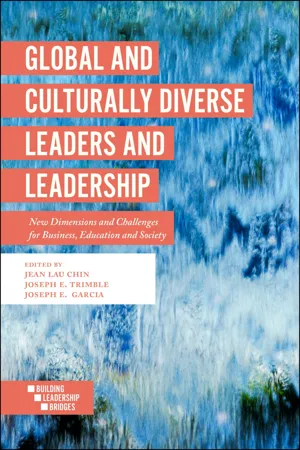
Global and Culturally Diverse Leaders and Leadership
New Dimensions and Challenges for Business, Education and Society
- 348 pages
- English
- ePUB (mobile friendly)
- Available on iOS & Android
eBook - ePub
Global and Culturally Diverse Leaders and Leadership
New Dimensions and Challenges for Business, Education and Society
About this book
Global and Culturally Diverse Leaders and Leadership explores diverse cultural leadership styles and paradigms that are dynamic, complex, globally authentic and culturally competent for the 21st century. An outstanding group of scholars considers how the different worldviews and lived experiences of leaders influence their leadership styles. They discuss several dimensions, models and initiatives for examining leadership in a global and diverse world, ultimately offering ways in which these leadership processes may be assessed and cultivated in a culturally sensitive and ecologically valid manner. Redefining leadership as global and diverse, this book imparts a new understanding of the criteria for selecting, training and evaluating leaders in the 21st century.
Information
A New Look at Leadership: Overview
CHAPTER
1
Theory Leadership from Africa: Examples of Trait Theory
Leadership from Africa: Examples of Trait Theory: Introduction
Written from a Leadership Studies educator’s perspective, this chapter highlights and challenges the Western bias of leadership theories, and disrupts this ideological ethnocentrism by presenting leadership trait theory through the experiences of contemporary African community leaders. Using one of the most recognizable theories in leadership studies, this chapter proposes reimagining trait theory by presenting examples of skills, abilities, and qualities of leadership by contemporary leaders from Liberia, Cameroon, and South Africa.
By using examples of leadership in African countries, this chapter demonstrates that the Western bias of leadership is artificial because its theories, particularly trait theory, can be successfully employed to discuss leadership in non-western contexts in ways that prize the differences in culture and societies.
Current leadership theories need not be forsaken in favor of creating new Afro-centered leadership theories. It is possible to explore the attributes, skills, and abilities of trait theory using examples from places around the world that have typically been excluded as viable places to study leadership. To heed the call for inclusive leadership, particularly in a global society, it is crucial that Leadership Studies educators intentionally examine how leadership theories can be taught by exploring different ways of knowing and being. Failure to do so undermines the complexity of leadership and Leadership Studies, which transcend a single worldview.
This chapter presents an opportunity to explore leadership trait theory beyond typical examples from the West. Valuable lessons about leadership skills, abilities, and traits, can come from parts of the world that have been excluded from the leadership studies canon.
The objective of this chapter is to bring Africa into Leadership Studies education by demonstrating how Western theories of Leadership Studies can be studied and taught using Africans as examples of theories. The secondary objective of this chapter is to prompt leadership educators to think about expanding their understanding and examples of leadership by intentionally seeking leadership voices and experiences from different parts of the world.
With an aggregate population of almost one billion, the African continent is an important part of the global marketplace, with imports and exports in the form of goods and services worth billions of dollars (Nwosu in Deardoff, 2009, p. 158). Africans are creating and participating robustly in a world that has seen widespread shifts due to trade, technology, and migration (p. 159). This assertion is hardly new, yet Africa is noticeably and frequently excluded from conversations that explore the study of leadership. As Bangura (2011, p. 133) noted: “no one would deny that the continent of Africa is intimately involved when the disciplines of Geography, History, Political Science, Linguistics, Economics or Anthropology” are examined. However, the same cannot be said for the Leadership Studies canon. African voices and experiences have been excluded from the intellectual pursuit of leadership. This exclusion of Africa in Leadership Studies harkens back to the ideas advanced by 19th-century European thinkers who wrote and spoke of Africans “as objects unworthy of study, as lacking history, as lacking culture” (p. 133). Yet the rich and complex precolonial, colonial, and postcolonial histories of Africa’s 55 recognized states show leadership in nuanced forms.
Exclusion from the Leadership Studies canon is not unique to Africa. The global south is noticeably absent in leadership theories and approaches that dominate academic curricula, international policy, and models of governance. The emergence of Leadership Studies as a discipline in the last 60 years has shown the pervasiveness of a Western, particularly North American lens (Den Hartog & Dickson, 2012). The result has been a discursive imperialism of sorts, wherein the West is positioned as the authority on the concept and practice of leadership, and leadership that occurs outside of this particular framework is not legitimate or noteworthy. In an effort to counter the problematic ethnocentrism in leadership theory, I call for intentional inclusion of non-Western experiences and perspectives in Leadership Studies education.
In this chapter, I propose a reimagining of trait theory by highlighting examples of young Africans who are influencing and advancing their communities: Arthur Zang, Fatu Kekula, and Sizwe Nzima. Arthur Zang, a Cameroonian engineer, invented the Cardiopad: “a touch screen medical tablet that enables heart examinations…to be performed at remote rural locations while the results of the test are transferred wirelessly to specialists…” (Nsehe, 2012). Fatu Kekula from Liberia saved her entire immediate family from the deadly Ebola virus (Cohen & Bonifield, 2015). Sizwe Nzima from South Africa started Iyeza Express: a medication delivery service (Kelto, 2014). The achievements of these three remarkable leaders show a kind of leadership that Masango (2002) designated as life giving and innovative. Moreover, these exceptional individuals exhibit some of the oft-cited desirable traits in leadership trait theory: intelligence, determination, and integrity (Northouse, 2015). Ultimately, this chapter serves as a resource for leadership educators to explore some of what Africa has to offer Leadership Studies education.
Before presenting the leadership stories of Arthur, Fatu, and Sizwe, I begin by discussing the positioning of Leadership Studies as a Western concept, followed by a brief overview of trait theory. The chapter ends with a discussion of the implications of shifting trait theory from a Eurocentric lens to a more global perspective that considers cultural and social context, which ultimately invites different voices and experiences in Leadership Studies education.
Locating Personal Interest
Sikes (2010, p. 19) noted that in maintaining a standard of ethics regarding their work, scholars must clearly present “where they are positioned in regard to their work.” Explaining one’s position includes revealing the origin of interest in the topic, and how the topic relates to personal experience (p. 19). I am a Leadership Studies educator. Teaching at the undergraduate level, my work in the classroom is committed to guiding learners towards and through the complexity of leadership. Guided by a postmodern lens, I hold that leadership is socially and culturally mediated, and one’s geographical positioning in the world affects perceptions and practice of leadership.
Born and raised in Zimbabwe, I navigate the world as an African woman. I respond to people, places, things, and events as an African woman. I know that the continent, in its rich yet complex state, is poised to contribute valuable ways of knowing and being when it comes to the study and practice of leadership. As a young African, I believe that there are many young Africans who are doing incredible work to uplift their communities to little or no fanfare. Their leadership is a powerful reminder of Masango’s (2002) life giving and innovative leadership.
At this juncture, I will also note that though I am writing about African examples of leadership trait theory and specifically name the countries of Liberia, Cameroon, and South Africa, I also invoke the rest of the global south, for the exclusion in Leadership Studies extends to regions such Latin America, the Middle East, and parts of South Asia. One can also find powerful examples of leadership that are scarcely written about and given due designation as demonstrations of leadership as it is known in the discipline. Though I do not write specifically about the global south in this chapter, the point remains that this is a part of the world that is not included in the framing of Leadership Studies and in the way that leadership is taught.
Leadership as a Western Paradigm
In a New York Times opinion piece, Garfield and Van Nordern (2016) issued a poignant call to their colleagues in the field of Philosophy. In a clear and pointed critique, they highlighted the flaw in their discipline, noting: “the vast majority of philosophy departments in the United States offer courses only on Philosophy derived from Europe and the English-speaking world” (2016). This same critique is gaining momentum in Leadership Studies education, particularly directed at leadership theories and approaches. Works by Chin and Trimble (2015), Schedlitzki and Edwards (2014), and Den Hartog and Dickinson (2012) extensively discuss a Western bias of leadership theory.
Presenting a history of Leadership Studies, Perkins (2009) advised that though there is a Western bias in leadership research, the study and practice of leadership is ancient and universal, meaning that the concept of leadership transcends borders and fixed time periods. For example, the concepts of leader, follower, and leadership have been pointed out in Egyptian symbols dating back to 5,000 years ago (Bass, 1995). Such resources interrupt the notion of the discipline of Leadership Studies as couched in Western civilization, with examples of ideal leadership often associated with the works of Plato and Aristotle (Wren, 1995).
Alvez, Manz, and Butterfield (2005) proposed that leadership has “long been treated as a global field of study, borrowing from Eastern and Western classic teachings” (p. 9). However, this is a narrow treatment of the term “global field” in that it excludes much of the world as contributors to the field. These Eastern and Western classic teachings on leadership are often limited to examples such as Aristotle, Confucius, Buddha, Churchill, and Gandhi. However, this leaves out too many parts of the world as valuable sources for studies and scholarship on leadership, particularly Africa. This vacuum led Jallow (2014) to proclaim that there is “a need for African Leadership Studies, Asian Leadership Studies, Latin American Leadership Studies, and Middle Eastern Leadership Studies” (p. 3).
Shifting focus from historical major figures, contemporary leadership scholarship increasingly examines societal and contextual issues such as power, gender, and ethics (Day & Antonakis, 2012). However, there is no explicit focus on worldview. The arena in which leadership is studied and practiced is vast, so it is concerning that Leadership Studies as a discipline discusses cultural and social influences on leadership as special issues rather than critical shapers of the discipline. For example, a review of widely used textbooks on leadership shows the topic of leadership and culture at the bottom of the table of contents, and/or covered within a single chapter. Peter Northouse’s Leadership: Theory and Practice (2015), places leadership and culture as Chapter 16 out of 16 chapters. Similarly, Richard Daft and Patricia Lane’s The Leadership Experience (2015) examines leadership and culture in Chapter 14 out of 15 chapters. By treating leadership and culture as a special interest topic, the implication is that cultural and social contexts operate at the periphery of the discipline. Ideally, such chapters should be at the beginning of popular textbooks because it is important to frame cultural and social contexts as critical shapers in assessing the strengths and weaknesses of leadership theories, particularly for learners who are new to the discipline. Texts such as Chin and Tremble’s Diversity and Leadership (2015) underscore how global shifts in trade, technology, and migration have buoyed advocacy for the inclusion of cultural and social contexts as a focal point for leadership.
If students, scholars, and educators are to laud Leadership Studies as an interdisciplinary field, then collective and intentional work must be done to make it an intercultural field of study. What I am proposing is not radical. Scholars need not completely change the basis of current leadership theory in order to be inclusive. Instead, there are opportunities to contextualize existing leadership theories so that their tenets can be appreciated from a culturally relativistic lens (Jallow, 2014). Indeed, the intellectual space for this already exists. Leadership is the study of possibilities based on context, situations, and contingencies (Ayman & Adams, 2012). This view creates space to critique, advance, and reimagine the concept and practice of leadership while spanning geographical borders. This is the allure of Leadership Studies despite its current limitations in inclusivity.
With this perspective, I present trait theory in contemporary terms with African exemplars. Even though I have levied the critique that Leadership Studies is presented from a Western centric lens, this very same lens can be used to study leadership related to Africa in a way that prizes African voices and experiences. This follows Bangura’s (2011) proposition that...
Table of contents
- Halftitle Page
- Series
- Title Page
- Copyright
- Contents
- List of Contributors
- Foreword
- Introduction
- Part 1 A New Look at Leadership: Overview
- Part 2 Ethnocultural Contexts
- Part 3 Application of Global and Diverse Perspectives in Different Contexts
- Epilogue
- About the Authors
- About the Editors
- Index
Trusted by 375,005 students
Access to over 1.5 million titles for a fair monthly price.
Study more efficiently using our study tools.
Frequently asked questions
Yes, you can cancel anytime from the Subscription tab in your account settings on the Perlego website. Your subscription will stay active until the end of your current billing period. Learn how to cancel your subscription
No, books cannot be downloaded as external files, such as PDFs, for use outside of Perlego. However, you can download books within the Perlego app for offline reading on mobile or tablet. Learn how to download books offline
Perlego offers two plans: Essential and Complete
- Essential is ideal for learners and professionals who enjoy exploring a wide range of subjects. Access the Essential Library with 800,000+ trusted titles and best-sellers across business, personal growth, and the humanities. Includes unlimited reading time and Standard Read Aloud voice.
- Complete: Perfect for advanced learners and researchers needing full, unrestricted access. Unlock 1.5M+ books across hundreds of subjects, including academic and specialized titles. The Complete Plan also includes advanced features like Premium Read Aloud and Research Assistant.
We are an online textbook subscription service, where you can get access to an entire online library for less than the price of a single book per month. With over 1.5 million books across 990+ topics, we’ve got you covered! Learn about our mission
Look out for the read-aloud symbol on your next book to see if you can listen to it. The read-aloud tool reads text aloud for you, highlighting the text as it is being read. You can pause it, speed it up and slow it down. Learn more about Read Aloud
Yes! You can use the Perlego app on both iOS and Android devices to read anytime, anywhere — even offline. Perfect for commutes or when you’re on the go.
Please note we cannot support devices running on iOS 13 and Android 7 or earlier. Learn more about using the app
Please note we cannot support devices running on iOS 13 and Android 7 or earlier. Learn more about using the app
Yes, you can access Global and Culturally Diverse Leaders and Leadership by Jean Lau Chin, Joseph E. Trimble, Joseph E. Garcia, Jean Lau Chin,Joseph E. Trimble,Joseph E. Garcia in PDF and/or ePUB format, as well as other popular books in Business & Human Resource Management. We have over 1.5 million books available in our catalogue for you to explore.