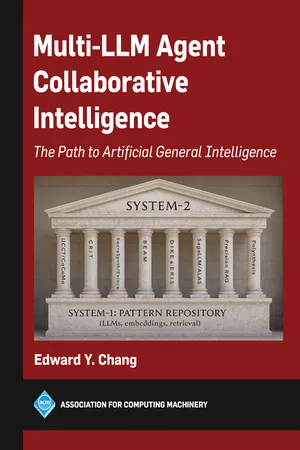
Multi-LLM Agent Collaborative Intelligence
The Path to Artificial General Intelligence
- English
- ePUB (mobile friendly)
- Available on iOS & Android
About this book
Today's large language models excel at pattern recall yet falter on long-range planning, self-critique, context loss, and the tendency of maximum-likelihood training to reward popularity over quality. MACI offers a promising route to AGI by orchestrating specialized LLM agents through explicit protocols rather than enlarging a single model. Several modules remedy complementary weaknesses: adversarial-collaborative debate surfaces hidden assumptions; critical-reading rubrics filter incoherent arguments; information-theoretic signals steer dialogue quantitatively; transactional memory enables reliable long-horizon execution; and a dual-agent ethical court adjudicates outputs. Crucially, MACI also modulates linguistic behavior, tuning each agent's contentiousness and emotional tone, so the collective explores ideas from contrasting, affect-aware perspectives before converging.
Fourteen aphorisms distill the framework's philosophy, including "Intelligence emerges from regulated collaboration, not isolated brilliance" and "Exploration must remain in tension with exploitation." Across healthcare diagnosis, investment support, scheduling, supply-chain management, and news-bias mitigation, MACI ensembles deliver significant improvements in reasoning depth, planning horizon, and reliability compared with similar-sized single models. By uniting structured debate, information-theoretic coordination, persistent memory, affect-aware discourse, and deliberative ethics, MACI demonstrates that rigorously validated multi-agent collaboration provides a practical, interpretable path toward robust general intelligence.
Tools to learn more effectively

Saving Books

Keyword Search

Annotating Text

Listen to it instead
Information
Table of contents
- Cover
- Halftitle
- ACM Books
- Title Page
- Copyright Page
- Dedication
- Contents
- Preface
- Acknowledgments
- Introduction to The MACI Framework: A System 2 Architecture for Artificial General Intelligence
- Chapter 1 A Brief History of AI: From Turing to Transformers
- Chapter 2 Capabilities and Opportunities of Language Models
- Chapter 3 Prompt Engineering: Few Shots, Chain of Thought, and Retrieval-Augmented Generation
- Chapter 4 Unified Cognitive Consciousness Theory: Introduction
- Chapter 5 CRIT: Socratic Inquiry for Critical Thinking in LLMs
- Chapter 6 SocraSynth: Adversarial Multi-LLM Reasoning
- Chapter 7 EVINCE: Optimizing Adversarial LLM Dialogues via Conditional Statistics and Information Theory
- Chapter 8 Bias Correction and Data Synthesis through Reflective LLM Collaboration
- Chapter 9 Modeling Emotions in Multimodal LLMs
- Chapter 10 A Checks-and-Balances Framework for Context-Aware Ethical AI Alignment
- Chapter 11 SagaLLM: Persistent Context Management, Constraint Validation, and Transaction Guarantees
- Chapter 12 ALAS: A Stateful Multi-LLM Agent Framework for Disruption-Aware Planning
- Chapter 13 CoCoMo: Computational Consciousness Model
- Chapter 14 Unified Cognitive Consciousness Theory: Formalization, Validation, and Outlook
- Chapter 15 A Retrospective and Adaptive Framework to Improve LLMs
- Chapter 16 Polynthesis: Discovering Insights Beyond the Known
- Chapter 17 Aphorisms for Collaborative Intelligence
- Epilogue: Two Paradigm Bridges
- Author’s Biography
- Index
Frequently asked questions
- Essential is ideal for learners and professionals who enjoy exploring a wide range of subjects. Access the Essential Library with 800,000+ trusted titles and best-sellers across business, personal growth, and the humanities. Includes unlimited reading time and Standard Read Aloud voice.
- Complete: Perfect for advanced learners and researchers needing full, unrestricted access. Unlock 1.4M+ books across hundreds of subjects, including academic and specialized titles. The Complete Plan also includes advanced features like Premium Read Aloud and Research Assistant.
Please note we cannot support devices running on iOS 13 and Android 7 or earlier. Learn more about using the app