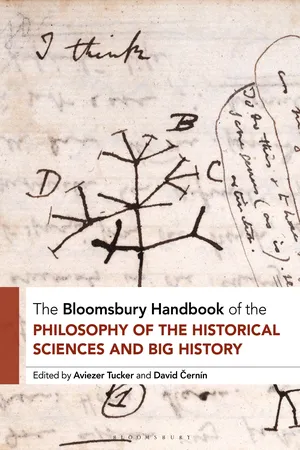
This handbook examines the philosophy of the historical sciences and their synthesis in concepts like Big or Deep History. Written by interdisciplinary philosophers, historians, and scientists, it acts as a valuable guide for anybody interested in scientific knowledge of the deep past, Big History, and the philosophy of science.
The Bloomsbury Handbook of the Philosophy of the Historical Sciences and Big History is the first philosophical reference work to recognize that History is not what it used to be: the historical sciences, Deep History, Big History, and even the history of the Anthropocene have now expanded the scope of historiography beyond that of literate civilizations to cover all scientific inferences about the past, from the Big Bang through the history of the planet and the history of life to the history of humanity. Different views about the scope of History have ontological, epistemic, methodological, explanatory, ethical, and educational reasons and implications. The historical sciences and the knowledge they have generated are founded on theories of knowledge of the past, epistemology of history. The contributions in this book consider whether there are common epistemic properties to all the historical sciences that distinguish them from non-historical or theoretical sciences.
The first part of the handbook examines the recent expansion of the scope of the historical sciences in Big History, natural history, global history, and environmental history, and older broader concepts of history like universal history and philosophy of history. The second part of the handbook addresses the ontology and epistemology of the past, including the basic concepts of the historical sciences such as origins, the end of history, determination and underdetermination, contingency and necessity, historical predictions and counterfactuals, and historical pseudoscience. The third part examines the philosophies of the special historical sciences, historical linguistics, textual criticism, geology, evolutionary biology, systematics, archaeology, cosmology, history of the environment, and most significantly, their integrations and combinations – for example, how genetics, archaeology, and historical linguistics have generated a whole new knowledge of deep human history.
This collection offers an overview of what the philosophy of the historical sciences is and is becoming for students and experts alike.
eBook - ePub
The Bloomsbury Handbook of the Philosophy of the Historical Sciences and Big History
- English
- ePUB (mobile friendly)
- Available on iOS & Android
eBook - ePub
The Bloomsbury Handbook of the Philosophy of the Historical Sciences and Big History
About this book
Information
Table of contents
- Cover
- Halftitle Page
- Title Page
- Contents
- List of Figures
- List of Contributors
- Acknowledgements
- Introduction – History is not what it used to be
- Part One The scopes of history and historiography
- Part Two Ontology and epistemology of history
- Part Three The philosophies of the special historical sciences
- Index
- Imprint
Trusted by 375,005 students
Access to over 1.5 million titles for a fair monthly price.
Study more efficiently using our study tools.
Frequently asked questions
Yes, you can cancel anytime from the Subscription tab in your account settings on the Perlego website. Your subscription will stay active until the end of your current billing period. Learn how to cancel your subscription
No, books cannot be downloaded as external files, such as PDFs, for use outside of Perlego. However, you can download books within the Perlego app for offline reading on mobile or tablet. Learn how to download books offline
Perlego offers two plans: Essential and Complete
- Essential is ideal for learners and professionals who enjoy exploring a wide range of subjects. Access the Essential Library with 800,000+ trusted titles and best-sellers across business, personal growth, and the humanities. Includes unlimited reading time and Standard Read Aloud voice.
- Complete: Perfect for advanced learners and researchers needing full, unrestricted access. Unlock 1.5M+ books across hundreds of subjects, including academic and specialized titles. The Complete Plan also includes advanced features like Premium Read Aloud and Research Assistant.
We are an online textbook subscription service, where you can get access to an entire online library for less than the price of a single book per month. With over 1.5 million books across 990+ topics, we’ve got you covered! Learn about our mission
Look out for the read-aloud symbol on your next book to see if you can listen to it. The read-aloud tool reads text aloud for you, highlighting the text as it is being read. You can pause it, speed it up and slow it down. Learn more about Read Aloud
Yes! You can use the Perlego app on both iOS and Android devices to read anytime, anywhere — even offline. Perfect for commutes or when you’re on the go.
Please note we cannot support devices running on iOS 13 and Android 7 or earlier. Learn more about using the app
Please note we cannot support devices running on iOS 13 and Android 7 or earlier. Learn more about using the app
Yes, you can access The Bloomsbury Handbook of the Philosophy of the Historical Sciences and Big History by Aviezer Tucker,David Cernín in PDF and/or ePUB format, as well as other popular books in History & Historiography. We have over 1.5 million books available in our catalogue for you to explore.