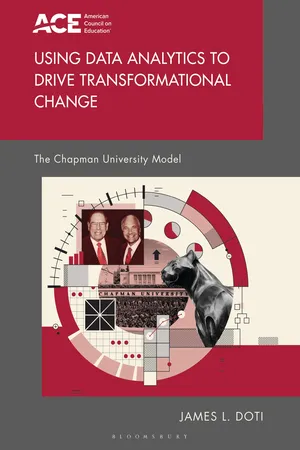
Using Data Analytics to Drive Transformational Change: The Chapman University Model opens with the statement, "Most strategic plans are a waste of time – a drain on precious resources." An alternative planning approach is described in this book. It represents a paradigm shift in tackling transformational change. Rather than developing all-around strategies, the author presents a planning model that guided Chapman's transformation that took place during James Doti's 25-year presidency at Chapman University.
Chapter 2 describes how data analytics were used to increase student selectivity by utilizing specific strategies relating to tuition pricing and discounting.
Chapter 3 shows how the progress of competing universities can be identified and measured in helping determine the optimal size for a university. The specific strategies relating to establishing a new film school, law school and physical therapy program are presented, as well as when and how to pursue national accreditation for a school's academic programs.
Chapter 4 describes how analytical tools can be used to optimally invest in buildings and land. Putting those tools to work is described in examples related to the construction of a new film studio, library, underground parking, and landscape development.
Chapter 5 explains how a unique budgetary system was developed to move Chapman's faculty salaries into the 95th percentile for all professional ranks. It also presents specific strategies relating to increasing the number of endowed faculty chairs and professorships.
Chapter 6 describes how the net income ratio can be used to assess the financial health of the institution as well as increase endowment growth and investments in buildings and land. Specific examples include increasing the number of natural science majors as well as developing a new campus devoted to graduate health science programs. The chapter also presents a unique strategy relating to succession planning
eBook - ePub
Using Data Analytics to Drive Transformational Change
The Chapman University Model
- English
- ePUB (mobile friendly)
- Available on iOS & Android
eBook - ePub
About this book
Information
Topic
EducationSubtopic
Education AdministrationTable of contents
- Cover
- Halftitle Page
- THE ACE SERIES ON HIGHER EDUCATION
- Title Page
- Preface
- 1 Becoming President
- 2 Enhancing Student Selectivity 1991–1996
- 3 Building Enrollment and Developing New Academic Programs 1996–2001
- 4 Investing in Buildings and Land 2001–2006
- 5 Developing the Faculty 2006–2011
- 6 Strengthening the Natural and Health Sciences 2011–2016
- 7 Continuing the Journey
- Epilogue
- Acknowledgments
- Index
- About the Author
- Imprint
Trusted by 375,005 students
Access to over 1.5 million titles for a fair monthly price.
Study more efficiently using our study tools.
Frequently asked questions
Yes, you can cancel anytime from the Subscription tab in your account settings on the Perlego website. Your subscription will stay active until the end of your current billing period. Learn how to cancel your subscription
No, books cannot be downloaded as external files, such as PDFs, for use outside of Perlego. However, you can download books within the Perlego app for offline reading on mobile or tablet. Learn how to download books offline
Perlego offers two plans: Essential and Complete
- Essential is ideal for learners and professionals who enjoy exploring a wide range of subjects. Access the Essential Library with 800,000+ trusted titles and best-sellers across business, personal growth, and the humanities. Includes unlimited reading time and Standard Read Aloud voice.
- Complete: Perfect for advanced learners and researchers needing full, unrestricted access. Unlock 1.5M+ books across hundreds of subjects, including academic and specialized titles. The Complete Plan also includes advanced features like Premium Read Aloud and Research Assistant.
We are an online textbook subscription service, where you can get access to an entire online library for less than the price of a single book per month. With over 1.5 million books across 990+ topics, we’ve got you covered! Learn about our mission
Look out for the read-aloud symbol on your next book to see if you can listen to it. The read-aloud tool reads text aloud for you, highlighting the text as it is being read. You can pause it, speed it up and slow it down. Learn more about Read Aloud
Yes! You can use the Perlego app on both iOS and Android devices to read anytime, anywhere — even offline. Perfect for commutes or when you’re on the go.
Please note we cannot support devices running on iOS 13 and Android 7 or earlier. Learn more about using the app
Please note we cannot support devices running on iOS 13 and Android 7 or earlier. Learn more about using the app
Yes, you can access Using Data Analytics to Drive Transformational Change by James L. Doti in PDF and/or ePUB format, as well as other popular books in Education & Education Administration. We have over 1.5 million books available in our catalogue for you to explore.