eBook - PDF
Privileging Water in Lima, Mexico City, and New Orleans
An Environmental History
- 189 pages
- English
- PDF
- Available on iOS & Android
eBook - PDF
About this book
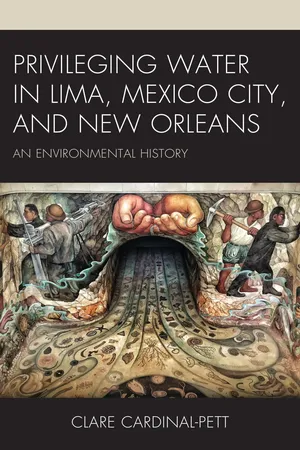
Privileging Water in Lima, Mexico City, and New Orleans: An Environmental History charts the development of the indigenous hydro-social territories and their colonial transformations into "modern" political ecologies. This book begins with a summary of the environmental histories of these regions before the arrival of people. To give water its due as an agent of historical processes, it is important to understand its role in shaping these three distinct ecosystems – a role it still plays today despite thousands of years of human intervention in the hydrological nature of those systems. It is certain that, as human-caused climate changes rework ecosystems worldwide, surviving the Anthropocene in Mexico City, New Orleans, and Lima will require other ways of knowing water – as hydro-social territories that challenge modern notions of urbanism and foreground ways of knowing formerly considered archaic. Following the inextricable histories of water and anthropogenic landscapes provokes many questions about the nature of cities, especially questions of environmental justice. The answers should not be abstract or universal. Instead, Clare Cardinal-Pett argues that urbanization on the planet must be reimagined and reconstructed as bio-regional systems and hydro-social territories that can be best defined more comprehensively as political ecologies.
Information
Table of contents
- Cover
- Half Title
- Title Page
- Copyright Page
- Dedication
- Contents
- Figures
- Acknowledgments
- Introduction
- Chapter 1: Indigenous Landscapes
- Chapter 2: Colonial Transformations and Industrial Revolutions
- Chapter 3: Decolonizing the Contemporary Metropolis
- Conclusion
- Bibliography
- Index
- About the Author
Trusted by 375,005 students
Access to over 1.5 million titles for a fair monthly price.
Study more efficiently using our study tools.
Frequently asked questions
Yes, you can cancel anytime from the Subscription tab in your account settings on the Perlego website. Your subscription will stay active until the end of your current billing period. Learn how to cancel your subscription
No, books cannot be downloaded as external files, such as PDFs, for use outside of Perlego. However, you can download books within the Perlego app for offline reading on mobile or tablet. Learn how to download books offline
Perlego offers two plans: Essential and Complete
- Essential is ideal for learners and professionals who enjoy exploring a wide range of subjects. Access the Essential Library with 800,000+ trusted titles and best-sellers across business, personal growth, and the humanities. Includes unlimited reading time and Standard Read Aloud voice.
- Complete: Perfect for advanced learners and researchers needing full, unrestricted access. Unlock 1.5M+ books across hundreds of subjects, including academic and specialized titles. The Complete Plan also includes advanced features like Premium Read Aloud and Research Assistant.
We are an online textbook subscription service, where you can get access to an entire online library for less than the price of a single book per month. With over 1.5 million books across 990+ topics, we’ve got you covered! Learn about our mission
Look out for the read-aloud symbol on your next book to see if you can listen to it. The read-aloud tool reads text aloud for you, highlighting the text as it is being read. You can pause it, speed it up and slow it down. Learn more about Read Aloud
Yes! You can use the Perlego app on both iOS and Android devices to read anytime, anywhere — even offline. Perfect for commutes or when you’re on the go.
Please note we cannot support devices running on iOS 13 and Android 7 or earlier. Learn more about using the app
Please note we cannot support devices running on iOS 13 and Android 7 or earlier. Learn more about using the app
Yes, you can access Privileging Water in Lima, Mexico City, and New Orleans by Clare Cardinal-Pett in PDF and/or ePUB format, as well as other popular books in History & Historical Geography. We have over 1.5 million books available in our catalogue for you to explore.