Technologies such as tablets, plagiarism software, and learning videos are now an important part of teaching and learning around the world. The underlying human-technology relations that shape modern educational settings have a decisive influence on what education is and will be in the future.
This volume applies the analytical tools of postphenomenology to the context of education. In three sections, the contributors present empirical evidence on the use of technology in schools, show conceptual convergences with current theories relevant to education and training, and challenge and reframe the technologically situated subject as the goal of education in relation to technology.
This collection, edited by Markus Bohlmann and Patrizia Breil, opens up the research field of postphenomenology to the broad field of educational technologies. Postphenomenology and Technologies Within Educational Settings extends the scope of the philosophy of technology and further expands its repertoire of theories and analytical tools.
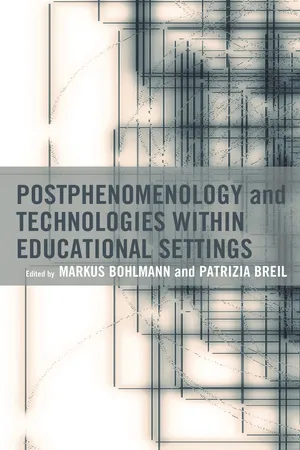
eBook - PDF
Postphenomenology and Technologies within Educational Settings
- 377 pages
- English
- PDF
- Available on iOS & Android
eBook - PDF
Postphenomenology and Technologies within Educational Settings
About this book
Information
Topic
PhilosophySubtopic
Education Theory & PracticeTable of contents
- Half Title
- Series Page
- Title Page
- Copyright Page
- Contents
- Tables and Figures
- Introduction
- Part I: Empirical Evidence
- Chapter 1: “What To Do With Your Life and How To Spend Your Time?”: Life Concepts Mediated through Popular (Educational) Videos
- Chapter 2: A Note on the Materiality of Educational Frog Dissection
- Chapter 3: Affordances as Solicitations: The Role of Technical Mediation in Academic Care
- Chapter 4: Mediated (Mis)Conduct: Turnitin as an Audience for Academic Work
- Chapter 5: Equipping Tablets: In-Depth Interviews with Early Adopters on the Sedimentation of Human–Technology Relations in Schools
- Chapter 6: Fugitive Pathways: Sensors, Lines, and Knots in the Academic Library
- Chapter 7: Leveling Up: A Postphenomenological Perspective on Gamification
- Chapter 8: Skype, Zoom, and the Zoombies: Reflections on Artistic Play, Malfunction, and the Traits of the Trade-Offs
- Chapter 9: Let’s Study Together: A Postphenomenological Investigation of “Study with Me” Content in South Korea
- Part II: Conceptual Convergence
- Chapter 10: Ambiguous Relations : A Postphenomenological Reflection on Technological Multistability in Education
- Chapter 11: Freedom through Restriction? : Merleau-Ponty, Dewey, and Foucault on Habit-Formation
- Chapter 12: A Critical Examination of Teaching and Learning in Times of Algorithmic Reasoning
- Chapter 13: A Postphenomenological-Constructionist Assessment of AI in Education: Toward a Multidimensional Democratic Education
- Chapter 14: Diverging Ethical Concepts : Postphenomenological Analysis through the Lens of Japanese Culture
- Chapter 15: Taking Care for the School in Times of Zoom-Education : A Stieglerian Account
- Part III: Subject Subversion
- Chapter 16: After Phenomenology? : Digital Subjects and the Relevance of Experience
- Chapter 17: Asking Educational Questions about Technology
- Chapter 18: Speaking of Education’s Technologically Mediated Character(s)
- Chapter 19: Rethinking Ihde’s Relations Pedagogically : On Learning and Becoming Who We Are in Relations to Things
- Index
- About the Contributors
Trusted by 375,005 students
Access to over 1.5 million titles for a fair monthly price.
Study more efficiently using our study tools.
Frequently asked questions
Yes, you can cancel anytime from the Subscription tab in your account settings on the Perlego website. Your subscription will stay active until the end of your current billing period. Learn how to cancel your subscription
No, books cannot be downloaded as external files, such as PDFs, for use outside of Perlego. However, you can download books within the Perlego app for offline reading on mobile or tablet. Learn how to download books offline
Perlego offers two plans: Essential and Complete
- Essential is ideal for learners and professionals who enjoy exploring a wide range of subjects. Access the Essential Library with 800,000+ trusted titles and best-sellers across business, personal growth, and the humanities. Includes unlimited reading time and Standard Read Aloud voice.
- Complete: Perfect for advanced learners and researchers needing full, unrestricted access. Unlock 1.5M+ books across hundreds of subjects, including academic and specialized titles. The Complete Plan also includes advanced features like Premium Read Aloud and Research Assistant.
We are an online textbook subscription service, where you can get access to an entire online library for less than the price of a single book per month. With over 1.5 million books across 990+ topics, we’ve got you covered! Learn about our mission
Look out for the read-aloud symbol on your next book to see if you can listen to it. The read-aloud tool reads text aloud for you, highlighting the text as it is being read. You can pause it, speed it up and slow it down. Learn more about Read Aloud
Yes! You can use the Perlego app on both iOS and Android devices to read anytime, anywhere — even offline. Perfect for commutes or when you’re on the go.
Please note we cannot support devices running on iOS 13 and Android 7 or earlier. Learn more about using the app
Please note we cannot support devices running on iOS 13 and Android 7 or earlier. Learn more about using the app
Yes, you can access Postphenomenology and Technologies within Educational Settings by Markus Bohlmann,Patrizia Breil in PDF and/or ePUB format, as well as other popular books in Philosophy & Education Theory & Practice. We have over 1.5 million books available in our catalogue for you to explore.