There is nothing new in thinking that we live in stupid times. Many past thinkers thought about stupidity as a symptom, however, Lacan considered stupidity as immune to the influence of psychoanalysis, saying about himself, "I am only relatively stupid?that is to say, I am as stupid as all people?perhaps because I got a little bit enlightened." Here it seems that stupidity signifies (and is signified by) the absence of any coherent foundation in desire and lack, but instead emanate from the will to jouissance. Here stupidity is inescapable whether it be individual, communal, or ideological.
In Stupidity and Psychoanalysis, chapters by internationally respected Lacanian analysts and theoreticians think about how we can understand stupidity as a specific psychoanalytic encounter. This collection draws critical Lacanian attention to considering new ways to approach stupidity and stupor as new contemporary subjective and social forms. Contributors provide various insights into how stupidity might be rethought as contemporary signifiers whose importance lies (for better or worse) more in producing effect than in transmitting meaning.
Contributors: Giole P. Cima, Christian Ingo Lenz Dunker, David Ferraro, Luis Izcovich, Adrian Johnston, James Martell, Jean-Michel Rabate, Samo Tomsic, Antonio Viselli, and Cindy Zeiher.
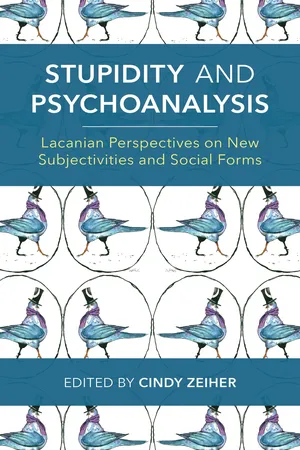
eBook - PDF
Stupidity and Psychoanalysis
Lacanian Perspectives on New Subjectivities and Social Forms
- 291 pages
- English
- PDF
- Available on iOS & Android
eBook - PDF
Stupidity and Psychoanalysis
Lacanian Perspectives on New Subjectivities and Social Forms
About this book
Information
Table of contents
- Cover
- PRAISE FOR STUPIDITY AND PSYCHOANALYSIS
- Half Title
- Title Page
- Copyright Page
- Contents
- Acknowledgements
- Introduction: Why We Should Listen to Stupidity’s Bad Reputation
- Chapter 1: Stupid Jokes
- Chapter 2: Natural Born Dupes: A Lacanian Theory of Stupidity
- Chapter 3: ‘For to begin yet again’: Re-rising the Ground(s) of Stupidity in Deleuze-Schelling-Lacan
- Chapter 4: Stupidity of the Signifier
- Chapter 5: Lacan, Pigeons and Hedgehogs in Barbery and Achache’s The (Elegance of the) Hedgehog
- Chapter 6: Errare Humanum Est: On Psychoanalysis as Morosophy
- Chapter 7: Responses to the Sexual Void: Capitalism, Paranoia and Disavowal
- Chapter 8: A Mass of Fools and Knaves: Psychoanalysis and the World’s Many Asininities
- Chapter 9: Can One Be Less Stupid?
- Chapter 10: A Paradigmatic Case of Brazilian National Stupidity
- Chapter 11: Seriously! That Is Fucking Stupid!: The Importance of Being Stupid, Earnestly
- Index
- About the Contributors
Trusted by 375,005 students
Access to over 1.5 million titles for a fair monthly price.
Study more efficiently using our study tools.
Frequently asked questions
Yes, you can cancel anytime from the Subscription tab in your account settings on the Perlego website. Your subscription will stay active until the end of your current billing period. Learn how to cancel your subscription
No, books cannot be downloaded as external files, such as PDFs, for use outside of Perlego. However, you can download books within the Perlego app for offline reading on mobile or tablet. Learn how to download books offline
Perlego offers two plans: Essential and Complete
- Essential is ideal for learners and professionals who enjoy exploring a wide range of subjects. Access the Essential Library with 800,000+ trusted titles and best-sellers across business, personal growth, and the humanities. Includes unlimited reading time and Standard Read Aloud voice.
- Complete: Perfect for advanced learners and researchers needing full, unrestricted access. Unlock 1.5M+ books across hundreds of subjects, including academic and specialized titles. The Complete Plan also includes advanced features like Premium Read Aloud and Research Assistant.
We are an online textbook subscription service, where you can get access to an entire online library for less than the price of a single book per month. With over 1.5 million books across 990+ topics, we’ve got you covered! Learn about our mission
Look out for the read-aloud symbol on your next book to see if you can listen to it. The read-aloud tool reads text aloud for you, highlighting the text as it is being read. You can pause it, speed it up and slow it down. Learn more about Read Aloud
Yes! You can use the Perlego app on both iOS and Android devices to read anytime, anywhere — even offline. Perfect for commutes or when you’re on the go.
Please note we cannot support devices running on iOS 13 and Android 7 or earlier. Learn more about using the app
Please note we cannot support devices running on iOS 13 and Android 7 or earlier. Learn more about using the app
Yes, you can access Stupidity and Psychoanalysis by Cindy Zeiher in PDF and/or ePUB format, as well as other popular books in Psychology & Ethics & Moral Philosophy. We have over 1.5 million books available in our catalogue for you to explore.