Choice 2025 Outstanding Academic Title
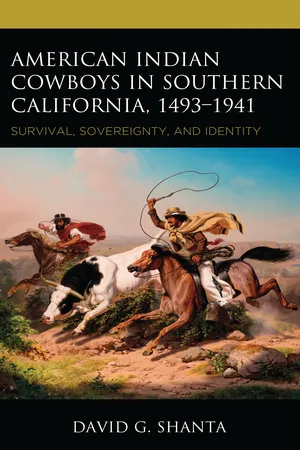
In 1769–1770, Spanish Catholic missionaries, soldiers, and Cochimí Indians of Baja California launched The Sacred Expedition to Alta California, to claim it for God and King. Domesticated animals like horses and cattle provided food security in the continual expansion of the Spanish empire. The rapidly increasing herds consumed traditional sources of Indigenous foods, medicines, tools, and weapons and soon outstripped the ability of soldiers and priests to control them. This reality forced the Spanish to train trusted Indian converts in the art of cowboying and cattle ranching. In this book, David G. Shanta provides new insights into the impact of horses and cattle on the Indigenous peoples of the Spanish Borderlands after early colonization. American Indian cowboys formed the backbone of Spanish mission economies, the international trade in cowhides and tallow that created the Mexican ranchero class known as Californios, and later on American cattle operations. Shanta shows that California Native peoples first adopted cowboying and cattle ranching, as a survival strategy. They acquired and ran their own herds, forming a new, California Indian economy based on cattle. This new economy reinforced their demands for sovereignty over their ancestral lands. This book affirms the innovative nature of American Indian Cowboys and brings to light how they survived, gained recognition of their sovereign status, and incorporated cowboying and cattle ranching into family traditions and tribal identities.
eBook - PDF
American Indian Cowboys in Southern California, 1493–1941
Survival, Sovereignty, and Identity
- 195 pages
- English
- PDF
- Available on iOS & Android
eBook - PDF
American Indian Cowboys in Southern California, 1493–1941
Survival, Sovereignty, and Identity
About this book
Information
Table of contents
- Half Title
- Title Page
- Copyright Page
- Dedication
- Contents
- List of Illustrations
- Acknowledgments
- Introduction
- Chapter 1: Spanish Origins of California Mission Cattle
- Chapter 2: Marches to New California, 1769–1781
- Chapter 3: California Mission Cattle and Native American Vaqueros 1769–1833
- Chapter 4: Hides and Tallow: Native American Labor and the Rise of Californio Society, 1833–1848
- Chapter 5: The Early American Period, 1848–1890
- Chapter 6: “Subjects But Not Citizens,” 1891–1920
- Chapter 7: A New Economy Based on Cattle, 1921–1941
- Conclusion
- Bibliography
- Index
- About the Author
Trusted by 375,005 students
Access to over 1.5 million titles for a fair monthly price.
Study more efficiently using our study tools.
Frequently asked questions
Yes, you can cancel anytime from the Subscription tab in your account settings on the Perlego website. Your subscription will stay active until the end of your current billing period. Learn how to cancel your subscription
No, books cannot be downloaded as external files, such as PDFs, for use outside of Perlego. However, you can download books within the Perlego app for offline reading on mobile or tablet. Learn how to download books offline
Perlego offers two plans: Essential and Complete
- Essential is ideal for learners and professionals who enjoy exploring a wide range of subjects. Access the Essential Library with 800,000+ trusted titles and best-sellers across business, personal growth, and the humanities. Includes unlimited reading time and Standard Read Aloud voice.
- Complete: Perfect for advanced learners and researchers needing full, unrestricted access. Unlock 1.5M+ books across hundreds of subjects, including academic and specialized titles. The Complete Plan also includes advanced features like Premium Read Aloud and Research Assistant.
We are an online textbook subscription service, where you can get access to an entire online library for less than the price of a single book per month. With over 1.5 million books across 990+ topics, we’ve got you covered! Learn about our mission
Look out for the read-aloud symbol on your next book to see if you can listen to it. The read-aloud tool reads text aloud for you, highlighting the text as it is being read. You can pause it, speed it up and slow it down. Learn more about Read Aloud
Yes! You can use the Perlego app on both iOS and Android devices to read anytime, anywhere — even offline. Perfect for commutes or when you’re on the go.
Please note we cannot support devices running on iOS 13 and Android 7 or earlier. Learn more about using the app
Please note we cannot support devices running on iOS 13 and Android 7 or earlier. Learn more about using the app
Yes, you can access American Indian Cowboys in Southern California, 1493–1941 by David G. Shanta in PDF and/or ePUB format, as well as other popular books in History & North American History. We have over 1.5 million books available in our catalogue for you to explore.