Choice 2025 Outstanding Academic Title
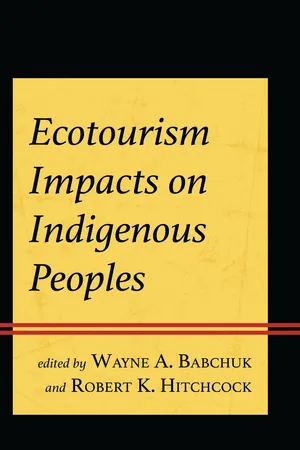
Ecotourism, defined as responsible travel to natural areas that conserves the environment and improves the well-being of local people, has become one of the fastest growing industries in the world. The impacts of ecotourism on people in virtually every part of the planet are particularly true for Indigenous people. Indigenous people are found in over half of the world's countries and their cultures, customs, traditions, identities, and natural resource management systems are of great interest to scientists, tourists, and travelers. Many Indigenous peoples reside in conservation hotspots and places with high biological biodiversity. As shown in this book, ecotourism has both promises and pitfalls for Indigenous peoples, who seek to enhance their livelihoods while conserving the habitats in which they reside and the sacredness of their traditions. Drawing on cases from South America, North America, Africa, and Asia, Ecotourism Impacts on Indigenous Peoples examines the social, economic, political, and environmental impacts of ecotourism. A common plea of Indigenous people is that they have greater control over incoming ecotourists and receive more equitable social, economic, and cultural benefits from what they recognize as a highly complex industry with significant environmental, economic, and political effects.
- 263 pages
- English
- PDF
- Available on iOS & Android
eBook - PDF
Ecotourism Impacts on Indigenous Peoples
About this book
Information
Table of contents
- Cover
- Half Title
- Title Page
- Copyright Page
- Contents
- Figures
- Tables
- Acknowledgments
- Chapter 1: Ecotourism, Indigenous Peoples, and Societal Impacts
- Chapter 2: Sustainable Tourism: Marketing Indigenous Identity in the Plurinational State of Bolivia
- Chapter 3: Challenges of Ecotourism among the San of Botswana, Namibia, and Zimbabwe
- Chapter 4: Ecotourism, Anthropology, and San Community Docents and Activists: Some Interactions
- Chapter 5: “Your Soul Will Remember”: Reconnecting with the Kalahari, Celebrating Traditional Knowledge, Sharing the Meat, and Becoming a Community on the ǂKhomani San Lands Today
- Chapter 6: The Mayanization of the Ch’orti’: Indigenous Identity amid Tourism-Based Development Initiatives in Copán, Honduras
- Chapter 7: Aboriginal Alternative Tourism in Arnhem Land: Tourism as Cultural Learning
- Chapter 8: How Does Cultural Tourism in a National Monument Affect Its Affiliated Pueblo Tribes?
- Chapter 9: COVID-19 and the Limits of Community-Based Ecotourism as a Sustainable Livelihood Diversification Strategy: The Case of the Indigenous Karo of Batu Katak, North Sumatra, Indonesia
- Chapter 10: Change among the Wannilaeto of Sri Lanka: Land, Livelihoods, and Ecotourism Impacts
- Index
- About the Contributors
Trusted by 375,005 students
Access to over 1.5 million titles for a fair monthly price.
Study more efficiently using our study tools.
Frequently asked questions
Yes, you can cancel anytime from the Subscription tab in your account settings on the Perlego website. Your subscription will stay active until the end of your current billing period. Learn how to cancel your subscription
No, books cannot be downloaded as external files, such as PDFs, for use outside of Perlego. However, you can download books within the Perlego app for offline reading on mobile or tablet. Learn how to download books offline
Perlego offers two plans: Essential and Complete
- Essential is ideal for learners and professionals who enjoy exploring a wide range of subjects. Access the Essential Library with 800,000+ trusted titles and best-sellers across business, personal growth, and the humanities. Includes unlimited reading time and Standard Read Aloud voice.
- Complete: Perfect for advanced learners and researchers needing full, unrestricted access. Unlock 1.5M+ books across hundreds of subjects, including academic and specialized titles. The Complete Plan also includes advanced features like Premium Read Aloud and Research Assistant.
We are an online textbook subscription service, where you can get access to an entire online library for less than the price of a single book per month. With over 1.5 million books across 990+ topics, we’ve got you covered! Learn about our mission
Look out for the read-aloud symbol on your next book to see if you can listen to it. The read-aloud tool reads text aloud for you, highlighting the text as it is being read. You can pause it, speed it up and slow it down. Learn more about Read Aloud
Yes! You can use the Perlego app on both iOS and Android devices to read anytime, anywhere — even offline. Perfect for commutes or when you’re on the go.
Please note we cannot support devices running on iOS 13 and Android 7 or earlier. Learn more about using the app
Please note we cannot support devices running on iOS 13 and Android 7 or earlier. Learn more about using the app
Yes, you can access Ecotourism Impacts on Indigenous Peoples by Wayne A. Babchuk,Robert K. Hitchcock in PDF and/or ePUB format, as well as other popular books in Social Sciences & Ecology. We have over 1.5 million books available in our catalogue for you to explore.