- 265 pages
- English
- PDF
- Available on iOS & Android
eBook - PDF
Teaching Writing in the Age of Catastrophic Climate Change
About this book
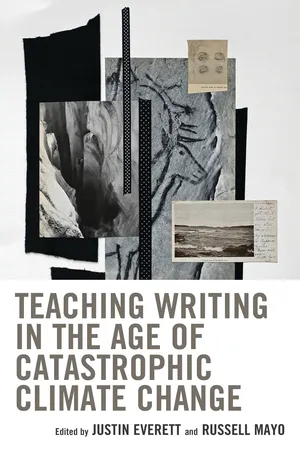
Catastrophic storms, searing heat waves, crumbling waterfronts, warming oceans, air-fouling forest fires and mass extinction have become facts of life. Under these conditions, it is difficult to imagine that the global industrial civilization will continue in its present form. This requires us to reconsider the subject of ecocomposition from a new perspective: "What does it mean to teach college writing in the face of this sobering reality?" The introduction reviews the history of ecocomposition and reframes it in light of the apocalyptic turn in climate discourse over the last quarter century as well as the role that ecocomposition theory can play in framing these discussions. Teaching Writing in the Age of Catastrophic Climate Change is organized into four sections. The first section considers the environmental narrative from the viewpoint of climate justice, while the second reframes pedagogies of place in light of the climate catastrophe. The third section examines the intersections of writing studies and the natural sciences, while the fourth section entertains the personal and emotional dimensions of teaching ecocomposition within the framework of catastrophic climate change. If we have been successful, these chapters provide a starting place for having sobering discussions in our classrooms, and considering what ecocomposition means in this unsettling age.
Information
Table of contents
- Cover
- Half Title
- Series Page
- Title Page
- Copyright Page
- Contents
- Foreword
- Acknowledgments
- Introduction
- Part I: Storytelling and Climate Justice Pedagogies
- Part II: Teaching Writing with Place and Space
- Part III: Rhetoric-Science Interchanges
- Part IV: Emotion, Affect, and Relationality
- Index
- About the Editors
- About the Contributors
Trusted by 375,005 students
Access to over 1.5 million titles for a fair monthly price.
Study more efficiently using our study tools.
Frequently asked questions
Yes, you can cancel anytime from the Subscription tab in your account settings on the Perlego website. Your subscription will stay active until the end of your current billing period. Learn how to cancel your subscription
No, books cannot be downloaded as external files, such as PDFs, for use outside of Perlego. However, you can download books within the Perlego app for offline reading on mobile or tablet. Learn how to download books offline
Perlego offers two plans: Essential and Complete
- Essential is ideal for learners and professionals who enjoy exploring a wide range of subjects. Access the Essential Library with 800,000+ trusted titles and best-sellers across business, personal growth, and the humanities. Includes unlimited reading time and Standard Read Aloud voice.
- Complete: Perfect for advanced learners and researchers needing full, unrestricted access. Unlock 1.5M+ books across hundreds of subjects, including academic and specialized titles. The Complete Plan also includes advanced features like Premium Read Aloud and Research Assistant.
We are an online textbook subscription service, where you can get access to an entire online library for less than the price of a single book per month. With over 1.5 million books across 990+ topics, we’ve got you covered! Learn about our mission
Look out for the read-aloud symbol on your next book to see if you can listen to it. The read-aloud tool reads text aloud for you, highlighting the text as it is being read. You can pause it, speed it up and slow it down. Learn more about Read Aloud
Yes! You can use the Perlego app on both iOS and Android devices to read anytime, anywhere — even offline. Perfect for commutes or when you’re on the go.
Please note we cannot support devices running on iOS 13 and Android 7 or earlier. Learn more about using the app
Please note we cannot support devices running on iOS 13 and Android 7 or earlier. Learn more about using the app
Yes, you can access Teaching Writing in the Age of Catastrophic Climate Change by Justin Everett,Russell Mayo in PDF and/or ePUB format, as well as other popular books in Biological Sciences & Teaching Arts & Humanities. We have over 1.5 million books available in our catalogue for you to explore.