Topics in Modal Analysis, Volume 7: Proceedings of the 31st IMAC, A Conference and Exposition on Structural Dynamics, 2013, the seventh volume of seven from the Conference, brings together contributions to this important area of research and engineering. The collection presents early findings and case studies on fundamental and applied aspects of Structural Dynamics, including papers on:
Fluid Structure Interaction
Adaptive Structures
Experimental Techniques
Analytical Methods
Damage Detection
Damping of Materials & Members
Modal Parameter Identification
Modal Testing Methods
System Identification
Active Control
Modal Parameter Estimation
Processing Modal Data
Similar content being.
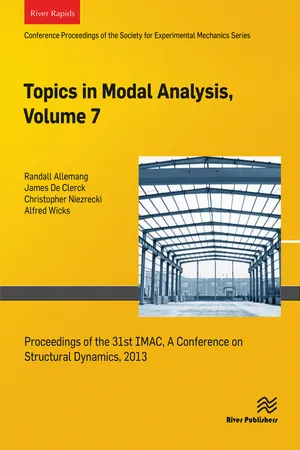
eBook - ePub
Topics in Modal Analysis, Volume 7
Proceedings of the 31st IMAC, A Conference on Structural Dynamics, 2013
- English
- ePUB (mobile friendly)
- Available on iOS & Android
eBook - ePub
Topics in Modal Analysis, Volume 7
Proceedings of the 31st IMAC, A Conference on Structural Dynamics, 2013
About this book
Information
Table of contents
- Cover
- Series Page
- Title Page
- Copyright Page
- Table of Contents
- 1 Damage Detection Using Flexibility Proportional Coordinate Modal Assurance Criterion
- 2 Automated Selection of Damage Detection Features by Genetic Programming
- 3 Optimal Selection of Artificial Boundary Conditions for Model Update and Damage Detection – Part 1: Theory
- 4 Optimal Selection of Artificial Boundary Conditions for Model Update and Damage Detection – Part 2: Experiment
- 5 Detection of Mass Change on a Glass Plate
- 6 Vibro-Acoustic Research on a Full-Scale Aircraft Structure
- 7 Control of Dynamic Mass as Boundary Condition for Testing Substructures
- 8 Multi-body-Simulation of a Self Adaptive Torsional Vibration Absorber
- 9 Combined Optimization of Actuator/Sensor Positions and Weighting Matrices for an Active Noise Reduction System
- 10 SSDI Technique Evolution to Improve Attenuation Performances with Random Disturbances
- 11 Geometrically Nonlinear Dynamic Analysis of Piezoelectric Integrated Thin-Walled Smart Structures
- 12 Linear/Nonlinear Reduced-Order Substructuring for Uncertainty Quantification and Predictive Accuracy Assessment
- 13 Damage Detection in an Energy Flow Model Including Parameter Uncertainty
- 14 A Coupled Approach for Structural Damage Detection with Incomplete Measurements
- 15 Efficient and Robust Solution of Inverse Structural Dynamic Problems for Vibration Health Monitoring
- 16 Finite Element-Based Damage Detection Using Expanded Ritz Vector Residuals
- 17 Proportional Damping from Experimental Data
- 18 Superior Damping of Hybrid Carbon Fiber Composites Grafted by ZnO Nanorods
- 19 Advanced Identification Techniques for Operational Wind Turbine Data
- 20 Tracking and Removing Modulated Harmonic Components with Spectral Kurtosis and Kalman Filters
- 21 Vibration Reduction of Brush Cutter
- 22 Design of a Test Setup for Measuring Dynamic Stiffness of Vibration Isolators
- 23 An Impact Excitation System for Repeatable, High-Bandwidth Modal Testing of Miniature Structures
- 24 Replicating Aerodynamic Excitation in the Laboratory
- 25 A Systematic Approach to Modal Testing of Nonlinear Structures
- 26 Fiber Optics Sensing of Stressing and Fracture in Cylindrical Structures
- 27 Real-Time Damage Identification in Nonlinear Smart Structures Using Hyperchaotic Excitation and Stochastic Estimation
- 28 Damage Detection Based on Electromechanical Impedance Principle and Principal Components
- 29 Enhanced Modal Wavelet Analysis for Damage Detection in Beams
- 30 Linear Projection Techniques in Damage Detection Under a Changing Environment
- 31 Modal Reduction Based on Accurate Input-Output Relation Preservation
- 32 Fast Precise Algorithm of Computing FRF by Considering Initial Response
- 33 Development of Full Space System Model Modes from Expansion of Reduced Order Component Modal Information
- 34 Damage Localization from the Image of Changes in Flexibility
- 35 Spectral Element Method for Cable Harnessed Structure
- 36 Analytic Formula Derivation for a Rolling Tire with a Ring Model
- 37 Nonlinear Identification of the Viscous Damping of the Resistor for Nuclear Plants
- 38 Effect of Spin Speed on Stability Lobes in High Speed Machining
- 39 Chatter Reduction in Turning by Using Piezoelectric Shunt Circuits
- 40 Damage Quantification from the Column Space of Flexibility Changes
- 41 State Estimate of Wind Turbine Blades Using Geometrically Exact Beam Theory
- 42 Damage Index Matrix: A Novel Damage Identification Method Using Hilbert-Huang Transformation
- 43 An Approach to the Moving Load Problem for Multiple Cracked Beam
- 44 Detection of Structural Damage Through Nonlinear Identification by Using Modal Testing
- 45 Vibration Fatigue Analysis of a Cantilever Beam Using Different Fatigue Theories
- 46 Automated Modal Analysis Based on Statistical Evaluation of Frequency Responses
- 47 The Modal Observability Correlation as a Modal Correlation Metric
- 48 A Modal Test Method Based on Vibro-acoustical Reciprocity
- 49 Reactionless Test to Identify Dynamic Young's Modulus and Damping of Isotropic Plastic Materials
- 50 Real-Time Modal Analysis of Shell-Shaped Objects Using High-Frame-Rate Structured-Light-Based Vision
- 51 Field and Numerical Testing of the BWE SchRs4600.50 Dynamic Behavior
- 52 Modal Analysis of Rotating Carbon Nanotube Infused Composite Beams
- 53 Modal Analysis and Dynamic Monitoring of a Concentrating Solar Heliostat
- 54 Identification of Stability Cutting Parameters Using Laser Doppler Vibrometry
- 55 System Identification Using Kalman Filters
- 56 Identification of Time-Varying Nonlinear Systems Using Differential Evolution Algorithm
- 57 Experimental Verification and Improvement of Dynamic Characterization Method for Structural Joints
- 58 Transfer Functions to Measure Translational and Rotational Velocities with Continuous-Scan Laser Doppler Vibrometry
- 59 Empirical Slow-Flow Identification for Structural Health Monitoring and Damage Detection
- 60 Continuous Scanning for Acoustic Field Characterization
- 61 Operating Deflection Shapes of a Violin String via High Speed/High Resolution Videography
- 62 Automated Measurement Grid Generation for Scanning Laser Doppler Vibrometers
- 63 Mode Filtering of Continuous Scanning Laser Doppler Vibration Data
- 64 The Characterization of the Time Delay Problem in Hardware in the Loop System Applications
- 65 Optimal Placement of Piezoelectric Patches on a Cylindrical Shell for Active Vibration Control
- 66 Adaptive Feedback Linearisation and Control of a Flexible Aircraft Wing
- 67 Limit Cycle Assignment in Nonlinear Aeroelastic Systems Using Describing Functions and the Receptance Method
- 68 Investigation of an Active Structural Acoustic Control System on a Complex 3D Structure
- 69 Development of a Stabilized Pan/Tilt Platform and the State of the Art
- 70 Dynamic Equations for an Anisotropic Cylindrical Shell
- 71 Expansion of Nonlinear System Response Using Linear Transformation Matrices from Reduced Component Model Representations
- 72 Explicit Construction of Rods and Beams with Given Natural Frequencies
- 73 A Metric for Modal Truncation in Model Reduction Problems Part 1: Performance and Error Analysis
- 74 A Metric for Modal Truncation in Model Reduction Problems Part 2: Extension to Systems with High-Dimensional Input Space
- 75 On Gramian-Based Techniques for Minimal Realization
Trusted by 375,005 students
Access to over 1.5 million titles for a fair monthly price.
Study more efficiently using our study tools.
Frequently asked questions
Yes, you can cancel anytime from the Subscription tab in your account settings on the Perlego website. Your subscription will stay active until the end of your current billing period. Learn how to cancel your subscription
No, books cannot be downloaded as external files, such as PDFs, for use outside of Perlego. However, you can download books within the Perlego app for offline reading on mobile or tablet. Learn how to download books offline
Perlego offers two plans: Essential and Complete
- Essential is ideal for learners and professionals who enjoy exploring a wide range of subjects. Access the Essential Library with 800,000+ trusted titles and best-sellers across business, personal growth, and the humanities. Includes unlimited reading time and Standard Read Aloud voice.
- Complete: Perfect for advanced learners and researchers needing full, unrestricted access. Unlock 1.5M+ books across hundreds of subjects, including academic and specialized titles. The Complete Plan also includes advanced features like Premium Read Aloud and Research Assistant.
We are an online textbook subscription service, where you can get access to an entire online library for less than the price of a single book per month. With over 1.5 million books across 990+ topics, we’ve got you covered! Learn about our mission
Look out for the read-aloud symbol on your next book to see if you can listen to it. The read-aloud tool reads text aloud for you, highlighting the text as it is being read. You can pause it, speed it up and slow it down. Learn more about Read Aloud
Yes! You can use the Perlego app on both iOS and Android devices to read anytime, anywhere — even offline. Perfect for commutes or when you’re on the go.
Please note we cannot support devices running on iOS 13 and Android 7 or earlier. Learn more about using the app
Please note we cannot support devices running on iOS 13 and Android 7 or earlier. Learn more about using the app
Yes, you can access Topics in Modal Analysis, Volume 7 by Randall Allemang,James De Clerck,Christopher Niezrecki,Alfred Wicks in PDF and/or ePUB format, as well as other popular books in Technology & Engineering & Mechanical Engineering. We have over 1.5 million books available in our catalogue for you to explore.