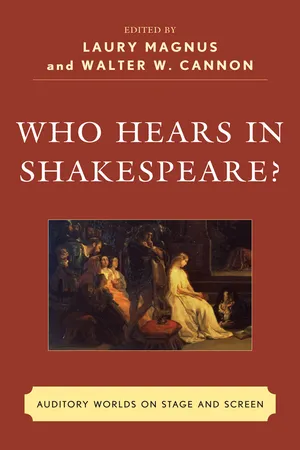
This volume, examining the ways in which Shakespeare's plays are designed for hearers as well as spectators, has been prompted by recent explorations of the auditory dimension of early modern drama by such scholars as Andrew Gurr, Bruce Smith, and James Hirsh. To look at the dynamics of hearing in Shakespeare's plays involves a paradigm shift that changes how we understand virtually everything about them, from the architecture of the buildings, to playing spaces, to blocking, and to larger interpretative issues, including our understanding of character based on players' responses to what they hear, mishear, or refuse to hear. Who Hears in Shakespeare? Auditory Worlds on Stageand Screen is comprised of three sections on Shakespeare's texts and performance history: "The Poetics of Hearing and the Early Modern Stage"; "Metahearing: Hearing, Knowing, and Audiences, Onstage and Off"; and "Transhearing: Hearing, Whispering, Overhearing, and Eavesdropping in Film and Other Media."
Chapters by noted scholars explore the complex reactions and interactions of onstage and offstage audiences and show how Shakespearean stagecraft, actualized on stage and adapted on screen, revolves around various situations and conventions of hearing—soliloquies,, asides, avesdropping, overhearing, and stage whispers. In short, Who Hears in Shakespeare? enunciates Shakespeare's nuanced, powerful stagecraft of hearing. The volume ends with Stephen Booth's afterword, his inspiring meditation on hearing that considers Shakespearean "audiences" and their responses to what they hear—or don't hear—in Shakespeare's plays.
eBook - PDF
Who Hears in Shakespeare?
Shakespeare’s Auditory World, Stage and Screen
- 285 pages
- English
- PDF
- Available on iOS & Android
eBook - PDF
Who Hears in Shakespeare?
Shakespeare’s Auditory World, Stage and Screen
About this book
Information
Table of contents
- Dedication
- Contents
- Acknowledgments
- Introduction: Shakespeare’s Auditory World
- Part I: The Poetics of Hearing and the Early Modern Stage
- Chapter 01. Why Was the Globe Round?
- Chapter 02. Guarded, Unguarded, and Unguardable Speech in Late Renaissance Drama
- Chapter 03. Hearing Complexity
- Chapter 04. “If This Be Worth Your Hearing”
- Part II: Metahearing: Hearing, Knowing, and Audiences, Onstage and Off
- Chapter 05. Mimetic Hearing and Meta-Hearing in Hamlet
- Chapter 06. Hearing and Overhearing in The Tempest
- Chapter 07. Asides and Multiple Audiences in The Merchant of Venice
- Chapter 08. Negotiating Audiences
- Chapter 09. Hearing Power in Measure for Measure
- Chapter 10. “Hark, a Word in Your Ear”
- Part III: Transhearing: Hearing, Overhearing, Whispering, and Eavesdropping in Film and Other Media
- Chapter 11. “Mutes or Audience to This Act”
- Chapter 12. Overhearing Malvolio for Pleasure or Pity
- Chapter 13. “But Mark His Gesture”
- Afterword: Who Doesn’t Listen in Shakespeare?
- Index
- Contributor Biographies
Trusted by 375,005 students
Access to over 1.5 million titles for a fair monthly price.
Study more efficiently using our study tools.
Frequently asked questions
Yes, you can cancel anytime from the Subscription tab in your account settings on the Perlego website. Your subscription will stay active until the end of your current billing period. Learn how to cancel your subscription
No, books cannot be downloaded as external files, such as PDFs, for use outside of Perlego. However, you can download books within the Perlego app for offline reading on mobile or tablet. Learn how to download books offline
We are an online textbook subscription service, where you can get access to an entire online library for less than the price of a single book per month. With over 1.5 million books across 990+ topics, we’ve got you covered! Learn about our mission
Look out for the read-aloud symbol on your next book to see if you can listen to it. The read-aloud tool reads text aloud for you, highlighting the text as it is being read. You can pause it, speed it up and slow it down. Learn more about Read Aloud
Yes! You can use the Perlego app on both iOS and Android devices to read anytime, anywhere — even offline. Perfect for commutes or when you’re on the go.
Please note we cannot support devices running on iOS 13 and Android 7 or earlier. Learn more about using the app
Please note we cannot support devices running on iOS 13 and Android 7 or earlier. Learn more about using the app
Yes, you can access Who Hears in Shakespeare? by Laury Magnus,Walter W. Cannon in PDF and/or ePUB format, as well as other popular books in Literature & English Literary Criticism. We have over 1.5 million books available in our catalogue for you to explore.