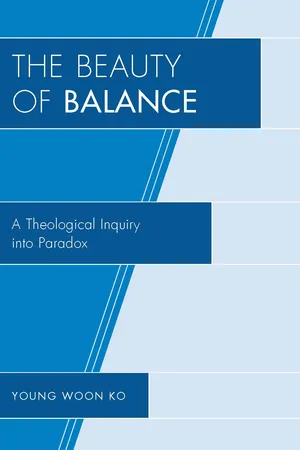
These essays examine the significance of balance between the opposites in order to understand God and the world. The author argues that opposites-the subject and object, mind and nature, good and evil, truth and falsehood-are not separated from each other but interdependent in the relational paradigm. Each cannot exist without the other. Creative advancement is achieved by their dynamic tensions. The paradoxical relationship between the opposites is not posited in the mechanistic model in which opposites are recognized as separate entities and thereby antagonists; rather, they are dialectical and creative in the organic model. Based on this organic model, the relationship between God and the world is not hierarchical but interdependent.
In the organic model, God is not described simply as a transcendent reality in a dualistic structure of God and the world. God reveals God-self in harmonious order and pattern as the ultimate principle formed in the world. In other words, God reveals God-self in the relative contexts of the opposites good and evil, true and false. Unlike Aristotle's Law of Contrast, God is both A (transcendent) and -A (immanent), which is the basic logic of the organic model. In this context, God is different from eternal reality such as Plato's Idea or the transcendent God developed in the Western tradition.
In this text, the author explores how the complex of divine reality entails the dialogue of differences in a constructive way, using inter-religious dialogue and religion-nature dialogue as examples. The author also brings the theme of paradox into his discussion to connect the West with the East and explore how it can be a positive method of understanding God and the world in the organic model, which can in turn be a key to the understanding of the common good.
- 121 pages
- English
- PDF
- Available on iOS & Android
eBook - PDF
About this book
Information
Topic
PhilosophySubtopic
Philosophy History & TheoryTable of contents
- Contents
- Introduction
- Ch01. Hegel’s Dialectical Methodand the System of Totality
- Ch02. Creativity and God in Process
- Ch03. Divine Paradox and Harmonyin Whitehead and Jung
- Ch04. Bateson’s Theory ofDouble-Binding and Meta-Context
- Ch05. Non-directed Order and Harmony
- Ch06. Wonhyo’s Buddhist Thought ofOne Mind in the Organic Model
- Ch07. The Theological Significance ofParadox in the Organic Model
- Conclusion
- Selected Bibliography
- Index
Trusted by 375,005 students
Access to over 1.5 million titles for a fair monthly price.
Study more efficiently using our study tools.
Frequently asked questions
Yes, you can cancel anytime from the Subscription tab in your account settings on the Perlego website. Your subscription will stay active until the end of your current billing period. Learn how to cancel your subscription
No, books cannot be downloaded as external files, such as PDFs, for use outside of Perlego. However, you can download books within the Perlego app for offline reading on mobile or tablet. Learn how to download books offline
Perlego offers two plans: Essential and Complete
- Essential is ideal for learners and professionals who enjoy exploring a wide range of subjects. Access the Essential Library with 800,000+ trusted titles and best-sellers across business, personal growth, and the humanities. Includes unlimited reading time and Standard Read Aloud voice.
- Complete: Perfect for advanced learners and researchers needing full, unrestricted access. Unlock 1.5M+ books across hundreds of subjects, including academic and specialized titles. The Complete Plan also includes advanced features like Premium Read Aloud and Research Assistant.
We are an online textbook subscription service, where you can get access to an entire online library for less than the price of a single book per month. With over 1.5 million books across 990+ topics, we’ve got you covered! Learn about our mission
Look out for the read-aloud symbol on your next book to see if you can listen to it. The read-aloud tool reads text aloud for you, highlighting the text as it is being read. You can pause it, speed it up and slow it down. Learn more about Read Aloud
Yes! You can use the Perlego app on both iOS and Android devices to read anytime, anywhere — even offline. Perfect for commutes or when you’re on the go.
Please note we cannot support devices running on iOS 13 and Android 7 or earlier. Learn more about using the app
Please note we cannot support devices running on iOS 13 and Android 7 or earlier. Learn more about using the app
Yes, you can access The Beauty of Balance by Young Woon Ko in PDF and/or ePUB format, as well as other popular books in Philosophy & Philosophy History & Theory. We have over 1.5 million books available in our catalogue for you to explore.