eBook - ePub
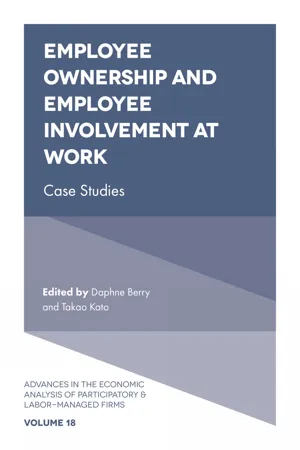
Employee Ownership and Employee Involvement at Work
Case Studies
- 161 pages
- English
- ePUB (mobile friendly)
- Available on iOS & Android
eBook - ePub
Employee Ownership and Employee Involvement at Work
Case Studies
About this book
With a growing prominence of
sophisticated econometric research in a much-expanded field of New Economics of
Participation (NEP), it is of particular value to learn about real-world
examples of participatory and labor-managed firms in the advanced market economies
through extensive case studies. In this volume of Advances in the Economic Analysis of Participatory and Labor-Managed
Firms, the authors present such case studies. The real-world examples of
participatory organizations described vividly in this volume will help
researchers in NEP to design empirical strategies better, and to interpret
their econometric results more sensibly. Furthermore, they will help
policymakers and practitioners in their efforts to construct better public
policy and design management practices.
Information
ULMA ARCHITECTURAL SOLUTIONS: A CASE FROM THE MONDRAGON COOPERATIVE GROUP
ABSTRACT
To examine perceptions of organizational atmosphere and joint ownership in a firm in which capital ownership is broadly shared among members of its work force.
A questionnaire was administered with a sample of 123 people from a Mondragon cooperative firm, ULMA Architectural Solutions, and responses were analyzed using principal components’ analysis and regression techniques.
Two factors are found to play especially important roles in explaining perceptions: (1) work and management/supervisory practices, especially those relating to communication and participation in decisions in respondents’ immediate work area, and (2) job type (blue collar vs. white collar).
Research Implications: The study confirms earlier research on the broad centrality of participation and related practices to perceptions of work and the organization in employee ownership settings, while findings focus on the immediate work environment and relationships with immediate managers for blue-collar workers.
These are closely related to the research implications, underlining the importance to worker-owners, in manufacturing contexts, of communication and involvement in decisions in their immediate work environment.
Widespread concerns about inequality, poor working conditions, and competitiveness suggest the importance of investigating enterprises with broadly shared capital ownership, enterprises that tend to address these concerns.
The chapter reinforces the fundamental roles of information-sharing and participation in enterprises with shared ownership, while making key distinctions between shopfloor and office workers experiences and perceptions.
Keywords: Mondragon; worker cooperative; employee ownership; organizational atmosphere; blue collar; white collar; ownership satisfaction; employee participation
INTRODUCTION
This chapter presents the case of ULMA Architectural Solutions (UAS), a industrial cooperative and member of the Mondragon Corporation1 and its ULMA subgroup.2 As with most cooperatives in the Mondragon group, UAS is a worker-cooperative; that is, membership-ownership rights correspond not to user-members, as in consumer co-ops or credit unions but to worker-members, the enterprise’s frontline workers, managers, technical staff, etc. Here we seek to describe UAS using quantitative data gathered over the course of 2016 and address research questions about (1) participants’ general perceptions of work, the company, and cooperative ownership, and (2) specific factors that might explain these perceptions.
There are persuasive reasons to pursue research on worker-owned enterprise. Many scholars, policymakers, politicians, and others have underscored in recent years the extreme and growing levels of inequality in wealth and income in both industrialized and emerging economies (Edsall, 2013; Long, 2016; Oxfam, 2015; Picketty, 2014). Journalists and academics have also documented extensive worker dissatisfaction and distress in many conventionally owned firms due to low pay, poor working conditions, and draconian management practices (Daily Mail Online, 2014; Kantor & Streitfeld, 2015; New York Times, 2015). Finally, competitiveness is a perennial concern for many audiences: academics in various fields, policy makers, organized labor, and the business and general public. In sum, many observers believe that promoting more inclusive ownership structures such as those described in this volume could contribute substantially to addressing troubling trends in inequality and working conditions as well as boost firms’ economic performance (Blasi, Freeman, & Kruse, 2014). In addition, detailed descriptions of these firms should assist not only employee-owners understand their particular firms better and take evidence-based measures to improve their operations, but should also help the other audiences mentioned above assess the potential benefits and challenges of broad employee ownership. Further, detailed case studies such as those in this volume fill in key gaps in the literature concerning factors that explain organizational dynamics in enterprises with shared ownership. This chapter hopes to contribute to both these applied and scientific objectives.
The rest of the chapter is structured in the following way: Section 2 offers basic background information on the firm UAS. Section 3 locates this case in the literature on worker cooperatives and substantially employee-owned firms. The methods used to carry out the research are outlined in Section 4, followed by Results in Section 5 and Discussion and Conclusions in the final section.
1. ULMA ARCHITECTURAL SOLUTIONS
ULMA Architectural Solutions is a small-to-medium-sized worker cooperative corporation headquartered in the small, inland, industrial town of Oñati in the province of Gipuzkoa of the Basque Country of Spain. The Basque Country is a three-province, political-administrative region of Spain with a population of approximately 2.1 million. Oñati is located in an area, the Alto Deba, with a strong industrial tradition and a relatively large portion of employment, 38%, is in manufacturing, in comparison to 21.6% in the European Union (EU-28) as a whole (Eurostat, 2015; Eustat, 2016). Although it has suffered periods of high unemployment during times of industrial restructuring or recession (13.4% in 2016), the Basque Country is a prosperous part of Spain whose standard of living is substantially higher than European averages (Eustat, 2016).
The firm was founded in 1990 as a worker cooperative in the ULMA Group, as mentioned, a subgroup of the Mondragon cooperatives. It designs and manufactures prefabricated products for the construction of drainage systems, architectural precast, external wall systems, and ventilated facades. The UAS work force averaged approximately 180 people in 2016 and all but about 15 people work in Oñati. These 15 or so are employed by the firm in Portugal, France, and Brazil; in addition, the company has distributors in several countries in Europe, South America, and the Middle East. The Great Recession was a difficult period for UAS as the construction market in Spain collapsed. The firm’s sales declined substantially in 2012 and 2013. These years were equally or more difficult for its principal regional competitors, all conventionally owned firms, and several went bankrupt between 2012 and 2015. UAS’s other competitors consist of conventionally owned multinationals who only do a small portion of their sales in Spain and whose performance is quite difficult to compare with that of UAS. In any case, UAS’s sales declined in 2012 and 2013, but the company returned to growth and profitability in 2014, focusing on expanding international sales, and subsequent growth has averaged well over 15% per year.
The ULMA Group, located in and around the town of Oñati, neighboring Mondragón, consists of eight highly diverse firms and has a work force of several thousand people. It is itself a formal organization, with its own governance and management bodies composed of the senior members of the governance and management bodies of its constituent cooperatives, although the constituent cooperatives have complete operational autonomy and nearly full strategic autonomy as well. The chairperson of the board3 (or “governing council”) of the ULMA Group, Raul García, has been leading a multi-faceted initiative to examine and strengthen worker participation in management among its member enterprises. This study came about as a result of one of García’s many efforts in this arena.
2. RESEARCH ON PSYCHOSOCIAL ISSUES IN EMPLOYEE-OWNED AND COOPERATIVE FIRMS
Many scholars have found that companies in which employees participate substantially in capital ownership tend to outperform conventionally owned companies or i...
Table of contents
- Cover
- Title
- Introduction
- Inter-Cooperation Mechanisms in Mondragon: Managing The Crisis of Fagor Electrodomésticos
- Ulma Architectural Solutions: a Case from the Mondragon Cooperative Group
- Mid South Building and Supply: Surviving the Great Recession
- Employee Involvement Under Rising Competitive Pressure: Evidence from Two Manufacturing Firms in Japan
- Limitations of Business Unionism and Co-Op Conservatism: A Case Study of Denver’s Taxi Driver Union-Cooperatives
- Structuring Firms to Benefit Low-Income Workers: An Employee Ownership Case Study
- Board Structure at Carris Reels: A Participatory ESOP Company
- Atlas Container Corporation: Thinking Outside the Box
- Index
Trusted by 375,005 students
Access to over 1.5 million titles for a fair monthly price.
Study more efficiently using our study tools.
Frequently asked questions
Yes, you can cancel anytime from the Subscription tab in your account settings on the Perlego website. Your subscription will stay active until the end of your current billing period. Learn how to cancel your subscription
No, books cannot be downloaded as external files, such as PDFs, for use outside of Perlego. However, you can download books within the Perlego app for offline reading on mobile or tablet. Learn how to download books offline
Perlego offers two plans: Essential and Complete
- Essential is ideal for learners and professionals who enjoy exploring a wide range of subjects. Access the Essential Library with 800,000+ trusted titles and best-sellers across business, personal growth, and the humanities. Includes unlimited reading time and Standard Read Aloud voice.
- Complete: Perfect for advanced learners and researchers needing full, unrestricted access. Unlock 1.5M+ books across hundreds of subjects, including academic and specialized titles. The Complete Plan also includes advanced features like Premium Read Aloud and Research Assistant.
We are an online textbook subscription service, where you can get access to an entire online library for less than the price of a single book per month. With over 1.5 million books across 990+ topics, we’ve got you covered! Learn about our mission
Look out for the read-aloud symbol on your next book to see if you can listen to it. The read-aloud tool reads text aloud for you, highlighting the text as it is being read. You can pause it, speed it up and slow it down. Learn more about Read Aloud
Yes! You can use the Perlego app on both iOS and Android devices to read anytime, anywhere — even offline. Perfect for commutes or when you’re on the go.
Please note we cannot support devices running on iOS 13 and Android 7 or earlier. Learn more about using the app
Please note we cannot support devices running on iOS 13 and Android 7 or earlier. Learn more about using the app
Yes, you can access Employee Ownership and Employee Involvement at Work by Daphne Berry, Takao Kato, Daphne Berry,Takao Kato in PDF and/or ePUB format, as well as other popular books in Economics & Organisational Behaviour. We have over 1.5 million books available in our catalogue for you to explore.