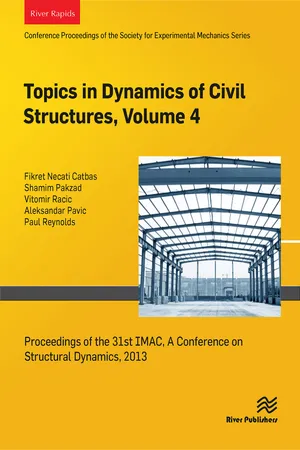
Topics in Dynamics of Civil Structures, Volume 4: Proceedings of the 31st IMAC, A Conference and Exposition on Structural Dynamics, 2013, the fourth volume of seven from the Conference, brings together contributions to this important area of research and engineering. The collection presents early findings and case studies on fundamental and applied aspects of Structural Dynamics, including papers on:
Modal Parameter Identification for Civil Structures
Vibration Control of Civil Structures
Cable Dynamics
Damage Detection Models for Civil Structures
Data-Driven Health Monitoring of Structures & Infrastructure
Experimental Techniques for Civil Structures
Human-induced Vibrations of Civil Structures
Structural Modeling for Civil Structures.
eBook - ePub
Topics in Dynamics of Civil Structures, Volume 4
Proceedings of the 31st IMAC, A Conference on Structural Dynamics, 2013
- English
- ePUB (mobile friendly)
- Available on iOS & Android
eBook - ePub
Topics in Dynamics of Civil Structures, Volume 4
Proceedings of the 31st IMAC, A Conference on Structural Dynamics, 2013
About this book
Information
Topic
Physical SciencesSubtopic
MechanicsTable of contents
- Cover
- Series Page
- Title Page
- Copyright Page
- Preface
- Table of Contents
- Chapter 1 Accurate Damping Estimation by Automated OMA Procedures
- Chapter 2 Real-Time Structural Health Monitoring and Damage Detection
- Chapter 3 Improved Substructure Identification Through Use of an Active Control Device
- Chapter 4 Hybrid MPC: An Application to Semiactive Control of Structures
- Chapter 5 Findings with AVC Design for Mitigation of Human Induced Vibrations in Office Floors
- Chapter 6 Power Requirements for Active Control of Floor Vibrations
- Chapter 7 Tuning TMDs to “Fix” Floors in MDOF Shear Buildings
- Chapter 8 Precise Stiffness Control with MR Dampers
- Chapter 9 Employing Hybrid Tuned Mass Damper to Solve Off-Tuning Problems for Controlling Human Induced Vibration in Stadia
- Chapter 10 Semi-Active TMD Concept for Volgograd Bridge
- Chapter 11 A New Shape Memory Alloy-Based Damping Device Dedicated to Civil Engineering Cables
- Chapter 12 Using Pall Friction Dampers for Seismic Retrofit of a 4-Story Steel Building in Iran
- Chapter 13 Modal Identification of a 5-Story RC Building Tested on the NEES-UCSD Shake Table
- Chapter 14 Modal Testing of a Repaired Building After 2010 Chile Earthquake
- Chapter 15 System Identification and Displacement Profiles of Multi-Span Skewed Bridges with Seat Type Abutments
- Chapter 16 Robustness of Modal Parameter Estimation Methods Applied to Lightweight Structures
- Chapter 17 A Comparative Study of System Identification Techniques Under Ambient Vibration
- Chapter 18 Some Implications of Human-Structure Interaction
- Chapter 19 Evolution of Dynamic Properties of a 5-Story RC Building During Construction
- Chapter 20 Structural Dynamic Parameter Identification and the Effect of Test Techniques
- Chapter 21 Comparison of Damping Models for Space Flight Cables
- Chapter 22 Forced 3D Nonlinear Dynamics of a Hanging Cable Under Multiple Resonance Conditions
- Chapter 23 Computationally Efficient Design of Semiactive Structural Control in the Presence of Measurement Noise
- Chapter 24 Optimal Nonlinear Control Using a Non-quadratic Cost Function for Scalar Systems
- Chapter 25 Optimal Sensor Placement with a Statistical Criterion for Subspace-Based Damage Detection
- Chapter 26 Application of Efficient Model Correction for Damage Assessment Using Limited Measurements
- Chapter 27 Theory Based Sensitivity Analysis and Damage Detection of Steel Roof Sheeting for Hailstone Impact
- Chapter 28 Long-Term Dynamic Monitoring of an Offshore Wind Turbine
- Chapter 29 Nondestructive Evaluation of Surface Crack Depth in Concrete
- Chapter 30 An Improved Methodology for Anomaly Detection Based on Time Series Modeling
- Chapter 31 Response Surface Model Updating for Nonlinear Structures
- Chapter 32 Application of Multivariate Statistically Based Algorithms for Civil Structures Anomaly Detection
- Chapter 33 System Identification of a Three-Story Precast Concrete Parking Structure
- Chapter 34 Structural Damage Localization Using Sensor Cluster Based Regression Schemes
- Chapter 35 Operational Modal Analysis Based on Multivariable Transmissibility Functions: Revisited
- Chapter 36 Diagnosis of Building Vibration Sources via Time-Frequency Analysis
- Chapter 37 Medial-Lateral Gait Patterns in Healthy Adult Walkers
- Chapter 38 Quantifying Differences Between Walking Locomotion on Rigid and Flexible Pavements
- Chapter 39 Using MSD Model to Simulate Human-Structure Interaction During Walking
- Chapter 40 Effect of Sensory Stimuli on Dynamic Loading Induced by People Bouncing
- Chapter 41 Design and Construction of a Very Lively Bridge
- Chapter 42 Experimental Results from a Laboratory Test Program to Examine Human-Structure Interaction
- Chapter 43 Alleviation of Wind-induced Vibrations of Railings in a Building
- Chapter 44 Operational Modal Analysis of a Slender Footbridge to Serviceability Purposes
- Chapter 45 Optimal Sensor Placement for Structural Health Monitoring of Power Transmission Tower-Line Systems
- Chapter 46 Evaluation of Economical Dynamic Exciters for Vibration Testing of Bridges
- Chapter 47 Assessment of Floor Vibrations for Building Re-use: A Case Study
- Chapter 48 Experimental Validation on a Continuous Modulated Wave-Form Command Shaping Applied on Damped Systems
- Chapter 49 Quantification of Damping Effect of Humans on Lightly Damped Staircases
- Chapter 50 Robust Design Optimization of Steel Moment Resisting Frame Under Ground Motion Uncertainty
- Chapter 51 Structural Assessment of Fort Sumter Masonry Coastal Fortification Subject to Foundation Settlements
- Chapter 52 Condition Assessment of a Coal Mine Shiploader
- Chapter 53 Experimental Assessment of Structure Borne Noise Generated by a Braking Resistor
- Chapter 54 Pre-Test Nonlinear FE Modeling and Simulation of a Full-Scale Five-Story Reinforced Concrete Building
- Chapter 55 The Dynamic Stiffening Effects of Non-Structural Partitions in Building Floors
- Chapter 56 Experimental Characterization and Predictive Modeling of a Residential-Scale Wind Turbine
- Chapter 57 Sizing Optimization of Trapezoidal Corrugated Roof Sheeting, Supporting Solar Panels, Under Wind Loading
- Chapter 58 Establishment of Optimized Digging Trajectory for Hydraulic Excavator
- Chapter 59 Modeling, Simulation, and Optimization of California High-Speed Rail Bridge Under Earthquakes
Trusted by 375,005 students
Access to over 1.5 million titles for a fair monthly price.
Study more efficiently using our study tools.
Frequently asked questions
Yes, you can cancel anytime from the Subscription tab in your account settings on the Perlego website. Your subscription will stay active until the end of your current billing period. Learn how to cancel your subscription
No, books cannot be downloaded as external files, such as PDFs, for use outside of Perlego. However, you can download books within the Perlego app for offline reading on mobile or tablet. Learn how to download books offline
Perlego offers two plans: Essential and Complete
- Essential is ideal for learners and professionals who enjoy exploring a wide range of subjects. Access the Essential Library with 800,000+ trusted titles and best-sellers across business, personal growth, and the humanities. Includes unlimited reading time and Standard Read Aloud voice.
- Complete: Perfect for advanced learners and researchers needing full, unrestricted access. Unlock 1.5M+ books across hundreds of subjects, including academic and specialized titles. The Complete Plan also includes advanced features like Premium Read Aloud and Research Assistant.
We are an online textbook subscription service, where you can get access to an entire online library for less than the price of a single book per month. With over 1.5 million books across 990+ topics, we’ve got you covered! Learn about our mission
Look out for the read-aloud symbol on your next book to see if you can listen to it. The read-aloud tool reads text aloud for you, highlighting the text as it is being read. You can pause it, speed it up and slow it down. Learn more about Read Aloud
Yes! You can use the Perlego app on both iOS and Android devices to read anytime, anywhere — even offline. Perfect for commutes or when you’re on the go.
Please note we cannot support devices running on iOS 13 and Android 7 or earlier. Learn more about using the app
Please note we cannot support devices running on iOS 13 and Android 7 or earlier. Learn more about using the app
Yes, you can access Topics in Dynamics of Civil Structures, Volume 4 by Fikret Necati Catbas,Shamim Pakzad,Vitomir Racic,Aleksandar Pavic in PDF and/or ePUB format, as well as other popular books in Physical Sciences & Mechanics. We have over 1.5 million books available in our catalogue for you to explore.