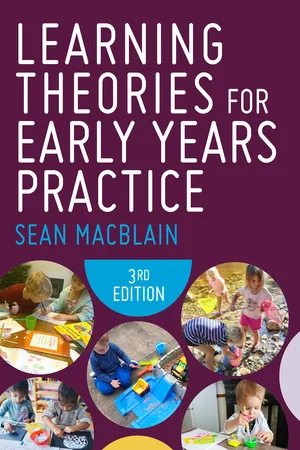
Learning Theories for Early Years Practice
eBook - ePub

Learning Theories for Early Years Practice

  1. English
  2. ePUB (mobile friendly)
  3. Available on iOS & Android
eBook - ePub

Learning Theories for Early Years Practice

About this book

This third edition showcases captivating full-color photographs, compelling case studies, engaging activities, and thought-provoking discussion points. Each chapter delves into the theorist and the theory, illustrating their practical applications, strengths, weaknesses, and connections to other theorists. This indispensable resource empowers students to create inclusive learning environments.

New to this edition:

  • New chapter on Barbara Rogoff and children in cultural communities
  • Expanded final section on theorists in the contemporary world, covering vital issues such as mental health, diversity, gender, special educational needs, play, valuing our environments, and artificial intelligence
  • Updated case studies and examples

Frequently asked questions

Yes, you can cancel anytime from the Subscription tab in your account settings on the Perlego website. Your subscription will stay active until the end of your current billing period. Learn how to cancel your subscription.
At the moment all of our mobile-responsive ePub books are available to download via the app. Most of our PDFs are also available to download and we're working on making the final remaining ones downloadable now. Learn more here.
Perlego offers two plans: Essential and Complete
  • Essential is ideal for learners and professionals who enjoy exploring a wide range of subjects. Access the Essential Library with 800,000+ trusted titles and best-sellers across business, personal growth, and the humanities. Includes unlimited reading time and Standard Read Aloud voice.
  • Complete: Perfect for advanced learners and researchers needing full, unrestricted access. Unlock 1.4M+ books across hundreds of subjects, including academic and specialized titles. The Complete Plan also includes advanced features like Premium Read Aloud and Research Assistant.
Both plans are available with monthly, semester, or annual billing cycles.
We are an online textbook subscription service, where you can get access to an entire online library for less than the price of a single book per month. With over 1 million books across 1000+ topics, we’ve got you covered! Learn more here.
Look out for the read-aloud symbol on your next book to see if you can listen to it. The read-aloud tool reads text aloud for you, highlighting the text as it is being read. You can pause it, speed it up and slow it down. Learn more here.
Yes! You can use the Perlego app on both iOS or Android devices to read anytime, anywhere — even offline. Perfect for commutes or when you’re on the go.
Please note we cannot support devices running on iOS 13 and Android 7 or earlier. Learn more about using the app.
Yes, you can access Learning Theories for Early Years Practice by Sean MacBlain in PDF and/or ePUB format, as well as other popular books in Education & Early Childhood Education. We have over one million books available in our catalogue for you to explore.

Table of contents

  1. Cover
  2. Half Title
  3. Title Page
  4. Copyright Page
  5. Acknowledgements
  6. Contents
  7. About the Author
  8. Foreword
  9. Acknowledgements
  10. Introduction
  11. Part I Early Influences
  12. John Locke and the Emergence of Empiricism
  13. Jean-Jacques Rousseau and the Concept of ‘Child’
  14. Johann Pestalozzi and the Importance of Nature
  15. Friedrich Froebel and the Importance of Play
  16. Rachel and Margaret McMillan and Social Reform
  17. The Psychodynamic Tradition
  18. Rudolf Steiner and the Changing Needs of Children
  19. Maria Montessori: The Environment and Learning
  20. Part II Modern Influences
  21. John Dewey and Child-Centred Education
  22. Burrhus Skinner and Behaviourism
  23. Jean Piaget: An Enduring Legacy
  24. Lev Vygotsky: Learning and Social Constructivism
  25. John Bowlby and Early Attachment
  26. Albert Bandura and Social Learning Theory
  27. Urie Bronfenbrenner: Learning in the Wider Context
  28. Jerome Bruner and Constructivism
  29. Howard Gardner and Theories of Multiple Intelligence
  30. Reuven Feuerstein and Instrumental Enrichment
  31. Nel Noddings and the Ethics of Care
  32. Te WhĀriki
  33. Loris Malaguzzi and Reggio Emilia
  34. Carol Dweck and Children’s Mindsets
  35. Guy Claxton: Building Learning Power
  36. Barbara Rogoff: Children as Participants in Their Cultural Communities
  37. Part III Challenges for Theorists in a Changing World
  38. Poverty
  39. Artificial Intelligence: Changing landscapes
  40. Glossary
  41. Index