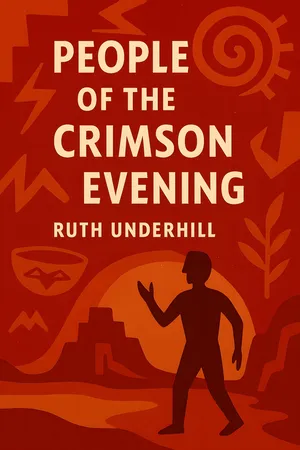
People of the Crimson Evening is Ruth Underhill's vivid ethnographic portrait of the Tohono O'odham (Papago) people of the American Southwest, capturing their traditions, daily life, and spiritual worldview at a time when modernization was beginning to alter long-standing ways of living. Drawing on years of fieldwork, Underhill presents a richly detailed account of a desert culture shaped by the rhythms of the land, the cycles of planting and harvest, and the ceremonial practices that knit the community together.
Underhill's narrative blends anthropological observation with the warmth of personal relationships developed during her research. She describes architecture, foodways, crafts, and oral traditions, while also delving into kinship systems, governance, and the role of mythology in everyday life. The title evokes the striking colors of the desert at sunset, a fitting metaphor for a culture balancing continuity and change in the mid-20th century.
With clear, empathetic prose, People of the Crimson Evening is more than an academic study—it is a respectful and engaging tribute to a resilient people. Underhill's work preserves invaluable cultural knowledge, offering insight into a society whose adaptation to its harsh but beautiful environment stands as a testament to human ingenuity and endurance. It remains a significant contribution to the anthropological literature of the Southwest and an accessible introduction for general readers.