A fully illustrated study of the Roman cavalry's evolution, this fascinating book chronicles tactics and composition from the time of the Republic to the fall of the Dominate.
The cavalry 'wings' that probed ahead of the Roman Army played a key role in its campaigns of conquest, masking its marching flanks and seeking to encircle enemies in battle. However, the original small cavalry arm provided by the citizen nobility had proved inadequate before the end of the Republic, and Julius Caesar's cavalry was largely made up of hired allies. During the Early Principate, the armies under Augustus continued in this vein, incorporating large numbers of non-citizen auxiliary cavalry units. The provinces came under increasing attack throughout and following the chaotic mid-3rd century, and Rome took lessons from its 'barbarian' enemies in how to improve its military mobility, adopting both new, heavily armoured shock cavalry and horse-archers, and vitally shaping the tactics employed during the Dominate.
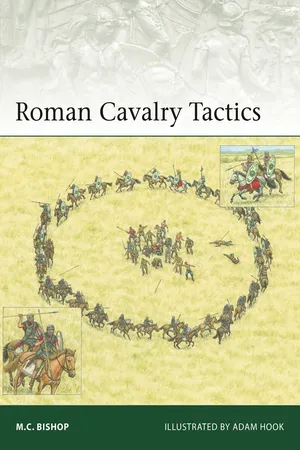
In this engaging study, Roman Army expert M.C. Bishop charts how the cavalry grew to become the dominant force in Roman field armies by the twilight of the Western Empire. Eight newly commissioned artwork plates and a rich selection of artefact photographs and archaeological sources provide vivid detail and insight, helping to bring to the life the evolving tactics, clothing and weaponry of Rome's cavalry from the 2nd century BC through to the 5th century AD.
- English
- ePUB (mobile friendly)
- Available on iOS & Android
eBook - ePub
Roman Cavalry Tactics
About this book
Information
Table of contents
- Cover
- Title Page
- Table of Contents
- Introduction
- The Republic (before 27 BC)
- The Early Principate (27 BC–AD 117)
- The High and Late Principate(AD 117–192 and 192–284)
- The Dominate (AD 284–476)
- Conclusions
- Bibliography
- About the Author
- eCopyright
Trusted by 375,005 students
Access to over 1.5 million titles for a fair monthly price.
Study more efficiently using our study tools.
Frequently asked questions
Yes, you can cancel anytime from the Subscription tab in your account settings on the Perlego website. Your subscription will stay active until the end of your current billing period. Learn how to cancel your subscription
No, books cannot be downloaded as external files, such as PDFs, for use outside of Perlego. However, you can download books within the Perlego app for offline reading on mobile or tablet. Learn how to download books offline
Perlego offers two plans: Essential and Complete
- Essential is ideal for learners and professionals who enjoy exploring a wide range of subjects. Access the Essential Library with 800,000+ trusted titles and best-sellers across business, personal growth, and the humanities. Includes unlimited reading time and Standard Read Aloud voice.
- Complete: Perfect for advanced learners and researchers needing full, unrestricted access. Unlock 1.5M+ books across hundreds of subjects, including academic and specialized titles. The Complete Plan also includes advanced features like Premium Read Aloud and Research Assistant.
We are an online textbook subscription service, where you can get access to an entire online library for less than the price of a single book per month. With over 1.5 million books across 990+ topics, we’ve got you covered! Learn about our mission
Look out for the read-aloud symbol on your next book to see if you can listen to it. The read-aloud tool reads text aloud for you, highlighting the text as it is being read. You can pause it, speed it up and slow it down. Learn more about Read Aloud
Yes! You can use the Perlego app on both iOS and Android devices to read anytime, anywhere — even offline. Perfect for commutes or when you’re on the go.
Please note we cannot support devices running on iOS 13 and Android 7 or earlier. Learn more about using the app
Please note we cannot support devices running on iOS 13 and Android 7 or earlier. Learn more about using the app
Yes, you can access Roman Cavalry Tactics by M.C. Bishop,Adam Hook in PDF and/or ePUB format, as well as other popular books in History & Military & Maritime History. We have over 1.5 million books available in our catalogue for you to explore.