How the social organization of Europe and China shaped their divergent economic and political trajectories over the past millennium
In the eleventh century, when Europe was still backward and poor, China was a rich and sophisticated civilization. Yet Europe became the birthplace of democracy and the Industrial Revolution, driving the Great Enrichment, while China stagnated until the end of the twentieth century and was always ruled by autocracies. Two Paths to Prosperity traces the emergence of two very different social organizations in premodern China and Europe—the clan and the corporation—showing how they were key factors in the economic and political divergence of these two great civilizations.
In this landmark book, three leading economists offer a bold new account of why Europe and China evolved along such different trajectories. In the early Middle Ages, public goods like risk sharing, religious worship, education, and conflict resolution were provided by nonstate organizations in both societies. China increasingly relied on kin-based cooperation within clans, while weaker kinship ties in Europe gave rise to corporations such as guilds, universities, and self-governing towns. Despite performing similar functions, clans and corporations were built on very different principles—with lasting consequences until today.
Providing a novel answer to a fundamental question in economic and political history, Two Paths to Prosperity shows how extended kinship in Chinese society facilitated the consolidation of autocracy and hindered innovation and economic development, and how corporations in Europe influenced emerging state institutions and set the stage for the Industrial Revolution.
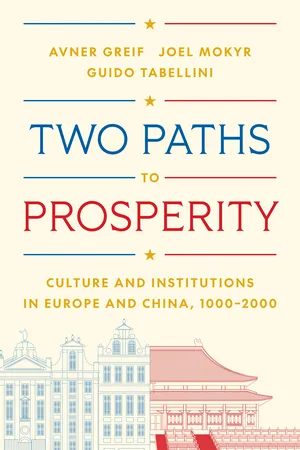
eBook - ePub
Two Paths to Prosperity
Culture and Institutions in Europe and China, 1000–2000
- English
- ePUB (mobile friendly)
- Available on iOS & Android
eBook - ePub
Two Paths to Prosperity
Culture and Institutions in Europe and China, 1000–2000
About this book
Information
Publisher
Princeton University PressYear
2025Print ISBN
9780691267722
9780691265940
eBook ISBN
9780691267715
Table of contents
- Cover
- Title Page
- Copyright
- Contents
- Acknowledgments
- 1. Introduction
- 2. The Great Divergence
- 3. Morality and Social Organizations
- 4. The Social and Cultural Origins of the Great Bifurcation
- 5. The Clan and the Corporation
- 6. Social Organizations in Europe and China
- 7. Political Divergence
- 8. The State and Social Organizations
- 9. The Industrial Revolution
- 10. Modern China
- 11. Conclusions
- References
- Index
Trusted by 375,005 students
Access to over 1.5 million titles for a fair monthly price.
Study more efficiently using our study tools.
Frequently asked questions
Yes, you can cancel anytime from the Subscription tab in your account settings on the Perlego website. Your subscription will stay active until the end of your current billing period. Learn how to cancel your subscription
No, books cannot be downloaded as external files, such as PDFs, for use outside of Perlego. However, you can download books within the Perlego app for offline reading on mobile or tablet. Learn how to download books offline
Perlego offers two plans: Essential and Complete
- Essential is ideal for learners and professionals who enjoy exploring a wide range of subjects. Access the Essential Library with 800,000+ trusted titles and best-sellers across business, personal growth, and the humanities. Includes unlimited reading time and Standard Read Aloud voice.
- Complete: Perfect for advanced learners and researchers needing full, unrestricted access. Unlock 1.5M+ books across hundreds of subjects, including academic and specialized titles. The Complete Plan also includes advanced features like Premium Read Aloud and Research Assistant.
We are an online textbook subscription service, where you can get access to an entire online library for less than the price of a single book per month. With over 1.5 million books across 990+ topics, we’ve got you covered! Learn about our mission
Look out for the read-aloud symbol on your next book to see if you can listen to it. The read-aloud tool reads text aloud for you, highlighting the text as it is being read. You can pause it, speed it up and slow it down. Learn more about Read Aloud
Yes! You can use the Perlego app on both iOS and Android devices to read anytime, anywhere — even offline. Perfect for commutes or when you’re on the go.
Please note we cannot support devices running on iOS 13 and Android 7 or earlier. Learn more about using the app
Please note we cannot support devices running on iOS 13 and Android 7 or earlier. Learn more about using the app
Yes, you can access Two Paths to Prosperity by Avner Greif,Joel Mokyr,Guido Tabellini in PDF and/or ePUB format, as well as other popular books in Economics & Comparative Economics. We have over 1.5 million books available in our catalogue for you to explore.