Beyond unlivable wages and a lack of upward mobility, low-wage work in the United States is rife with danger and degrading treatment. Immigrants and people of color are overrepresented in these "bad jobs" and often feel as though they are unable to change their working conditions. In Legalized Inequalities, law scholar Kati L. Griffith, sociologist Shannon Gleeson, anthropologist Darlène Dubuisson, and political scientist Patricia Campos-Medina investigate the government's role in perpetuating poor and dangerous work environments for low-wage immigrant workers of color.
Drawing on interviews with over three hundred low-wage Haitian and Central American workers and worker advocates, Griffith, Gleeson, Dubuisson, and Campos-Medina reveal how U.S. policies produce and sustain job instability and insecurity. Together, contemporary U.S. labor and employment law, immigration policy, and enduring racial inequality work in tandem to keep workers' wages low, lock them into substandard working conditions, and minimize opportunities to push for change. Workplace regulations meant to protect workers are weak and underenforced, privileging employers over workers. At-will employment policies, which allow employers to terminate employees without cause, discourage workers from bargaining for better jobs or holding employers accountable for even the most egregious mistreatment. Federal immigration policy further disempowers workers by deputizing employers to act as immigration enforcement agents through immigration status verification requirements. Undocumented workers often believe they must endure maltreatment or risk deportation. Anti-immigrant sentiment—encouraged by U.S. policy—impacts workers across all status groups. Additionally, despite a proliferation of civil rights legislation, racial disparities remain in the workplace. Workers of color are often paid less, forced to complete more dangerous and demeaning tasks, and subjected to racial harassment.
?
While these workers face formidable barriers to fighting for their rights, they are not entirely powerless. Some low-wage workers filed formal complaints with government agencies. Others, on their own or collectively, confronted their employers to demand fair and dignified treatment. Some even quit in protest of their poor working conditions. The authors argue that reforming labor and employment law, immigration law, and Civil Rights law is necessary to reshape the low-wage workplace. They suggest increasing funding for workers' rights enforcement agencies, removing the mandate for employers to verify a worker's immigration status, and making it easier to prove that employment discrimination has occurred, among other policy proposals, to help empower and protect low-wage immigrant workers of color.
Legalized Inequalities not only highlights the crushing consequences of U.S. policy on low-wage immigrant workers of color but showcases their resilience in the face of these obstacles.
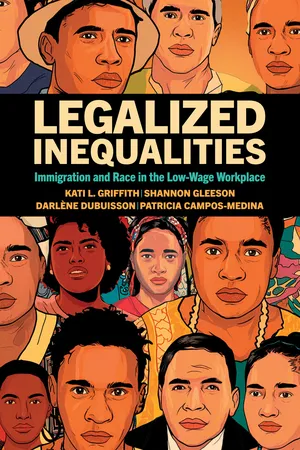
eBook - ePub
Legalized Inequalities
Immigration and Race in the Low-wage Workplace
- English
- ePUB (mobile friendly)
- Available on iOS & Android
eBook - ePub
Legalized Inequalities
Immigration and Race in the Low-wage Workplace
About this book
Information
Table of contents
- Cover Page
- Title Page
- Copyright Page
- Contents
- List of Tables
- About the Authors
- Acknowledgments
- 1. Introduction
- Part 1. Underregulated Rights at Work
- Part 2. An Immigration Regime at Work
- Part 3. Racisms and Colonial Legacies at Work
- Methodological Appendix
- Notes
- References
- Index
Trusted by 375,005 students
Access to over 1.5 million titles for a fair monthly price.
Study more efficiently using our study tools.
Frequently asked questions
Yes, you can cancel anytime from the Subscription tab in your account settings on the Perlego website. Your subscription will stay active until the end of your current billing period. Learn how to cancel your subscription
No, books cannot be downloaded as external files, such as PDFs, for use outside of Perlego. However, you can download books within the Perlego app for offline reading on mobile or tablet. Learn how to download books offline
Perlego offers two plans: Essential and Complete
- Essential is ideal for learners and professionals who enjoy exploring a wide range of subjects. Access the Essential Library with 800,000+ trusted titles and best-sellers across business, personal growth, and the humanities. Includes unlimited reading time and Standard Read Aloud voice.
- Complete: Perfect for advanced learners and researchers needing full, unrestricted access. Unlock 1.5M+ books across hundreds of subjects, including academic and specialized titles. The Complete Plan also includes advanced features like Premium Read Aloud and Research Assistant.
We are an online textbook subscription service, where you can get access to an entire online library for less than the price of a single book per month. With over 1.5 million books across 990+ topics, we’ve got you covered! Learn about our mission
Look out for the read-aloud symbol on your next book to see if you can listen to it. The read-aloud tool reads text aloud for you, highlighting the text as it is being read. You can pause it, speed it up and slow it down. Learn more about Read Aloud
Yes! You can use the Perlego app on both iOS and Android devices to read anytime, anywhere — even offline. Perfect for commutes or when you’re on the go.
Please note we cannot support devices running on iOS 13 and Android 7 or earlier. Learn more about using the app
Please note we cannot support devices running on iOS 13 and Android 7 or earlier. Learn more about using the app
Yes, you can access Legalized Inequalities by Kati L. Griffith,Shannon Gleeson,Patricia Campos-Medina,Dubuisson Darlene in PDF and/or ePUB format, as well as other popular books in Social Sciences & Labour Economics. We have over 1.5 million books available in our catalogue for you to explore.