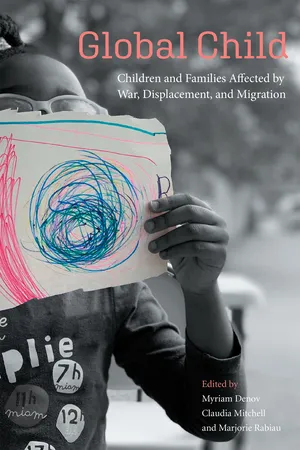
eBook - PDF
Global Child
Children and Families Affected by War, Displacement, and Migration
- 311 pages
- English
- PDF
- Available on iOS & Android
eBook - PDF
Global Child
Children and Families Affected by War, Displacement, and Migration
About this book
Armed conflicts continue to wreak havoc on children and families around the world with profound effects. In 2017, 420 million children—nearly one in five—were living in conflict-affected areas, an increase in 30 million from the previous year. The recent surge in war-induced migration, referred to as a "global refugee crisis" has made migration a highly politicized issue, with refugee populations and host countries facing unique challenges. We know from research related to asylum seeking families that it is vital to think about children and families in relation to what it means to stay together, what it means for parents to be separated from their children, and the kinds of everyday tensions that emerge in living in dangerous, insecure, and precarious circumstances. In Global Child, the authors draw on what they have learned through their collaborative undertakings, and highlight the unique features of participatory, arts-based, and socio-ecological approaches to studying war-affected children and families, demonstrating the collective strength as well as the limitations and ethical implications of such research. Building on work across the Global South and the Global North, this book aims to deepen an understanding of their tri-pillared approach, and the potential of this methodology for contributing to improved practices in working with war-affected children and their families.
Information
Publisher
Rutgers University PressYear
2023Print ISBN
9781978817739
9781978817746
eBook ISBN
9781978817777
Table of contents
- Cover
- Title Page
- Copyright
- Contents
- 1. A Tri-pillared Approach to Studying Children and Families Affected by War, Migration, and Displacement / Myriam Denov, Claudia Mitchell, and Marjorie Rabiau
- Part I: Socio-Ecological Approaches
- Part II: Participatory Approaches
- Part III: Arts-Based Approaches
- Acknowledgments
- Notes on Contributors
- Index
Trusted by 375,005 students
Access to over 1.5 million titles for a fair monthly price.
Study more efficiently using our study tools.
Frequently asked questions
Yes, you can cancel anytime from the Subscription tab in your account settings on the Perlego website. Your subscription will stay active until the end of your current billing period. Learn how to cancel your subscription
No, books cannot be downloaded as external files, such as PDFs, for use outside of Perlego. However, you can download books within the Perlego app for offline reading on mobile or tablet. Learn how to download books offline
Perlego offers two plans: Essential and Complete
- Essential is ideal for learners and professionals who enjoy exploring a wide range of subjects. Access the Essential Library with 800,000+ trusted titles and best-sellers across business, personal growth, and the humanities. Includes unlimited reading time and Standard Read Aloud voice.
- Complete: Perfect for advanced learners and researchers needing full, unrestricted access. Unlock 1.5M+ books across hundreds of subjects, including academic and specialized titles. The Complete Plan also includes advanced features like Premium Read Aloud and Research Assistant.
We are an online textbook subscription service, where you can get access to an entire online library for less than the price of a single book per month. With over 1.5 million books across 990+ topics, we’ve got you covered! Learn about our mission
Look out for the read-aloud symbol on your next book to see if you can listen to it. The read-aloud tool reads text aloud for you, highlighting the text as it is being read. You can pause it, speed it up and slow it down. Learn more about Read Aloud
Yes! You can use the Perlego app on both iOS and Android devices to read anytime, anywhere — even offline. Perfect for commutes or when you’re on the go.
Please note we cannot support devices running on iOS 13 and Android 7 or earlier. Learn more about using the app
Please note we cannot support devices running on iOS 13 and Android 7 or earlier. Learn more about using the app
Yes, you can access Global Child by Myriam Denov,Claudia Mitchell,Marjorie Rabiau in PDF and/or ePUB format, as well as other popular books in Social Sciences & Human Rights. We have over 1.5 million books available in our catalogue for you to explore.