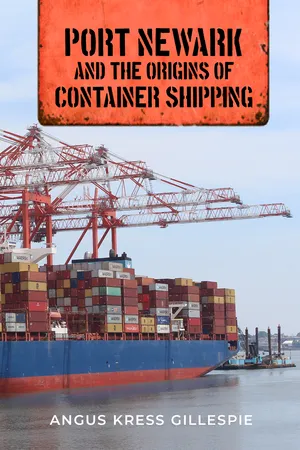
Container shipping is a vital part of the global economy. Goods from all around the world, from vegetables to automobiles, are placed in large metal containers which are transported across the ocean in ships, then loaded onto tractor-trailers and railroad flatbeds. But when and where did this world-changing invention get started?
This fascinating study traces the birth of containerization to Port Newark, New Jersey, in 1956 when trucker Malcom McLean thought of a brilliant new way to transport cargo. It tells the story of how Port Newark grew rapidly as McLean's idea was backed by both New York banks and the US military, who used containerization to ship supplies to troops in Vietnam. Angus Gillespie takes us behind the scenes of today's active container shipping operations in Port Newark, talking to the pilots who guide the ships into port, the Coast Guard personnel who help manage the massive shipping traffic, the crews who unload the containers, and even the chaplains who counsel and support the mariners. Port Newark shines a spotlight on the unsung men and women who help this complex global shipping operation run smoothly.
Since McLean's innovation, Port Newark has expanded with the addition of the nearby Elizabeth Marine Terminal. This New Jersey complex now makes up the busiest seaport on the East Coast of the United States. Some have even called it "America's Front Door." The book tells the story of the rapid growth of worldwide containerization, and how Port Newark has adapted to bigger ships with deeper channels and a raised bridge. In the end, there is speculation of the future of this port with ever-increasing automation, artificial intelligence, and automation.
- English
- ePUB (mobile friendly)
- Available on iOS & Android
eBook - ePub
Port Newark and the Origins of Container Shipping
About this book
Information
Table of contents
- Cover
- Title Page
- Copyright
- Epigrpah
- Contents
- Foreword by Michael Aaron Rockland
- Preface
- Introduction
- 1. Early Historical Background
- 2. The Post–World War II Era
- 3. The Invention of Containerization
- 4. The Rapid Growth of Containerization
- 5. From the Ocean to the Docks
- 6. Navigation
- 7. Pilotage
- 8. Tugboats
- 9. The Contemporary Port
- 10. Moving the Freight
- 11. The Seamen’s Church Institute
- 12. The Future
- Acknowledgments
- Notes
- Index
- About the Author
Trusted by 375,005 students
Access to over 1.5 million titles for a fair monthly price.
Study more efficiently using our study tools.
Frequently asked questions
Yes, you can cancel anytime from the Subscription tab in your account settings on the Perlego website. Your subscription will stay active until the end of your current billing period. Learn how to cancel your subscription
No, books cannot be downloaded as external files, such as PDFs, for use outside of Perlego. However, you can download books within the Perlego app for offline reading on mobile or tablet. Learn how to download books offline
Perlego offers two plans: Essential and Complete
- Essential is ideal for learners and professionals who enjoy exploring a wide range of subjects. Access the Essential Library with 800,000+ trusted titles and best-sellers across business, personal growth, and the humanities. Includes unlimited reading time and Standard Read Aloud voice.
- Complete: Perfect for advanced learners and researchers needing full, unrestricted access. Unlock 1.5M+ books across hundreds of subjects, including academic and specialized titles. The Complete Plan also includes advanced features like Premium Read Aloud and Research Assistant.
We are an online textbook subscription service, where you can get access to an entire online library for less than the price of a single book per month. With over 1.5 million books across 990+ topics, we’ve got you covered! Learn about our mission
Look out for the read-aloud symbol on your next book to see if you can listen to it. The read-aloud tool reads text aloud for you, highlighting the text as it is being read. You can pause it, speed it up and slow it down. Learn more about Read Aloud
Yes! You can use the Perlego app on both iOS and Android devices to read anytime, anywhere — even offline. Perfect for commutes or when you’re on the go.
Please note we cannot support devices running on iOS 13 and Android 7 or earlier. Learn more about using the app
Please note we cannot support devices running on iOS 13 and Android 7 or earlier. Learn more about using the app
Yes, you can access Port Newark and the Origins of Container Shipping by Angus Kress Gillespie in PDF and/or ePUB format, as well as other popular books in Business & Business General. We have over 1.5 million books available in our catalogue for you to explore.