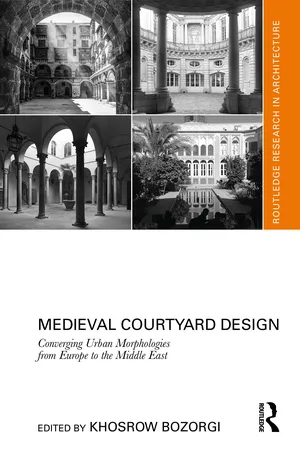
Medieval Courtyard Design
eBook - ePub

Medieval Courtyard Design

Converging Urban Morphologies from Europe to the Middle East

  1. English
  2. ePUB (mobile friendly)
  3. Available on iOS & Android
eBook - ePub

Medieval Courtyard Design

Converging Urban Morphologies from Europe to the Middle East

About this book

This groundbreaking study examines courtyard architecture across Paris, Florence, Siena, Granada, and Yazd to reveal how the deliberate creation of emptiness—the "bounded void"—functions as architecture's primary generative principle. Moving beyond conventional object-based analysis, the book demonstrates that architecture's essence lies not in built form but in calibrated absence.

Through rigorous comparative analysis, readers discover how courtyards operate as environmental mediators, social organizers, and cosmological instruments across diverse cultures. The study reveals striking morphological convergences that emerge through parallel evolution rather than stylistic diffusion. Drawing on spatial cognition research, urban morphology, and phenomenological analysis, the book establishes void-focused methodology as a new theoretical framework. This paradigm shift from analyzing solid to void transforms our understanding of both historical and contemporary spatial practice, uncovering universal principles that transcend geographic and temporal boundaries.

Essential for architectural theorists questioning disciplinary orthodoxies, historians seeking alternatives to period-style categorization, and researchers investigating architecture's cognitive dimensions. The work provides both radical historiographical revision and practical insights for contemporary designers who engage with density, sustainability, and social space.

Frequently asked questions

Yes, you can cancel anytime from the Subscription tab in your account settings on the Perlego website. Your subscription will stay active until the end of your current billing period. Learn how to cancel your subscription.
No, books cannot be downloaded as external files, such as PDFs, for use outside of Perlego. However, you can download books within the Perlego app for offline reading on mobile or tablet. Learn more here.
Perlego offers two plans: Essential and Complete
  • Essential is ideal for learners and professionals who enjoy exploring a wide range of subjects. Access the Essential Library with 800,000+ trusted titles and best-sellers across business, personal growth, and the humanities. Includes unlimited reading time and Standard Read Aloud voice.
  • Complete: Perfect for advanced learners and researchers needing full, unrestricted access. Unlock 1.4M+ books across hundreds of subjects, including academic and specialized titles. The Complete Plan also includes advanced features like Premium Read Aloud and Research Assistant.
Both plans are available with monthly, semester, or annual billing cycles.
We are an online textbook subscription service, where you can get access to an entire online library for less than the price of a single book per month. With over 1 million books across 1000+ topics, we’ve got you covered! Learn more here.
Look out for the read-aloud symbol on your next book to see if you can listen to it. The read-aloud tool reads text aloud for you, highlighting the text as it is being read. You can pause it, speed it up and slow it down. Learn more here.
Yes! You can use the Perlego app on both iOS or Android devices to read anytime, anywhere — even offline. Perfect for commutes or when you’re on the go.
Please note we cannot support devices running on iOS 13 and Android 7 or earlier. Learn more about using the app.
Yes, you can access Medieval Courtyard Design by Khosrow Bozorgi in PDF and/or ePUB format, as well as other popular books in Architecture & Architecture Design. We have over one million books available in our catalogue for you to explore.

Information

Table of contents

  1. Cover Page
  2. Half Title page
  3. Series Page
  4. Title Page
  5. Copyright Page
  6. Contents
  7. Figures
  8. Contributors
  9. Preface
  10. Part I Introduction and Foundation
  11. Part II From Cross-Cultural Precedents to Archetypal Urban Formation
  12. Part III Synthesis and Conclusion
  13. Index