eBook - ePub
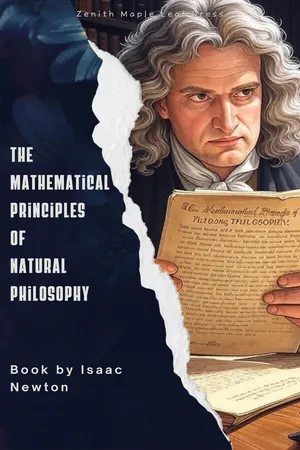
The Mathematical Principles of Natural Philosophy
Isaac Newton's Principia: The Foundation of Modern Science
- English
- ePUB (mobile friendly)
- Available on iOS & Android
eBook - ePub
The Mathematical Principles of Natural Philosophy
Isaac Newton's Principia: The Foundation of Modern Science
About this book
"The book that changed the universe—and how we understand it."
Isaac Newton's The Mathematical Principles of Natural Philosophy, better known as the Principia, is one of the most important works in the history of science. First published in 1687, this groundbreaking masterpiece laid the foundation for classical mechanics, celestial motion, and the laws of gravity—revolutionizing the way humanity views the cosmos.
In this monumental work, Newton introduced:
The three laws of motion that remain fundamental in physics today.
The law of universal gravitation, explaining the forces that govern both falling apples and orbiting planets.
The application of rigorous mathematical principles to natural philosophy, transforming speculation into science.
? Why Readers Treasure This Classic:
Recognized as one of the greatest scientific works ever written.
The cornerstone of modern physics, astronomy, and engineering.
A timeless intellectual achievement that continues to inspire scientists, scholars, and thinkers.
From the motions of planets to the behavior of objects on Earth, Newton's Principia reshaped knowledge and remains essential reading for anyone fascinated by science, history, and the power of human discovery.
? Step into the mind of the genius who unlocked the secrets of the universe—Click "Buy Now" to own Newton's masterpiece.
Information
Index
MathematicsTable of contents
- Top
- The Authors Preface
- Definitions.
- Axioms, or Laws of Motion.
- Book i. Of the Motion of Bodies.
- Of the method of first and last ratios of quantities.
- Of the Invention of Centripetal Forces.
- Of the motion of bodies in eccentric conic sections.
- Of the finding of elliptic, parabolic, and hyperbolic orbits, from the focus given.
- How the orbits are to be found when neither focus is given.
- How the motions are to be found in given orbits.
- Concerning the rectilinear ascent and descent of bodies.
- Of the invention of orbits wherein bodies will revolve, being acted upon by any sort of centripetal force.
- Of the motion of bodies in moveable orbits; and of the motion of the apsides.
- Of the motion of bodies in given superficies, and of the reciprocal motion of funependulous bodies.
- Of the motions of bodies tending to each other with centripetal forces.
- Of the attractive forces of sphaerical bodies.
- Of the attractive forces of bodies which are not of a sphaerical figure.
- Of the motion of very small bodies when agitated by centripetal forces tending to the several parts of any very great body.
- Book ii. Of the Motion of Bodies.
- Of the motion of bodies that are resisted in the ratio of the velocity.
- Of the motion of bodies that are resisted in the duplicate ratio of their velocities.
- Of the motions of bodies which are resisted partly in the ratio of the velocities, and partly in the duplicate of the same ratio.
- Of the circular motion of bodies in resisting mediums.
- Of the density and compression of fluids; and of hydrostatics.
- Of the motion and resistance of funependulous bodies.
- Of the motion of fluids, and the resistance made to projected bodies.
- Of motion propagated through fluids.
- Of the circular motion of fluids.
- Book iii.
- Rules of Reasoning in Philosophy.
- Phaenomena, or Appearances.
- Propositions
- General Scholium.
- Index.
Trusted by 375,005 students
Access to over 1.5 million titles for a fair monthly price.
Study more efficiently using our study tools.
Frequently asked questions
Yes, you can cancel anytime from the Subscription tab in your account settings on the Perlego website. Your subscription will stay active until the end of your current billing period. Learn how to cancel your subscription
No, books cannot be downloaded as external files, such as PDFs, for use outside of Perlego. However, you can download books within the Perlego app for offline reading on mobile or tablet. Learn how to download books offline
Perlego offers two plans: Essential and Complete
- Essential is ideal for learners and professionals who enjoy exploring a wide range of subjects. Access the Essential Library with 800,000+ trusted titles and best-sellers across business, personal growth, and the humanities. Includes unlimited reading time and Standard Read Aloud voice.
- Complete: Perfect for advanced learners and researchers needing full, unrestricted access. Unlock 1.5M+ books across hundreds of subjects, including academic and specialized titles. The Complete Plan also includes advanced features like Premium Read Aloud and Research Assistant.
We are an online textbook subscription service, where you can get access to an entire online library for less than the price of a single book per month. With over 1.5 million books across 990+ topics, we’ve got you covered! Learn about our mission
Look out for the read-aloud symbol on your next book to see if you can listen to it. The read-aloud tool reads text aloud for you, highlighting the text as it is being read. You can pause it, speed it up and slow it down. Learn more about Read Aloud
Yes! You can use the Perlego app on both iOS and Android devices to read anytime, anywhere — even offline. Perfect for commutes or when you’re on the go.
Please note we cannot support devices running on iOS 13 and Android 7 or earlier. Learn more about using the app
Please note we cannot support devices running on iOS 13 and Android 7 or earlier. Learn more about using the app
Yes, you can access The Mathematical Principles of Natural Philosophy by Isaac Newton,Zenith Maple Leaf Press in PDF and/or ePUB format, as well as other popular books in Mathematics & History & Philosophy of Mathematics. We have over 1.5 million books available in our catalogue for you to explore.