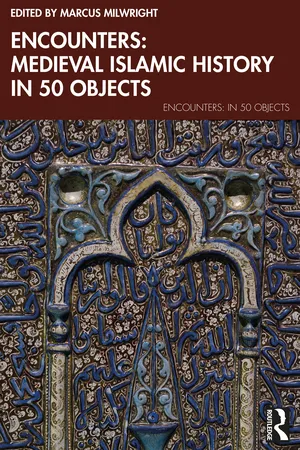
Encounters: Medieval Islamic History in 50 Objects
eBook - ePub

Encounters: Medieval Islamic History in 50 Objects

  1. English
  2. ePUB (mobile friendly)
  3. Available on iOS & Android
eBook - ePub

Encounters: Medieval Islamic History in 50 Objects

About this book

This book consists of fifty case studies and offers an innovative approach to the study of Medieval Islamic history, concentrating on the analysis of physical objects from the seventh to the eighteenth centuries and across most of the regions that make up the pre-Modern Islamic world.

These include a wide range of objects from portable items like coins, vessels and books to major constructions, including mosques, tombs, castles, dams, and canal systems. The central argument is that the interdisciplinary study of physical objects provides invaluable perspectives that can deepen or challenge the evidence in the written record. Object-based study can also shed light on the lives of social groups who are seldom discussed in Islamic texts written before the modern period. To demonstrate these points, each case study focusses on a single object or small group of related objects. The case studies combine close analysis of the material and visual characteristics with a discussion of the wider context in which such objects were commissioned, made, used, adapted and exchanged.

The book is intended as an introduction to the historical study of Islamic objects, employing perspectives from the fields of art history, archaeology, numismatics, ethnography, and epigraphy. Written with a minimum of technical language and supported by a critical introduction, an extensive glossary, a timeline and guide for further reading, the book is aimed at students and general readers who are interested in the political, economic, social, cultural, religious and intellectual histories of the Islamic world.

Frequently asked questions

Yes, you can cancel anytime from the Subscription tab in your account settings on the Perlego website. Your subscription will stay active until the end of your current billing period. Learn how to cancel your subscription.
No, books cannot be downloaded as external files, such as PDFs, for use outside of Perlego. However, you can download books within the Perlego app for offline reading on mobile or tablet. Learn more here.
Perlego offers two plans: Essential and Complete
  • Essential is ideal for learners and professionals who enjoy exploring a wide range of subjects. Access the Essential Library with 800,000+ trusted titles and best-sellers across business, personal growth, and the humanities. Includes unlimited reading time and Standard Read Aloud voice.
  • Complete: Perfect for advanced learners and researchers needing full, unrestricted access. Unlock 1.4M+ books across hundreds of subjects, including academic and specialized titles. The Complete Plan also includes advanced features like Premium Read Aloud and Research Assistant.
Both plans are available with monthly, semester, or annual billing cycles.
We are an online textbook subscription service, where you can get access to an entire online library for less than the price of a single book per month. With over 1 million books across 1000+ topics, weโ€™ve got you covered! Learn more here.
Look out for the read-aloud symbol on your next book to see if you can listen to it. The read-aloud tool reads text aloud for you, highlighting the text as it is being read. You can pause it, speed it up and slow it down. Learn more here.
Yes! You can use the Perlego app on both iOS or Android devices to read anytime, anywhere โ€” even offline. Perfect for commutes or when youโ€™re on the go.
Please note we cannot support devices running on iOS 13 and Android 7 or earlier. Learn more about using the app.
Yes, you can access Encounters: Medieval Islamic History in 50 Objects by Marcus Milwright in PDF and/or ePUB format, as well as other popular books in History & Middle Eastern History. We have over one million books available in our catalogue for you to explore.

Information

Table of contents

  1. Cover Page
  2. Endorsement Page
  3. Half Title page
  4. Series Page
  5. Title Page
  6. Copyright Page
  7. Contents
  8. Maps
  9. Figures
  10. Acknowledgements
  11. Contributors
  12. Notes for the Reader
  13. Glossary
  14. Timeline relevant to Chapters 1โ€“50
  15. Introduction
  16. Section 1 The Formative Phase, c. 650โ€“800
  17. Section 2 Expanded Horizons, c. 800โ€“1000
  18. Section 3 Political and Cultural Diversity, c. 1000โ€“1400
  19. Section 4 Realignments, c. 1400โ€“1800
  20. Section 5 The Rural Environment
  21. Section 6 Manufacturing and the Economy
  22. Section 7 The Movement of Goods and People
  23. Section 8 Faith in Practice
  24. Section 9 The Scholarly Elite
  25. Section 10 Alternative Perspectives and Marginalised Voices
  26. Further Reading
  27. Index