- 773 pages
- English
- PDF
- Available on iOS & Android
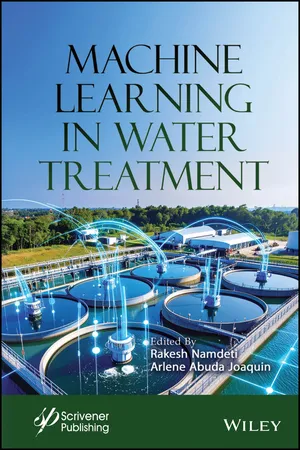
Machine Learning in Water Treatment
About this book
Machine Learning in Water Treatment is a must-have for anyone interested in how artificial intelligence is transforming water treatment, offering practical insights, case studies, and a deep dive into cutting-edge machine learning techniques that can improve water quality management.
Machine Learning in Water Treatment explores the complex fields of wastewater treatment and water purification, offering a thorough analysis of the cutting-edge machine learning methods used to solve problems with water quality control. It provides insights into how artificial intelligence can be incorporated with conventional procedures, bridging the gap between conventional water treatment techniques and state-of-the-art data-driven solutions. The book will cover the foundations of water treatment procedures, providing insights into the ideas behind physical, chemical, and biological treatment modalities. Difficulties in managing water and wastewater quality are paving the way for the use of machine learning as an effective tool for control and optimization.
Fundamentally, the book explains how machine learning models are used in water treatment system control, optimization, and predictive modeling. Readers will learn how to take advantage of machine learning algorithms' potential for real-time treatment process optimization, quality issue identification, and water pollutant level prediction through a thorough investigation of data collection, preprocessing, and model creation. Case studies and real-world applications provide insightful information about the application of machine learning technologies in a variety of scenarios. With its unique combination of theoretical understanding and real-world applications, this book is an invaluable tool for understanding how water quality management is changing in the age of data-driven decision-making.
Frequently asked questions
- Essential is ideal for learners and professionals who enjoy exploring a wide range of subjects. Access the Essential Library with 800,000+ trusted titles and best-sellers across business, personal growth, and the humanities. Includes unlimited reading time and Standard Read Aloud voice.
- Complete: Perfect for advanced learners and researchers needing full, unrestricted access. Unlock 1.4M+ books across hundreds of subjects, including academic and specialized titles. The Complete Plan also includes advanced features like Premium Read Aloud and Research Assistant.
Please note we cannot support devices running on iOS 13 and Android 7 or earlier. Learn more about using the app.
Information
Table of contents
- Cover
- Series Page
- Title Page
- Copyright Page
- Contents
- Preface
- Chapter 1 Overview of Wastewater Treatment and Water Purification
- Chapter 2 A Brief Study on Methods of Preparing Data for Machine Learning Models
- Chapter 3 Experimental Investigation of Greywater Treatment and Reuse Using a Wetland Adsorption System
- Chapter 4 Water Purification and Wastewater Treatment Challenges
- Chapter 5 Innovative Wastewater Treatment Technology: Integrating Microalgae in Aeration Reactors with Advanced Oxidation for Enhanced Water Quality
- Chapter 6 Hydrogen Production from Wastewater by Photo-Electrolysis: A Brief Review
- Chapter 7 Synopsis of Water Treatment Techniques
- Chapter 8 Physical Water Treatment Principles
- Chapter 9 Chemical Purification Procedures of Water
- Chapter 10 Biological Treatment Methods for Remediating Wastewater
- Chapter 11 Techniques for Gathering, Preparing, and Managing Water Quality Data
- Chapter 12 Overview of Machine Learning and Its Uses
- Chapter 13 Advanced Techniques for Water Quality Data Management Using Machine Learning
- Chapter 14 Water Treatment Process Optimization Techniques
- Chapter 15 Optimization of Biological Treatment Processes Through Machine Learning for Remediating Wastewater
- Chapter 16 Innovative Techniques for Enhancing Water Treatment Efficiency
- Chapter 17 Advancement in Machine Learning-Aided Advanced Oxidation Processes for Water Treatment
- Chapter 18 Machine Learning Strategies for Wastewater Treatment Toward Zero Liquid Discharge in a Lignocellulosic Biorefinery
- Chapter 19 Machine Learning Techniques in Water Treatment
- Chapter 20 Bionanocomposites as Innovative Bioadsorbents for Wastewater Remediation: A Comprehensive Exploration
- Chapter 21 Utilizations of Machine Learning Algorithms in the Context of Biological Wastewater Treatment: Recent Developments and Future Prospects
- Chapter 22 A Comprehensive Review on Machine Learning Techniques for Wastewater and Water Purification
- Chapter 23 Water and Wastewater Treatment and Technological Remedies for Preserving Water Quality and Implementation of Machine Learning
- Chapter 24 Experimental Study on Wastewater Treatment and Reuse Using a Biofiltration System with Machine Learning-Based Optimization
- Chapter 25 A Review on Machine Learning in Environmental Engineering: A Focus on the Gray Water Treatment
- Chapter 26 Machine Learning Techniques for Wastewater Treatment and Water Purification: Review of State-Of-The-Art Practices and Applications
- Chapter 27 Application of Predictive Modeling Approaches for Water Quality Prediction
- Chapter 28 Next-Generation Water Purification: Harnessing Machine Learning for Optimal Treatment and Monitoring
- Chapter 29 Revolutionizing Water Treatment Facilities with Machine Learning: Techniques, Applications, and Case Studies
- Chapter 30 Advanced Techniques for Water Treatment Process Optimization
- Chapter 31 Regression Models for Prediction and Evaluation of Water Contamination: A Comparative Study
- Chapter 32 Implications of Regression Analysis for Predicting Water Contamination Levels
- Index
- Also of Interest
- EULA