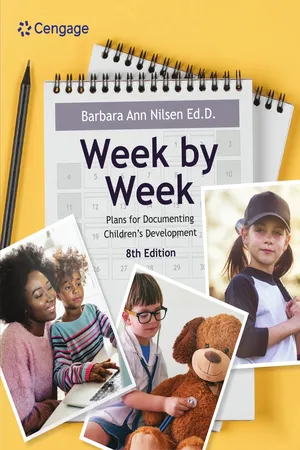
Nilsen's WEEK BY WEEK: PLANS FOR DOCUMENTING CHILDREN'S DEVELOPMENT, 8th Edition, provides an overview of accepted observation and recording methods, including examples and guidance about the advantages and disadvantages of each. Each chapter summarizes a developmental domain to focus your observation skills as you practice a specific recording method. These are integrated into a concrete, systematic plan for recording each child's development in all developmental areas -- a plan that can be extended over 40 weeks while in practicum, field experiences or your own classroom. It provides numerous practical observation forms and integrates NAEYC standards and Developmentally Appropriate Practices and learning objectives. Real-life anecdotes, practical tips, forms with clear instructions and step-by-step guidelines make this a valuable resource for teachers in training and practicing professionals.
- 566 pages
- English
- PDF
- Available on iOS & Android
eBook - PDF
Week by Week: Plans for Documenting Children's Development
About this book
Information
Topic
EducationSubtopic
Education GeneralTable of contents
- Cover
- Contents
- Preface
- Chapter 1: Getting Started
- Chapter 2: Using the Class List Log to Look at Separation and School Adjustment
- Chapter 3: Using Anecdotal Recordings to Look at Self-Care
- Chapter 4: Using Checklists to Look at Physical Development
- Chapter 5: Using Running Records to Look at Social Development
- Chapter 6: Using Frequency Counts to Look at Emotional Development
- Chapter 7: Using Conversations to Observe Language and Speech
- Chapter 8: Using Time Samples to Look at Attention Span
- Chapter 9: Using Standardized Measurements to Look at Cognitive Development
- Chapter 10: Getting Started Using Rating Scales to Look at Literacy
- Chapter 11: Getting Started Using Work Samples to Look at Creativity
- Chapter 12: Using Technology for Documentation of Dramatic Play
- Chapter 13: Using Documentation for Child Abuse Suspicions and Looking at Self-Concept
- Chapter 14: Getting Started Using Program Assessments to Look at Children in Groups
- Chapter 15: Using the Portfolio for Communications with Families and Looking at the Child's Interactions with Adults
- Glossary
- References
- Index
Trusted by 375,005 students
Access to over 1.5 million titles for a fair monthly price.
Study more efficiently using our study tools.
Frequently asked questions
Yes, you can cancel anytime from the Subscription tab in your account settings on the Perlego website. Your subscription will stay active until the end of your current billing period. Learn how to cancel your subscription
No, books cannot be downloaded as external files, such as PDFs, for use outside of Perlego. However, you can download books within the Perlego app for offline reading on mobile or tablet. Learn how to download books offline
Perlego offers two plans: Essential and Complete
- Essential is ideal for learners and professionals who enjoy exploring a wide range of subjects. Access the Essential Library with 800,000+ trusted titles and best-sellers across business, personal growth, and the humanities. Includes unlimited reading time and Standard Read Aloud voice.
- Complete: Perfect for advanced learners and researchers needing full, unrestricted access. Unlock 1.5M+ books across hundreds of subjects, including academic and specialized titles. The Complete Plan also includes advanced features like Premium Read Aloud and Research Assistant.
We are an online textbook subscription service, where you can get access to an entire online library for less than the price of a single book per month. With over 1.5 million books across 990+ topics, we’ve got you covered! Learn about our mission
Look out for the read-aloud symbol on your next book to see if you can listen to it. The read-aloud tool reads text aloud for you, highlighting the text as it is being read. You can pause it, speed it up and slow it down. Learn more about Read Aloud
Yes! You can use the Perlego app on both iOS and Android devices to read anytime, anywhere — even offline. Perfect for commutes or when you’re on the go.
Please note we cannot support devices running on iOS 13 and Android 7 or earlier. Learn more about using the app
Please note we cannot support devices running on iOS 13 and Android 7 or earlier. Learn more about using the app
Yes, you can access Week by Week: Plans for Documenting Children's Development by Barbara Ann Nilsen in PDF and/or ePUB format, as well as other popular books in Education & Education General. We have over 1.5 million books available in our catalogue for you to explore.