'What is accomplished by this sort of cultural warfare is impossible to say: but it [is] a part of total warfare which one must, as an individual, accept one's part in.'
At the height of the Second World War, T. S. Eliot commits himself to fighting for the cultural values of Europe. He goes on a lecture tour of Sweden; he writes talks for the BBC; he reads poems for the Czechoslovak Centre, for 'Aid to Russia' and for the 'French in Britain Fund'. He lectures on 'The Music of Poetry' in Glasgow; addresses the Classical Association; talks at the 'Moot', and visits organisations including the Anglo-Swedish Society and the British-Norwegian Institute; and he works for the Christian News-Letter. He serves as President of the English Circle of 'Books Across the Sea' and as first President of the Virgil Society. He feels exhausted by travel and performance but remains stalwart. And always there is the threat in London - he has 'no regular habitation' - of being bombed: 'I have taken . . . to sleeping in my teeth.'
Contacts and correspondents during these dark days include the film director George Hollering for whom he struggles to adapt his play
Murder in the Cathedral, Kenneth Clark, Henry Moore, David Jones, William Empson, Mary Trevelyan, Karl Mannheim, Louis MacNeice, Elizabeth Bowen, M. J. Tambimuttu, Edith Sitwell and Reinhold Niebuhr. Notable poets recruited to the Faber fold include Lawrence Durrell, Anne Ridler and Norman Nicholson.
Eliot's own creative energies are focused on completing
Little Gidding, the final poem of the supernal sequence
Four Quartets. The series of letters to John Hayward, who advises him, is a tour de force of the art: full of news, merriment and mischief.
- English
- ePUB (mobile friendly)
- Available on iOS & Android
eBook - ePub
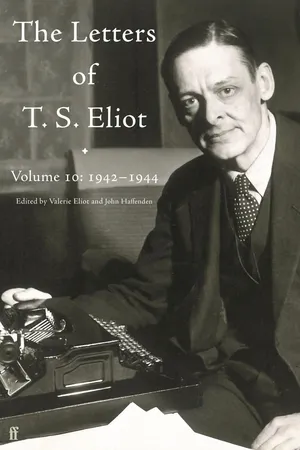
Letters of T. S. Eliot Volume 10: 1942–1944
About this book
Information
Subtopic
Literary LettersTable of contents
- Landing Page
- Title Page
- Contents
- Illustrations
- Acknowledgements
- Preface
- Biographical Commentary 1942–1944
- Abbreviations and Sources
- Editorial Notes
- The Letters 1942–1944
- Biographical Register
- Index of Correspondents and Recipients
- General Index
- Plates
- About the Author
- By the Same Author
- Copyright
Trusted by 375,005 students
Access to over 1.5 million titles for a fair monthly price.
Study more efficiently using our study tools.
Frequently asked questions
Yes, you can cancel anytime from the Subscription tab in your account settings on the Perlego website. Your subscription will stay active until the end of your current billing period. Learn how to cancel your subscription
No, books cannot be downloaded as external files, such as PDFs, for use outside of Perlego. However, you can download books within the Perlego app for offline reading on mobile or tablet. Learn how to download books offline
Perlego offers two plans: Essential and Complete
- Essential is ideal for learners and professionals who enjoy exploring a wide range of subjects. Access the Essential Library with 800,000+ trusted titles and best-sellers across business, personal growth, and the humanities. Includes unlimited reading time and Standard Read Aloud voice.
- Complete: Perfect for advanced learners and researchers needing full, unrestricted access. Unlock 1.5M+ books across hundreds of subjects, including academic and specialized titles. The Complete Plan also includes advanced features like Premium Read Aloud and Research Assistant.
We are an online textbook subscription service, where you can get access to an entire online library for less than the price of a single book per month. With over 1.5 million books across 990+ topics, we’ve got you covered! Learn about our mission
Look out for the read-aloud symbol on your next book to see if you can listen to it. The read-aloud tool reads text aloud for you, highlighting the text as it is being read. You can pause it, speed it up and slow it down. Learn more about Read Aloud
Yes! You can use the Perlego app on both iOS and Android devices to read anytime, anywhere — even offline. Perfect for commutes or when you’re on the go.
Please note we cannot support devices running on iOS 13 and Android 7 or earlier. Learn more about using the app
Please note we cannot support devices running on iOS 13 and Android 7 or earlier. Learn more about using the app
Yes, you can access Letters of T. S. Eliot Volume 10: 1942–1944 by T. S. Eliot in PDF and/or ePUB format. We have over 1.5 million books available in our catalogue for you to explore.