But for
Swallows and Amazons, some of Arthur Ransome's earlier writings would be better known. The extraordinary success Ransome achieved as a children's writer, from the 1930's until his death in 1967, perhaps inevitably eclipsed his earlier work, but in the case of his two books and pamphlet on the Russian revolutions of 1917 and the tumultuous events that followed that is a great loss: it can be said unequivocally that these writings are on a par, perhaps even exceeding, such classics as John Reed's
Ten Days that Shook the World
.
Arthur Ransome knew Russia. He lived there from 1914 to 1918 almost all the time. He taught himself Russian and became a foreign correspondent for the liberal Daily News and Manchester Guardian. More than that, he came to know many of the Bolshevik leaders like Lenin, Trotsky and Checherin almost as personal friends, and, indeed, married Trotsky's secretary, Evgenia Petrovna Shelepina.
Arthur Ransome as a commentator on the Russian scene at the most convulsive moment in its history is unique. Unlike famous visitors like H. G. Wells (though his marvellous book,
Russia in the Shadows shouldn't be overlooked) and Bertrand Russell, his was no brief journalistic inspection: and unlike other reporters such as John Reed, Victor Serge and Alfred Rosmer there was no tendentiousness in what he wrote - they were convinced revolutionaries, Ransome, although not unsympathetic to the Bolshevik cause, was a more objective recorder.
Six Weeks in Russia
,
The Crisis in Russia
and the pamphlet,
The Truth about Russia
constitute the best contemporary writing about Russia at the time of the Bolshevik takeover. They were reissued in the early 1990s, with an introduction by Paul Foot which has been retained for the Faber Finds reissue of
Six Weeks in Russia
; otherwise they have been out of print since first published
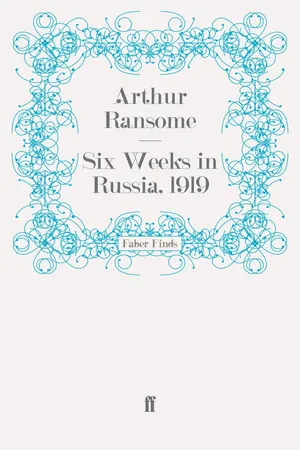
- English
- ePUB (mobile friendly)
- Available on iOS & Android
eBook - ePub
Six Weeks in Russia, 1919
About this book
Information
Subtopic
World HistoryIndex
HistoryTable of contents
- Cover
- Title Page
- Table of Contents
- PAUL FOOT : Arthur Ransome in revolutionary Russia
- The truth about Russia
- Six weeks in Russia, 1919
- Introduction
- One / To Petrograd
- Two / Smolni
- Three / Petrograd to Moscow
- Four / First days in Moscow
- Five / The Executive Committee on the reply to the Prinkipo proposal
- Six / Kamenev and the Moscow Soviet
- Seven / An ex-capitalist
- Eight / A theorist of revolution
- Nine / Effects of isolation
- Ten / An evening at the opera
- Eleven / The Committee of State Constructions
- Twelve / The Executive Committee and the Terror
- Thirteen / Notes of conversations with Lenin
- Fourteen / The Supreme Council of Public Economy
- Fifteen / The race with ruin
- Sixteen / A play of Chekhov
- Seventeen / The Centro-Textile
- Eighteen / Modification in the agrarian programme
- Nineteen / Foreign trade and munitions of war
- Twenty / The proposed delegation from Berne
- Twentyone / The Executive Committee on the rival parties
- Twenty two / Commissariat of Labour
- Twenty three / Education
- Twenty four / A Bolshevik fellow of the Royal Society
- Twenty five / Digression
- Twenty six / The opposition
- Twenty seven / The Third International
- Twenty eight / Last talk with Lenin
- Twenty nine / The journey out
- About the Author
- Copyright
Trusted by 375,005 students
Access to over 1.5 million titles for a fair monthly price.
Study more efficiently using our study tools.
Frequently asked questions
Yes, you can cancel anytime from the Subscription tab in your account settings on the Perlego website. Your subscription will stay active until the end of your current billing period. Learn how to cancel your subscription
No, books cannot be downloaded as external files, such as PDFs, for use outside of Perlego. However, you can download books within the Perlego app for offline reading on mobile or tablet. Learn how to download books offline
Perlego offers two plans: Essential and Complete
- Essential is ideal for learners and professionals who enjoy exploring a wide range of subjects. Access the Essential Library with 800,000+ trusted titles and best-sellers across business, personal growth, and the humanities. Includes unlimited reading time and Standard Read Aloud voice.
- Complete: Perfect for advanced learners and researchers needing full, unrestricted access. Unlock 1.5M+ books across hundreds of subjects, including academic and specialized titles. The Complete Plan also includes advanced features like Premium Read Aloud and Research Assistant.
We are an online textbook subscription service, where you can get access to an entire online library for less than the price of a single book per month. With over 1.5 million books across 990+ topics, we’ve got you covered! Learn about our mission
Look out for the read-aloud symbol on your next book to see if you can listen to it. The read-aloud tool reads text aloud for you, highlighting the text as it is being read. You can pause it, speed it up and slow it down. Learn more about Read Aloud
Yes! You can use the Perlego app on both iOS and Android devices to read anytime, anywhere — even offline. Perfect for commutes or when you’re on the go.
Please note we cannot support devices running on iOS 13 and Android 7 or earlier. Learn more about using the app
Please note we cannot support devices running on iOS 13 and Android 7 or earlier. Learn more about using the app
Yes, you can access Six Weeks in Russia, 1919 by Arthur Ransome in PDF and/or ePUB format, as well as other popular books in History & World History. We have over 1.5 million books available in our catalogue for you to explore.