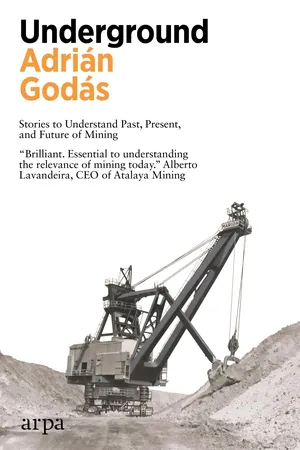
Underground
eBook - ePub

Underground

Stories to Understand Past, Present, and Future of Mining

  1. English
  2. ePUB (mobile friendly)
  3. Available on iOS & Android
eBook - ePub

Underground

Stories to Understand Past, Present, and Future of Mining

About this book

The thrilling history of the extraction and economic control of the world's major minerals – from Antiquity to the present day: gold, copper, iron, lithium, rare earths, and more.

Why should you read this book? Mining is on the verge of regaining a central role on the global stage. As the world gradually shifts toward deglobalization and an indirect confrontation between the United States and China – while countries like Russia and India seek to assert their influence in this emerging multipolar landscape – mineral extraction is becoming ever more strategic. Meanwhile, humanity, faced with the grave threat of climate change, is undergoing an energy transition that demands (and will continue to demand) more metals than ever before. To understand the relevance of mining today, we must revisit its past. History reveals the crucial role that metals and mines have played in shaping nations' destinies – closely monitored, even in recent times like the Cold War, by governments and powerful corporations alike.

From the jungles of the Congo to the glaciers of the Canadian Arctic, from the California Gold Rush to high-altitude excavations in Argentina, and the tale of Spanish tungsten during the Third Reich, Underground is a gripping guided tour through an ancient yet largely misunderstood industry – often reduced to caricatures and oversimplifications in public discourse.

"Brilliant. Essential to understanding the relevance of mining today." Alberto Lavandeira, CEO of Atalaya Mining

Frequently asked questions

Yes, you can cancel anytime from the Subscription tab in your account settings on the Perlego website. Your subscription will stay active until the end of your current billing period. Learn how to cancel your subscription.
No, books cannot be downloaded as external files, such as PDFs, for use outside of Perlego. However, you can download books within the Perlego app for offline reading on mobile or tablet. Learn more here.
Perlego offers two plans: Essential and Complete
  • Essential is ideal for learners and professionals who enjoy exploring a wide range of subjects. Access the Essential Library with 800,000+ trusted titles and best-sellers across business, personal growth, and the humanities. Includes unlimited reading time and Standard Read Aloud voice.
  • Complete: Perfect for advanced learners and researchers needing full, unrestricted access. Unlock 1.4M+ books across hundreds of subjects, including academic and specialized titles. The Complete Plan also includes advanced features like Premium Read Aloud and Research Assistant.
Both plans are available with monthly, semester, or annual billing cycles.
We are an online textbook subscription service, where you can get access to an entire online library for less than the price of a single book per month. With over 1 million books across 1000+ topics, we’ve got you covered! Learn more here.
Look out for the read-aloud symbol on your next book to see if you can listen to it. The read-aloud tool reads text aloud for you, highlighting the text as it is being read. You can pause it, speed it up and slow it down. Learn more here.
Yes! You can use the Perlego app on both iOS or Android devices to read anytime, anywhere — even offline. Perfect for commutes or when you’re on the go.
Please note we cannot support devices running on iOS 13 and Android 7 or earlier. Learn more about using the app.
Yes, you can access Underground by Adrián Godás, Sergio Lorenzi in PDF and/or ePUB format, as well as other popular books in Technology & Engineering & Natural Resource Extraction Industry. We have over one million books available in our catalogue for you to explore.

Table of contents

  1. Cover
  2. Title
  3. Copyright
  4. Contents
  5. Introduction
  6. Mining in the world of yesterday
  7. Mining in today’s world
  8. Conclusion
  9. Acknowledgments
  10. Bibliography