How the drama of Shakespeare’s time demonstrates the tensions within civility
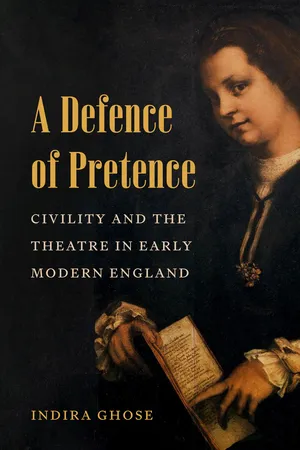
Is civility merely a matter of reinforcing status and excluding others? Or is it a lubricant in a polarised world, enabling us to overcome tribal loyalties and cooperate for the common good? In A Defence of Pretence, Indira Ghose argues that it is both. Ghose turns to the drama of Shakespeare’s time to explore the notion of civility. The theatre, she suggests, was a laboratory where many of the era’s conflicts played out. The plays test the precepts found in treatises on civility and show that, in the complexity and confusion of human life, moral purity is an illusion. We are always playing roles. In these plays, as in social life, pretence is inescapable. Could it be a virtue?
Civility, Ghose finds, is radically ambiguous. The plays of Shakespeare, Jonson and Middleton, grappling with dissimulation, lies and social performance, question the idea of a clear-cut boundary between sincerity and dissembling, between truth and lies. What is decisive is the use to which our play-acting is put. A pretence of mutual respect might serve an ethical end: to foster a sense of common purpose. In life, as in drama, the concept of the common good might be a fiction, but one that is crucial for human society.
- English
- ePUB (mobile friendly)
- Available on iOS & Android
eBook - ePub
About this book
Information
Publisher
Princeton University PressYear
2025Print ISBN
9780691269986
9780691269993
eBook ISBN
9780691270005
Table of contents
- Cover
- Title Page
- Copyright
- Dedication
- Contents
- Illustrations
- Introduction
- 1. Castiglione, The Merchant of Venice, and the Imperative of Style
- 2. Manners and the Market
- 3. Theatricality and Lies in Coriolanus
- 4. Sejanus and the Degradation of Civility
- 5. Wit and the Art of Jesting
- Conclusion
- Acknowledgements
- Bibliography
- Index
Trusted by 375,005 students
Access to over 1.5 million titles for a fair monthly price.
Study more efficiently using our study tools.
Frequently asked questions
Yes, you can cancel anytime from the Subscription tab in your account settings on the Perlego website. Your subscription will stay active until the end of your current billing period. Learn how to cancel your subscription
No, books cannot be downloaded as external files, such as PDFs, for use outside of Perlego. However, you can download books within the Perlego app for offline reading on mobile or tablet. Learn how to download books offline
Perlego offers two plans: Essential and Complete
- Essential is ideal for learners and professionals who enjoy exploring a wide range of subjects. Access the Essential Library with 800,000+ trusted titles and best-sellers across business, personal growth, and the humanities. Includes unlimited reading time and Standard Read Aloud voice.
- Complete: Perfect for advanced learners and researchers needing full, unrestricted access. Unlock 1.5M+ books across hundreds of subjects, including academic and specialized titles. The Complete Plan also includes advanced features like Premium Read Aloud and Research Assistant.
We are an online textbook subscription service, where you can get access to an entire online library for less than the price of a single book per month. With over 1.5 million books across 990+ topics, we’ve got you covered! Learn about our mission
Look out for the read-aloud symbol on your next book to see if you can listen to it. The read-aloud tool reads text aloud for you, highlighting the text as it is being read. You can pause it, speed it up and slow it down. Learn more about Read Aloud
Yes! You can use the Perlego app on both iOS and Android devices to read anytime, anywhere — even offline. Perfect for commutes or when you’re on the go.
Please note we cannot support devices running on iOS 13 and Android 7 or earlier. Learn more about using the app
Please note we cannot support devices running on iOS 13 and Android 7 or earlier. Learn more about using the app
Yes, you can access A Defence of Pretence by Indira Ghose in PDF and/or ePUB format, as well as other popular books in Literature & British History. We have over 1.5 million books available in our catalogue for you to explore.