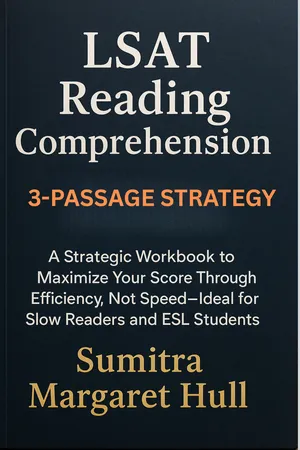
LSAT Reading Comprehension 3-Passage Strategy
A Strategic Workbook to Maximize Your Score Through Efficiency, Not Speed—Ideal for Slow Readers and ESL Students
- English
- ePUB (mobile friendly)
- Available on iOS & Android
LSAT Reading Comprehension 3-Passage Strategy
A Strategic Workbook to Maximize Your Score Through Efficiency, Not Speed—Ideal for Slow Readers and ESL Students
About this book
LSAT Reading Comprehension: 3-Passage Strategy
A Strategic Workbook to Maximize Your Score Through Efficiency, Not Speed—Ideal for Slow Readers and ESL Students
Transform your approach to LSAT Reading Comprehension with a revolutionary strategy designed specifically for test-takers who need more time to process complex academic texts. This comprehensive workbook challenges the myth that you must read faster to succeed and instead focuses on maximizing accuracy through strategic efficiency.
Stop trying to finish everything. Start maximizing your score.
This systematic methodology introduces the game-changing 3-Passage Strategy, allowing you to achieve competitive scores by focusing on three passages instead of rushing through four. Learn to redefine success on the RC section through strategic triage, structural reading techniques, and targeted question attack methods.
What You'll Master:
Strategic passage evaluation and time management techniques
"Low-Resolution" reading methods that capture essential structure while ignoring distracting details
Systematic question categorization and attack strategies
Process of elimination mastery for trap answer identification
Academic vocabulary and complex syntax decoding
Anxiety management and optimal pacing development
Perfect for:
Students who identify as slow readers
ESL students navigating complex academic English
Test-takers seeking strategic alternatives to speed reading
Anyone struggling with RC time management
Progressive Training System: From untimed accuracy building to full-section implementation, this workbook provides a complete step-by-step training program. The innovative "Step-Down Method" gradually introduces time pressure while maintaining accuracy, helping you find your optimal pace without sacrificing comprehension.
Evidence-Based Techniques: Every strategy is grounded in cognitive science research on reading comprehension, working memory, and test anxiety. This isn't about shortcuts—it's about working smarter within your natural reading capabilities.
Includes:
Detailed methodology explanations with real examples
Progressive drill sets for skill building
Full section implementation strategies
Emergency techniques for difficult passages
Comprehensive review checklists
Stop fighting your reading speed. Start leveraging your analytical strengths. This workbook proves that accuracy and strategy trump speed every time.
Tools to learn more effectively

Saving Books

Keyword Search

Annotating Text

Listen to it instead
Information
Table of contents
- Table of Contents
- Chapter 1: You Are Not Too Slow for the LSAT
- Chapter 2: How to Use This Workbook
- Step 1: Timed Section (The Reality Check)
- Step 2: Untimed Review (The Potential)
- Step 3: Analyzing Your Results
- Chapter 3: Redefining "Finished" – The 3-Passage Goal
- Step 1: Determine Your Target LSAT Score
- Step 2: Determine Your Target RC Score
- Step 3: Calculate Your Necessary Accuracy Rate
- Chapter 4: The Art of Triage: Choosing Your Battles
- Chapter 5: Time Management for the Slow Reader
- Chapter 6: The "Low-Resolution" Read
- Chapter 7: Identifying the Core Components
- Chapter 8: The Mechanics of Structural Mapping
- Chapter 9: Ignoring the Noise (Strategic Skimming)
- Chapter 10: Analyzing the Question Stem
- Chapter 11: The "Question-First" Hybrid Approach
- Step 1: Skim Specific Questions (60-90 seconds)
- Step 2: Create a "Hit List"
- Step 3: Perform the Structural Read (with Targeted Focus)
- Step 4: Attack the Questions
- Chapter 12: Efficient Information Retrieval
- Step 1: Locate
- Step 2: Deep Dive
- Step 3: Verify (Predict the Answer)
- Chapter 13: Mastering Answer Choices and Process of Elimination (POE)
- Chapter 14: Establishing Your Optimal Pace
- Chapter 15: Progressive Pacing Drills (The Step-Down Method)
- Chapter 16: Full Section Implementation
- Chapter 17: The 4th Passage Attack Plan (The "Panic Drill")
- Chapter 18: High-Value Academic Vocabulary
- Chapter 19: Decoding Complex Syntax
- Chapter 20: Mastering Tone and Attitude
- Conclusion
- References
Frequently asked questions
- Essential is ideal for learners and professionals who enjoy exploring a wide range of subjects. Access the Essential Library with 800,000+ trusted titles and best-sellers across business, personal growth, and the humanities. Includes unlimited reading time and Standard Read Aloud voice.
- Complete: Perfect for advanced learners and researchers needing full, unrestricted access. Unlock 1.4M+ books across hundreds of subjects, including academic and specialized titles. The Complete Plan also includes advanced features like Premium Read Aloud and Research Assistant.
Please note we cannot support devices running on iOS 13 and Android 7 or earlier. Learn more about using the app