The subject of wildlife both unites and deeply divides British Columbians. From concern over dwindling orca populations to deeply political debates over hunting and harvesting, questions surrounding fish and wildlife harvest rights and methods, and the effects of industrial resource extraction, tourism, and residential development upon wildlife populations, have produced an atmosphere of conflict and distrust in BC.
Spanning the deep history of human relationships with wildlife, from pre-contact Indigenous land stewardship to the present day,
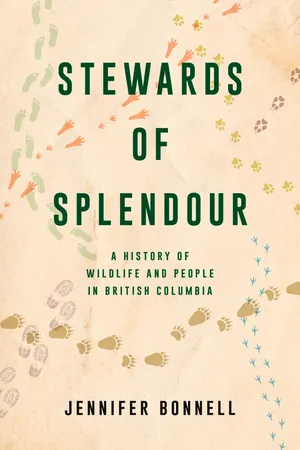
Stewards of Splendour explores the ways that government, Indigenous communities and stakeholder groups have sought to shape and deliver, or responded to the consequences of, wildlife management policies and practices and resource development activities in the province.
Throughout, it emphasizes the circumstances and initiatives that made and continue to make BC different--from the astonishing diversity of our ecosystems to our unusually high proportion (over 94%) of public land?while profiling instances of "made-in-BC" approaches. Drawing upon a rich body of historical, scientific and policy-related literature and over 80 interviews,
Stewards of Splendour examines changing societal values around wildlife and the implications of these changes for wildlife managers today.
eBook - ePub
Stewards of Splendour
A History of Wildlife and People in British Columbia
- English
- ePUB (mobile friendly)
- Available on iOS & Android
eBook - ePub
About this book
Information
Publisher
The Royal British Columbia MuseumeBook ISBN
9781039900011
Year
2025Table of contents
- Cover
- Title Page
- Copyright Page
- Dedication
- Contents
- List of Illustrations
- Maps, Graphs and Plates
- Foreword
- Acknowledgements
- Introduction
- Part One: Indigenous Wildlife Stewardship
- Part Two: Euro-American Trade and Settlement: Competition and Perceptions of Abundance, 1774–1904
- Part Three: Early Wildlife Conservation and the Rise of Scientific Management, 1905–1965
- Part Four: Making Space for Wildlife, 1966–1991
- Part Five: Rising Stakes, Changing Roles, 1992–2022
- Conclusion
- Appendix: Interviewees
- Glossary
- Notes
- Bibliography
- Index
Trusted by 375,005 students
Access to over 1.5 million titles for a fair monthly price.
Study more efficiently using our study tools.