- English
- ePUB (mobile friendly)
- Available on iOS & Android
About this book
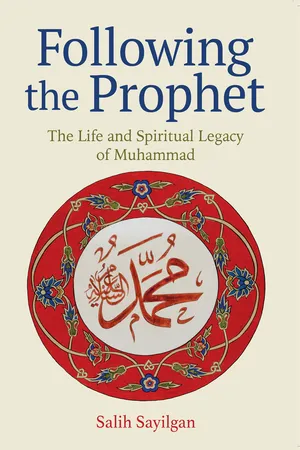
Biographies of the Prophet Muhammad often focus on his historical context in seventh-century Arabia. Yet understanding the Prophet solely through the lens of ancient history fails to capture the significance and meaning of this individual, whose teachings have shaped the world and continue to guide nearly one-quarter of the global population today.
With this book, Salih Sayilgan provides a loving portrait of the Prophet as he has lived in the hearts of Muslims across the centuries: as a religious light and spiritual guide. Drawing on a diverse body of Islamic literature on the Prophet, Sayilgan offers a vista onto the expansive and variegated legacy of this vitally significant religious figure. Examining how Muslims have remembered and reimagined the Prophet's spirit in different ways as expressions of their love for God and His messenger, this book highlights the central place of the Prophet Muhammad in the religious lives of Muslim believers.
Frequently asked questions
- Essential is ideal for learners and professionals who enjoy exploring a wide range of subjects. Access the Essential Library with 800,000+ trusted titles and best-sellers across business, personal growth, and the humanities. Includes unlimited reading time and Standard Read Aloud voice.
- Complete: Perfect for advanced learners and researchers needing full, unrestricted access. Unlock 1.4M+ books across hundreds of subjects, including academic and specialized titles. The Complete Plan also includes advanced features like Premium Read Aloud and Research Assistant.
Please note we cannot support devices running on iOS 13 and Android 7 or earlier. Learn more about using the app.
Information
Table of contents
- Cover
- Title Page
- Copyright
- Dedication
- Epigraph
- Contents
- Acknowledgments
- Introduction
- 1. Becoming the Prophet
- 2. The Prophet’s Spiritual Life and Character
- 3. The Prophet’s Spiritual Companions
- 4. Following the Prophet
- 5. Remembering the Prophet
- 6. Conclusion
- Bibliography
- Index