Investigating the origins of theatre in archaic Rome
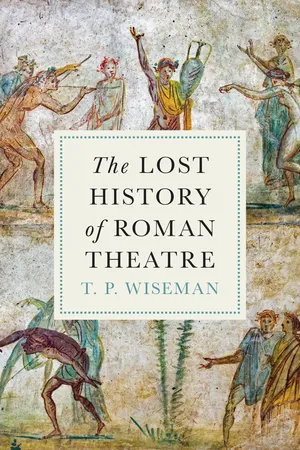
Theatre was an integral part of Roman civic, religious and political life for nearly a thousand years, but our understanding of it is skewed by the haphazard survival of usable evidence. The widely accepted date for the beginning of Roman drama is 240 BC, but that is only the date of the first known dramatic works. Theatre as a public spectacle was created in Athens and in Greek Sicily at the end of the sixth century BC, when the culture of Rome, to judge by the archaeological evidence, was itself thoroughly Greek. There is therefore no need to imagine that the Romans knew nothing of drama until centuries after its inception. In The Lost History of Roman Theatre, the distinguished classics scholar T. P. Wiseman reexamines the often-obscured origins of Roman theatre.
In a series of detailed investigations, Wiseman explores material ignored or inadequately treated in the modern literature, including previously overlooked information in Cicero’s letters, speeches and dialogues about what theatre meant to Romans of his era. He further shows that the various styles of drama presented on the Roman stage were listed by grammarians in late antiquity who were using well-informed histories of drama now lost, and brings to light a wide range of evidence, visual as well as textual, from all that thousand-year stretch of time, to offer a new sense of the range and richness of the Romans’ experience of theatre.
- English
- ePUB (mobile friendly)
- Available on iOS & Android
eBook - ePub
The Lost History of Roman Theatre
About this book
Trusted by 375,005 students
Access to over 1.5 million titles for a fair monthly price.
Study more efficiently using our study tools.
Information
Publisher
Princeton University PressYear
2025Print ISBN
9780691275833
9780691273235
eBook ISBN
9780691275840
Table of contents
- Cover
- Title Page
- Copyright
- Dedication
- Contents
- Preface
- Chapter 1: Rome and the Greek World
- Chapter 2: Cicero at the Theatre
- Chapter 3: Historical Evidence
- Chapter 4: Roman Satire and Roman Theatre
- Chapter 5: Religion, Ideology and Theatre: The Festival of Anna Perenna
- Chapter 6: Politics and the People
- Chapter 7: Tullia and the Furies
- Chapter 8: Brutus the Liberator
- Chapter 9: Velleius and the Games
- Chapter 10: Phaedrus and his Fables
- Chapter 11: Suetonius and the Origin of Pantomime
- Chapter 12: The Lupercalia as a Spectacle
- Appendix. The Greek Quotations in Cicero’s Correspondence
- Bibliography
- Index
- Index Locorum
Frequently asked questions
Yes, you can cancel anytime from the Subscription tab in your account settings on the Perlego website. Your subscription will stay active until the end of your current billing period. Learn how to cancel your subscription
No, books cannot be downloaded as external files, such as PDFs, for use outside of Perlego. However, you can download books within the Perlego app for offline reading on mobile or tablet. Learn how to download books offline
Perlego offers two plans: Essential and Complete
- Essential is ideal for learners and professionals who enjoy exploring a wide range of subjects. Access the Essential Library with 800,000+ trusted titles and best-sellers across business, personal growth, and the humanities. Includes unlimited reading time and Standard Read Aloud voice.
- Complete: Perfect for advanced learners and researchers needing full, unrestricted access. Unlock 1.5M+ books across hundreds of subjects, including academic and specialized titles. The Complete Plan also includes advanced features like Premium Read Aloud and Research Assistant.
We are an online textbook subscription service, where you can get access to an entire online library for less than the price of a single book per month. With over 1.5 million books across 990+ topics, we’ve got you covered! Learn about our mission
Look out for the read-aloud symbol on your next book to see if you can listen to it. The read-aloud tool reads text aloud for you, highlighting the text as it is being read. You can pause it, speed it up and slow it down. Learn more about Read Aloud
Yes! You can use the Perlego app on both iOS and Android devices to read anytime, anywhere — even offline. Perfect for commutes or when you’re on the go.
Please note we cannot support devices running on iOS 13 and Android 7 or earlier. Learn more about using the app
Please note we cannot support devices running on iOS 13 and Android 7 or earlier. Learn more about using the app
Yes, you can access The Lost History of Roman Theatre by T.P. Wiseman in PDF and/or ePUB format, as well as other popular books in Literature & Ancient & Classical Drama. We have over 1.5 million books available in our catalogue for you to explore.