Writing Groups in the Writing Center presents an empirical, qualitative study that examines collaborative practices in multidisciplinary writing groups, arguing that these collaborations offer rich expansions of writing center praxis. Using three case studies—undergraduate grant proposal writers, undergraduate thesis writers, and doctoral dissertation writers—the book explores how participants negotiate authority, navigate disciplinary boundaries, perform emotional labor, and develop expertise within writing center communities of practice.
As many higher education institutions strive to create spaces and systems that increase equity, accessibility, and diversity, they recognize the need for improved mentorship across academic levels. This book analyzes the significant benefits as well as the challenges faced by writing groups in providing such support. Wilder presents a nuanced account of how facilitators scaffold group practice, how members use and build genre knowledge across disciplines, and how institutional contexts shape emotional labor requirements.
For educators and tutors, the book provides an in-depth examination of the facilitator role, describing essential logistical, emotional, and intellectual practices, and addresses common conflicts and challenges. Administrators can find valuable material for training tutor-facilitators and frameworks for conceptualizing writing group functions on campus. For researchers, the book extends scholarship on writing groups, writing transfer, and collaborative learning, bridging writing center and broader writing studies research.
In an era of concern about generative AI's role in writing education, Writing Groups in the Writing Center extends research on group facilitation, collaborative learning, and authority negotiation in writing center communities of practice and emphasizes the human connections that make collaborative writing meaningful and valuable for student writers.
eBook - ePub
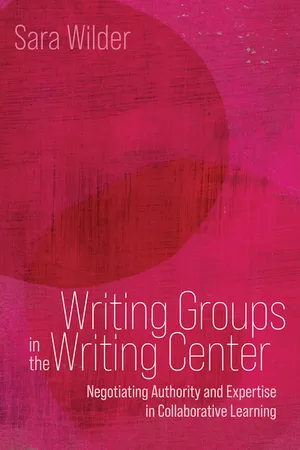
Writing Groups in the Writing Center
Negotiating Authority and Expertise in Collaborative Learning
- English
- ePUB (mobile friendly)
- Available on iOS & Android
eBook - ePub
Writing Groups in the Writing Center
Negotiating Authority and Expertise in Collaborative Learning
About this book
Information
Publisher
Utah State University PressYear
2025Print ISBN
9781646427666
9781646427659
eBook ISBN
9781646427673
Table of contents
- Cover
- Title Page
- Copyright Page
- Contents
- List of Tables
- Acknowledgments
- 1. Introduction: Studying Writing Groups as Communities of Practice
- 2. “People Thinking Differently About Writing”: The Role of the Group Facilitator
- 3. “It’s Not Necessarily Science”: Disciplinary Clashes, Convergences, and Learning in Multidisciplinary Groups
- 4. Storying the Difficulties: Emotional Labor in Writing Groups at a PWI
- 5. Expanding the Boundaries of Writing Center Work
- Appendix A: Interview Questions
- Appendix B: Survey Questions
- Appendix C: Survey Data
- Appendix D: Codebooks
- References
- Index
- About the Author
Trusted by 375,005 students
Access to over 1.5 million titles for a fair monthly price.
Study more efficiently using our study tools.
Frequently asked questions
Yes, you can cancel anytime from the Subscription tab in your account settings on the Perlego website. Your subscription will stay active until the end of your current billing period. Learn how to cancel your subscription
No, books cannot be downloaded as external files, such as PDFs, for use outside of Perlego. However, you can download books within the Perlego app for offline reading on mobile or tablet. Learn how to download books offline
Perlego offers two plans: Essential and Complete
- Essential is ideal for learners and professionals who enjoy exploring a wide range of subjects. Access the Essential Library with 800,000+ trusted titles and best-sellers across business, personal growth, and the humanities. Includes unlimited reading time and Standard Read Aloud voice.
- Complete: Perfect for advanced learners and researchers needing full, unrestricted access. Unlock 1.5M+ books across hundreds of subjects, including academic and specialized titles. The Complete Plan also includes advanced features like Premium Read Aloud and Research Assistant.
We are an online textbook subscription service, where you can get access to an entire online library for less than the price of a single book per month. With over 1.5 million books across 990+ topics, we’ve got you covered! Learn about our mission
Look out for the read-aloud symbol on your next book to see if you can listen to it. The read-aloud tool reads text aloud for you, highlighting the text as it is being read. You can pause it, speed it up and slow it down. Learn more about Read Aloud
Yes! You can use the Perlego app on both iOS and Android devices to read anytime, anywhere — even offline. Perfect for commutes or when you’re on the go.
Please note we cannot support devices running on iOS 13 and Android 7 or earlier. Learn more about using the app
Please note we cannot support devices running on iOS 13 and Android 7 or earlier. Learn more about using the app
Yes, you can access Writing Groups in the Writing Center by Sara Wilder in PDF and/or ePUB format, as well as other popular books in Languages & Linguistics & Linguistics. We have over 1.5 million books available in our catalogue for you to explore.