Toward a Small Data Archaeology presents an interpretive and methodological framework—a "small data" archaeology—elucidated through a case study at Xaltocan, Mexico. Aligned closely with Indigenous feminist principles by engaging directly with descendant communities that resist abstract, large-scale syntheses and instead emphasize deep, localized understanding of ancestral lives intertwined with their landscapes, this framework repositions archaeological inquiry by focusing on individual household contexts. Drawing on diverse lines of evidence from molecular archaeology and geochemistry to Bayesian statistics, Lisa Overholtzer uncovers the detailed social identities, economic practices, and ritual behaviors that defined everyday life in Xaltocan.
Xaltocan served as the Otomí city-state capital before being conquered by the Tepanecs, subsequently incorporated into the Aztec Empire, and finally integrated into the vast Spanish colonial sphere. In reconstructing long-term household histories that bridge the pre-Hispanic and early Colonial periods, this book resists narratives that define Indigenous peoples solely through the lens of conquest and subordination. Instead, it presents richly detailed reconstructions of familial relationships and social networks, achieved through the rigorous analysis of artifacts, ecofacts, human remains, and ancient DNA. This meticulous and community-collaborative approach not only maximizes insights available from a limited archaeological record but also honors the ethical imperative to work with descendant communities.
Toward a Small Data Archaeology offers an innovative reexamination of the past by privileging the intricate, household-level narratives of Indigenous communities over the homogenizing tendencies of broad-scale "big data" approaches. By peopling the past, Overholtzer redefines methodological boundaries within archaeology, produces reconstructions and narratives that are more in line with Indigenous philosophies, and offers a compelling vision for a future in which historical narratives are reconstructed through a lens that is both deeply scientific and inherently humane.
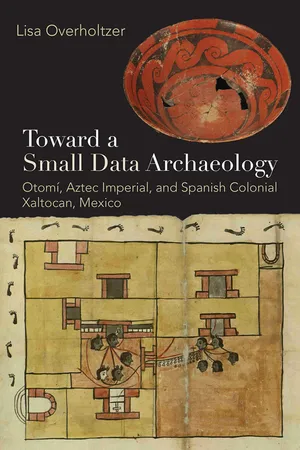
eBook - ePub
Toward a Small Data Archaeology
Otomí, Aztec Imperial, and Spanish Colonial Xaltocan, Mexico
- English
- ePUB (mobile friendly)
- Available on iOS & Android
eBook - ePub
Toward a Small Data Archaeology
Otomí, Aztec Imperial, and Spanish Colonial Xaltocan, Mexico
About this book
Information
Table of contents
- Cover
- Title Page
- Copyright Page
- Dedication
- Contents
- List of Figures
- List of Tables
- Acknowledgments
- 1. Toward a “Small Data” Archaeology: Peopling the Past Through a Data-Intensive, Indigenous Feminist Household Archaeology
- 2. Situating Ancestral Household Practice at Xaltocan, Mexico
- 3. Making Family in Empire: Tracing the Tlacamecayotl (Rope of People) of the Structure 122 Silenced Ancestors
- 4. Consuming in Empire: Ceramic Consumption, Social-Economic Networks, and the Making of Self
- 5. Feasting in Empire: A Social and Sensorial Household Journey
- 6. Flourishing in Empire: Indigenous Ceramic “Possible Futures” at Colonial Xaltocan
- 7. Conclusion
- References Cited
- Index
- About the Author
Trusted by 375,005 students
Access to over 1.5 million titles for a fair monthly price.
Study more efficiently using our study tools.
Frequently asked questions
Yes, you can cancel anytime from the Subscription tab in your account settings on the Perlego website. Your subscription will stay active until the end of your current billing period. Learn how to cancel your subscription
No, books cannot be downloaded as external files, such as PDFs, for use outside of Perlego. However, you can download books within the Perlego app for offline reading on mobile or tablet. Learn how to download books offline
Perlego offers two plans: Essential and Complete
- Essential is ideal for learners and professionals who enjoy exploring a wide range of subjects. Access the Essential Library with 800,000+ trusted titles and best-sellers across business, personal growth, and the humanities. Includes unlimited reading time and Standard Read Aloud voice.
- Complete: Perfect for advanced learners and researchers needing full, unrestricted access. Unlock 1.5M+ books across hundreds of subjects, including academic and specialized titles. The Complete Plan also includes advanced features like Premium Read Aloud and Research Assistant.
We are an online textbook subscription service, where you can get access to an entire online library for less than the price of a single book per month. With over 1.5 million books across 990+ topics, we’ve got you covered! Learn about our mission
Look out for the read-aloud symbol on your next book to see if you can listen to it. The read-aloud tool reads text aloud for you, highlighting the text as it is being read. You can pause it, speed it up and slow it down. Learn more about Read Aloud
Yes! You can use the Perlego app on both iOS and Android devices to read anytime, anywhere — even offline. Perfect for commutes or when you’re on the go.
Please note we cannot support devices running on iOS 13 and Android 7 or earlier. Learn more about using the app
Please note we cannot support devices running on iOS 13 and Android 7 or earlier. Learn more about using the app
Yes, you can access Toward a Small Data Archaeology by Lisa Overholtzer in PDF and/or ePUB format, as well as other popular books in Social Sciences & Archaeology. We have over 1.5 million books available in our catalogue for you to explore.