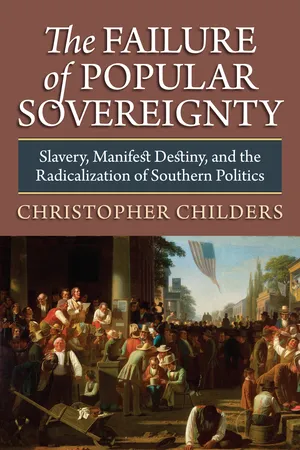
The Failure of Popular Sovereignty
eBook - ePub

The Failure of Popular Sovereignty

Slavery, Manifest Destiny, and the Radicalization of Southern Politics

  1. English
  2. ePUB (mobile friendly)
  3. Available on iOS & Android
eBook - ePub

The Failure of Popular Sovereignty

Slavery, Manifest Destiny, and the Radicalization of Southern Politics

About this book

As the expanding United States grappled with the question of how to determine the boundaries of slavery, politicians proposed popular sovereignty as a means of entrusting the issue to citizens of new territories. Christopher Childers now uses popular sovereignty as a lens for viewing the radicalization of southern states’ rights politics, demonstrating how this misbegotten offspring of slavery and Manifest Destiny, though intended to assuage passions, instead worsened sectional differences, radicalized southerners, and paved the way for secession.

In this first major history of popular sovereignty, Childers explores the triangular relationship among the extension of slavery, southern politics, and territorial governance. He shows how, as politicians from North and South redesigned popular sovereignty to lessen sectional tensions and remove slavery from the national political discourse, the doctrine instead made sectional divisions intractable, placed the territorial issue at the center of national politics, and gave voice to an increasingly radical states’ rights interpretation of the federal compact.

Childers explains how politicians offered the idea of local control over slavery as a way to appease the South—or at least as a compromise that would not offend the states’ rights constitutional scruples of southerners. In the end, that strategy backfired by transforming the South into a rigid sectional bloc dedicated to the protection and perpetuation of slavery—a political time bomb that eventually exploded into Civil War.

Tracing the doctrine of popular sovereignty back to its roots in the early American republic, Childers describes the dichotomy between believers in local control in the territories and national control as first embodied in the 1787 Northwest Ordinance. Noting that the slavery extension issue had surfaced before but obviously not been resolved, he shows how the debate over this issue played out over time, complicated the relationship between the federal government and the territories, and radicalized sectional politics. He also provides new insight into such topics as Arkansas and Florida statehood, the early phases of California’s statehood bid, and the emergence of John C. Calhoun’s common property doctrine.

Laced with new insights, Childers’s study offers a coherent narrative of the formative moments in the slavery debate that have been seen heretofore as discrete events. His work stands at the intersection of political, intellectual, and constitutional history, unfolding the formative moments in the slavery debate to expand our understanding of the peculiar institution in the early republic.

Frequently asked questions

Yes, you can cancel anytime from the Subscription tab in your account settings on the Perlego website. Your subscription will stay active until the end of your current billing period. Learn how to cancel your subscription.
At the moment all of our mobile-responsive ePub books are available to download via the app. Most of our PDFs are also available to download and we're working on making the final remaining ones downloadable now. Learn more here.
Perlego offers two plans: Essential and Complete
  • Essential is ideal for learners and professionals who enjoy exploring a wide range of subjects. Access the Essential Library with 800,000+ trusted titles and best-sellers across business, personal growth, and the humanities. Includes unlimited reading time and Standard Read Aloud voice.
  • Complete: Perfect for advanced learners and researchers needing full, unrestricted access. Unlock 1.4M+ books across hundreds of subjects, including academic and specialized titles. The Complete Plan also includes advanced features like Premium Read Aloud and Research Assistant.
Both plans are available with monthly, semester, or annual billing cycles.
We are an online textbook subscription service, where you can get access to an entire online library for less than the price of a single book per month. With over 1 million books across 1000+ topics, we’ve got you covered! Learn more here.
Look out for the read-aloud symbol on your next book to see if you can listen to it. The read-aloud tool reads text aloud for you, highlighting the text as it is being read. You can pause it, speed it up and slow it down. Learn more here.
Yes! You can use the Perlego app on both iOS or Android devices to read anytime, anywhere — even offline. Perfect for commutes or when you’re on the go.
Please note we cannot support devices running on iOS 13 and Android 7 or earlier. Learn more about using the app.
Yes, you can access The Failure of Popular Sovereignty by Christopher Childers in PDF and/or ePUB format, as well as other popular books in History & American Civil War History. We have over one million books available in our catalogue for you to explore.

Table of contents

  1. Front Cover
  2. Half Title
  3. Series Page
  4. Title Page
  5. Copyright Page
  6. Dedication
  7. Table of Contents
  8. List of Illustrations
  9. Acknowledgments
  10. Introduction
  11. 1. A Desire for Self-Government: Slavery in the Early American Territories
  12. 2. “Shall the Creature Govern the Creator?” Self-Government and the Missouri Compromise
  13. 3. “Forgotten Principles of Their Forefathers”: Retreat from the Missouri Compromise
  14. 4. “A Fit of Convulsions”: The Wilmot Proviso and Slavery in the West
  15. 5. “Intended to Delude the South”: Northern Democrats Redefine Popular Sovereignty
  16. 6. “Shall the Conquered Govern the Conqueror?” Popular Sovereignty in the Mexican Cession
  17. 7. “A Recurrence to First Principles”: Kansas-Nebraska and Popular Sovereignty
  18. 8. “Moves on the Political Chess-Board”: Southerners Redefine Popular Sovereignty
  19. Epilogue: The Demise of Popular Sovereignty and the Crisis of the Union
  20. Notes
  21. Bibliography
  22. Index
  23. Back Cover