Tracing the influence and impact of Plato’s Timaeus—and its major themes, creation and beauty—through the centuries
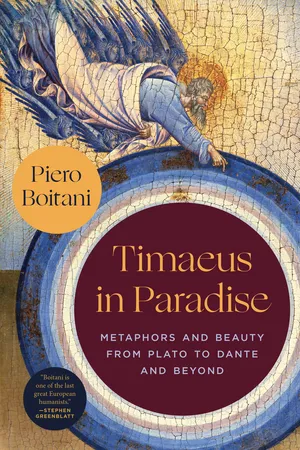
More than two thousand years after it was written, Plato’s Timaeus continues to fascinate and intrigue its readers. In Timaeus in Paradise, Piero Boitani traces the abiding legacy of the Timaeus, mapping an intellectual journey that begins with Plato and extends to Dante and beyond. In a series of short, lyrical chapters, Boitani sketches a lineage that includes Proclus, Boethius, the Hebrew and Christian Bibles, John Scotus Eriugena and Thomas Aquinas. Focusing on Plato’s metaphorical language—which Dante considered comparable to that of the Bible—and the beauty of its images, Boitani shows that these images penetrate deep into European culture, inspiring the anonymous author of the treatise on the Sublime as well as the mystical writings of Pseudo-Dionysius the Areopagite.
Plato’s account of the creation of the cosmos in the Timaeus supplants Hesiod’s myths and Parmenides’s theories—and was described by Johannes Kepler as the best gloss ever on the first chapter of Genesis. Boitani finds its echoes everywhere, from the sculptures of Chartres Cathedral and the frescoes of the Anagni Crypt to the paintings of Raphael and Michelangelo. He connects the beauty defined in the Timaeus to the beauties of the Hebrew Bible and to the lilies of the field invoked by Jesus in the Sermon on the Mount. Bringing together philosophy, theology, mysticism, poetry, sculpture and painting, Boitani charts Europe’s intellectual history—a history of ideas and images—by capturing the enduring reverberations of Plato’s summa. Illustrations accompanying the text cover more than two thousand years of iconography.
- English
- ePUB (mobile friendly)
- Available on iOS & Android
eBook - ePub
About this book
Information
Publisher
Princeton University PressYear
2025Print ISBN
9780691277257
9780691276144
eBook ISBN
9780691277264
Table of contents
- Cover
- Title Page
- Copyright
- Dedication
- Epigraph
- Contents
- List of Illustrations
- Preface
- Note on Translations
- 1. One, Two, Three
- 2. Emulator of Homer
- 3. Pythagorean and Socratic
- 4. Parens, fabricator, artifex: Demogorgon and Phaethon
- 5. Descendants and Intermediaries
- 6. Rachel’s Beauty
- 7. The Lilies of the Field
- Color Plates
- 8. ‘Mira profunditas’
- 9. Compunction and Transfiguration
- 10. ‘O qui perpetua mundum ratione gubernas’
- 11. Beauty
- 12. Metaphorá
- 13. Integumenta; Esthétique du Timée
- 14. The Three Days
- 15. Towards the altitudo terribilis
- 16. The Names of God
- 17. Decor, altitudo, gloria
- 18. Philomythía and Poetry
- 19. ‘I love those who love me’
- 20. ‘What Timaeus argues about the souls’
- 21. ‘The hall-mark of genius’
- 22. ‘We must lose ourselves’
- 23. ‘Those things that cannot die and those that can’
- 24. ‘To new loves Love Eternal opened out’
- 25. ‘That deep mind’
- 26. ‘Amor quo caelum regitur’
- 27. ‘He laughed, self-mockingly’
- 28. ‘This reason moved Augustine’
- 29. ‘Fountain of light, seedbed of life’
- 30. ‘Beings and accidents and modes of life’
- 31. The Moon Smiles Among the Eternal Nymphs
- 32. ‘Splendour of God!’
- 33. ‘The beauty I saw’
- 34. Neptune and Lethargy
- 35. The Last Simile: The Geometer
- 36. Epilogue: Descent from Heaven, Ascent to Art and Science
- 37. Afterword: The Unmoved Mover Begins to Move: Literary and Visual Renderings of the Christian Bible
- Appendix: The Timaeus
- Sigla
- Abbreviations
- Notes
- Further Reading
- Illustration Credits
- Index of Names
Trusted by 375,005 students
Access to over 1.5 million titles for a fair monthly price.
Study more efficiently using our study tools.
Frequently asked questions
Yes, you can cancel anytime from the Subscription tab in your account settings on the Perlego website. Your subscription will stay active until the end of your current billing period. Learn how to cancel your subscription
No, books cannot be downloaded as external files, such as PDFs, for use outside of Perlego. However, you can download books within the Perlego app for offline reading on mobile or tablet. Learn how to download books offline
Perlego offers two plans: Essential and Complete
- Essential is ideal for learners and professionals who enjoy exploring a wide range of subjects. Access the Essential Library with 800,000+ trusted titles and best-sellers across business, personal growth, and the humanities. Includes unlimited reading time and Standard Read Aloud voice.
- Complete: Perfect for advanced learners and researchers needing full, unrestricted access. Unlock 1.5M+ books across hundreds of subjects, including academic and specialized titles. The Complete Plan also includes advanced features like Premium Read Aloud and Research Assistant.
We are an online textbook subscription service, where you can get access to an entire online library for less than the price of a single book per month. With over 1.5 million books across 990+ topics, we’ve got you covered! Learn about our mission
Look out for the read-aloud symbol on your next book to see if you can listen to it. The read-aloud tool reads text aloud for you, highlighting the text as it is being read. You can pause it, speed it up and slow it down. Learn more about Read Aloud
Yes! You can use the Perlego app on both iOS and Android devices to read anytime, anywhere — even offline. Perfect for commutes or when you’re on the go.
Please note we cannot support devices running on iOS 13 and Android 7 or earlier. Learn more about using the app
Please note we cannot support devices running on iOS 13 and Android 7 or earlier. Learn more about using the app
Yes, you can access Timaeus in Paradise by Piero Boitani in PDF and/or ePUB format, as well as other popular books in Literature & Ancient & Classical Literary Criticism. We have over 1.5 million books available in our catalogue for you to explore.