eBook - ePub
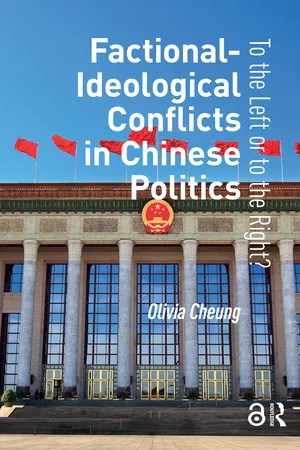
Factional-Ideological Conflicts in Chinese Politics
To the Left or to the Right?
- English
- ePUB (mobile friendly)
- Available on iOS & Android
eBook - ePub
About this book
This book reconstructs the factional-ideological conflicts surrounding socialist transformation and political reform in China that were played out through 'factional model-making', a norm-bound mechanism for elites of the Chinese Communist Party to contest the party line publicly. Dazhai, Anhui, Nanjie, Shekou, Shenzhen, Guangdong and Chongqing were cultivated into factional models by party elites before Xi Jinping came to power in 2012. Although factional model-making undermined party discipline, it often did not threaten regime security and even contributed to regime resilience through strengthening collective leadership and other means. This follows that the suppression of factional model-making under Xi might undermine longer-term regime resilience. However, Xi believes that regime security rests on his strongman rule, not any benefits that factional model-making may contribute. It is in this spirit that he grooms Zhejiang into a party model for his policy programme of common prosperity, which is designed to legitimize his vision of socialism.
Table of contents
- Cover
- Half Title
- Title Page
- Copyright Page
- Table of Contents
- Acknowledgements
- Preface
- Tables
- Abbreviations
- 1 Introduction
- 2 Learning from Dazhai after the Great Leap Forward : Mutations of Socialism under Mao Zedong Thought, 1964–1978
- 3 Decollectivizing Anhui : The Emergence of Market-oriented Socialism in the Countryside, 1979–1980
- 4 Recollectivizing Nanjie: Building a ‘Small Zone of Communism’ in the Post-Mao Era of Market Reform, 1984–2012
- 5 Shekou and Shenzhen : Blurring the Line between Special Economic Zone and Special Political Zone, 1979–1989
- 6 Guangdong versus Chongqing: Competing Models of Governance in the Run-up to the 18th Party Congress, 2008–2012
- 7 China under Xi Jinping: The End of Factional Model-making and the Pursuit of Common Prosperity in Zhejiang since 2021
- 8 Conclusion
- Bibliography
- Index
Trusted by 375,005 students
Access to over 1.5 million titles for a fair monthly price.
Study more efficiently using our study tools.
Frequently asked questions
Yes, you can cancel anytime from the Subscription tab in your account settings on the Perlego website. Your subscription will stay active until the end of your current billing period. Learn how to cancel your subscription
No, books cannot be downloaded as external files, such as PDFs, for use outside of Perlego. However, you can download books within the Perlego app for offline reading on mobile or tablet. Learn how to download books offline
Perlego offers two plans: Essential and Complete
- Essential is ideal for learners and professionals who enjoy exploring a wide range of subjects. Access the Essential Library with 800,000+ trusted titles and best-sellers across business, personal growth, and the humanities. Includes unlimited reading time and Standard Read Aloud voice.
- Complete: Perfect for advanced learners and researchers needing full, unrestricted access. Unlock 1.5M+ books across hundreds of subjects, including academic and specialized titles. The Complete Plan also includes advanced features like Premium Read Aloud and Research Assistant.
We are an online textbook subscription service, where you can get access to an entire online library for less than the price of a single book per month. With over 1.5 million books across 990+ topics, we’ve got you covered! Learn about our mission
Look out for the read-aloud symbol on your next book to see if you can listen to it. The read-aloud tool reads text aloud for you, highlighting the text as it is being read. You can pause it, speed it up and slow it down. Learn more about Read Aloud
Yes! You can use the Perlego app on both iOS and Android devices to read anytime, anywhere — even offline. Perfect for commutes or when you’re on the go.
Please note we cannot support devices running on iOS 13 and Android 7 or earlier. Learn more about using the app
Please note we cannot support devices running on iOS 13 and Android 7 or earlier. Learn more about using the app
Yes, you can access Factional-Ideological Conflicts in Chinese Politics by Olivia Cheung in PDF and/or ePUB format, as well as other popular books in History & Chinese History. We have over 1.5 million books available in our catalogue for you to explore.