eBook - ePub
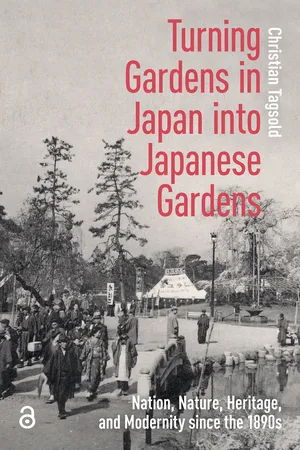
Turning Gardens in Japan into Japanese Gardens
Nation, Nature, Heritage, and Modernity since the 1890s
- English
- ePUB (mobile friendly)
- Available on iOS & Android
eBook - ePub
Turning Gardens in Japan into Japanese Gardens
Nation, Nature, Heritage, and Modernity since the 1890s
About this book
In the mid nineteenth century, as Japan rapidly modernized, garden building declined in popularity. Only in the late nineteenth century did a new class of political and business leaders revive interest in horticulture, seeking garden designs that broke away from established patterns. As a result, these innovative gardens were largely overlooked by early Japanese garden historians and excluded from the canon they sought to establish. In recent years, both scholars and the public have begun to reexamine and appreciate these gardens and their creators. Now recognized as part of Japan's national heritage, these sites are being integrated into the history of Japanese horticulture. Christian Tagsold's book examines this rediscovery, unraveling the complex dynamics of nature, heritage, nationhood, and modernity in Japan through the lens of these gardens.
Information
Table of contents
- Cover Page
- Half Title Page
- Title Page
- Copyright Page
- Table of Contents
- Acknowledgments
- Introduction
- 1 Defining Gardens in/for Japan—From the Edo Era to the Mid-Meiji Period
- 2 Building New Gardens—The Meiji and TaishO Periods
- 3 Appreciating New Japanese Gardens in the West—From the Late Meiji to Early Showa Periods
- 4 The Nation and Japanese Gardens—From the Taishō Period to the End of World War II
- 5 The Garden in Our Backyard—The Postwar Decades
- 6 Gardens as National Heritage between Scholars and Bureaucrats —From the Postwar Era to the Heisei Period
- 7 Turning Gardens into Attractions—The Present Landscape
- 8 A Past Modernity as Heritage?
- Conclusion
- Bibliography
- Index
Trusted by 375,005 students
Access to over 1.5 million titles for a fair monthly price.
Study more efficiently using our study tools.
Frequently asked questions
Yes, you can cancel anytime from the Subscription tab in your account settings on the Perlego website. Your subscription will stay active until the end of your current billing period. Learn how to cancel your subscription
No, books cannot be downloaded as external files, such as PDFs, for use outside of Perlego. However, you can download books within the Perlego app for offline reading on mobile or tablet. Learn how to download books offline
We are an online textbook subscription service, where you can get access to an entire online library for less than the price of a single book per month. With over 1.5 million books across 990+ topics, we’ve got you covered! Learn about our mission
Look out for the read-aloud symbol on your next book to see if you can listen to it. The read-aloud tool reads text aloud for you, highlighting the text as it is being read. You can pause it, speed it up and slow it down. Learn more about Read Aloud
Yes! You can use the Perlego app on both iOS and Android devices to read anytime, anywhere — even offline. Perfect for commutes or when you’re on the go.
Please note we cannot support devices running on iOS 13 and Android 7 or earlier. Learn more about using the app
Please note we cannot support devices running on iOS 13 and Android 7 or earlier. Learn more about using the app
Yes, you can access Turning Gardens in Japan into Japanese Gardens by Christian Tagsold in PDF and/or ePUB format, as well as other popular books in Art & Art & Politics. We have over 1.5 million books available in our catalogue for you to explore.